
Premature leaf fall in apple: Marssonina blotch symptoms and control
· लेखक: AgriVruddhi
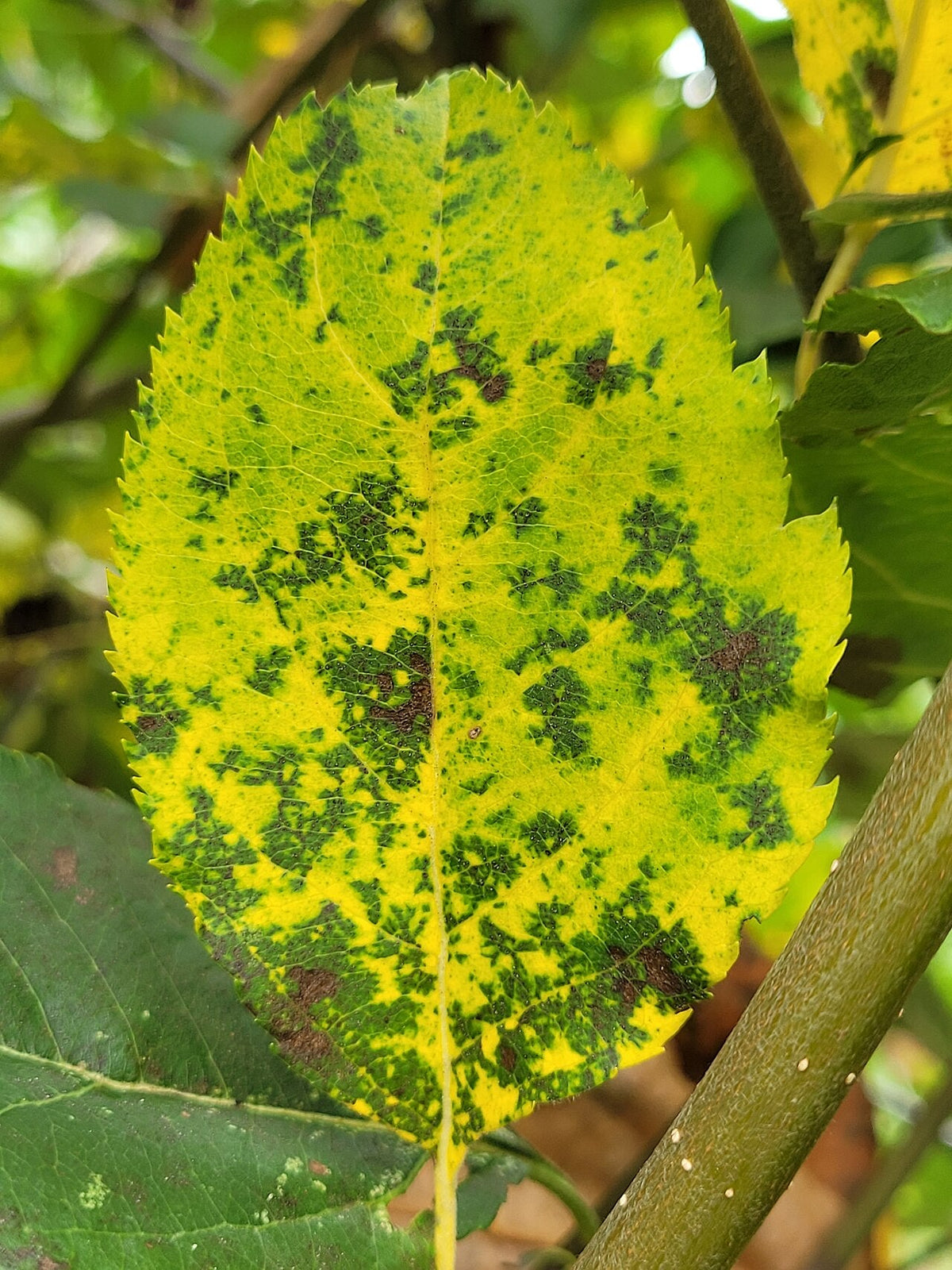
Photo at the top: Marssonina blotch on an apple leaf: dark green to brown blotches on a leaf that has turned yellow, Photo: Jimhue, CC0
Quick answer
Premature leaf fall of apple is a fungal disease, also called Marssonina blotch, caused by Marssonina coronaria. Leaves get dark blotches, turn yellow and drop in summer, long before autumn. Fruit size, colour and next year's crop suffer. Clear fallen leaves, prune for air, and spray a labelled fungicide before the first spots appear.
How to identify premature leaf fall in apple
In Hindi it is called samay se pehle patti girna (समय से पहले पत्ती गिरना), and in Telugu akulu munde raladam (ఆకులు ముందే రాలడం). Growers and books also call it Marssonina blotch, Marssonina leaf blotch or apple blotch. The fungus has a newer name, Diplocarpon coronariae. It is the same disease.
Check the lower and inner leaves of the tree first. They stay wet longest after rain, so spots often start there.
- First sign: dark green, roundish patches on the upper side of the leaf. In some varieties they look purple to brown.
- Brown spots: the patches die and turn into dark brown spots. Many spots join to form large, uneven brown blotches.
- Black dots: look closely at the blotches. You will see tiny black dots on the upper surface. These are the fruiting bodies of the fungus, which make the spores.
- Yellow leaf: the leaf around the blotches turns bright yellow, often with green patches left near the spots and veins. This yellow-and-green look is the clearest sign of the disease.
- Leaf drop: yellow leaves fall at a light touch. In a bad year the tree loses most of its leaves before harvest, and fruit hangs on bare branches.
- Fruit: sometimes small, brown to black, sunken round spots appear on the fruit. They lower its market value.
Marssonina blotch look-alikes and how to tell them apart
- Alternaria leaf spot: spots stay small, round and brown, with a purple border and sometimes rings like a target. They do not make the large yellow-and-green blotched leaf of Marssonina. Both diseases can drop leaves, and in Himachal Pradesh they are often listed together. See our guide to Alternaria leaf spot and blight in apple and other crops.
- Apple scab: olive-green, velvety spots that later turn dark, often on young leaves and fruit early in the season. Scab spots on fruit are rough and corky, not sunken.
- Powdery mildew: white powder on young leaves and shoot tips, which become narrow and silvery. There are no dark blotches. See our powdery mildew fungicide guide, which also covers apple.
- Nutrient shortage: magnesium or nitrogen shortage also yellows older leaves. But the yellowing is even, or between the veins, with no brown blotches and no black dots. A leaf and soil test will confirm it. See signs of magnesium deficiency in plants.
Life cycle and when it attacks
The fungus spends the winter in fallen, infected leaves and fruit on the orchard floor. In spring and early summer, when the weather turns warm and wet, spores are released from this old leaf litter. Rain splash and wind carry them up to the new leaves. This is the first infection of the season.
The fungus grows slowly inside the leaf at first. On naturally infected leaves the time from infection to visible spots is usually more than a month, says the Connecticut Agricultural Experiment Station. So leaves can carry the disease for weeks while they still look healthy. Once spots form, the black dots release new spores in wet weather. These spread the disease from leaf to leaf and tree to tree, again and again through the season.
Virginia Tech extension notes that spores spread and infect during or after long spells of rain, at 20 to 25 °C. In good weather for the fungus, leaves can start to drop as early as two weeks after the first spots appear. Shady, crowded orchards with poor air flow stay wet longer and suffer more.
In India, apple is grown mainly in the hills of Jammu and Kashmir, Himachal Pradesh and Uttarakhand. There, the rainy months of summer are the main risk period. In the northern half of the world the first spots usually appear in June or July, says Virginia Tech. The Connecticut Agricultural Experiment Station adds that new infections build up through the season, so the disease is most noticeable in late summer.

Crops it attacks
Apple: this is the crop that matters. Almost all commercial apple varieties can get the disease. Virginia Tech lists Rome, Mutsu, Royal Gala and Golden Delicious as highly susceptible, and Granny Smith and Pink Lady as only moderately resistant. Virginia Tech also notes that the disease has caused serious losses in Asia and Europe, especially on varieties bred to resist apple scab. So a scab-resistant orchard still needs watching.
The damage comes from losing leaves too early. A tree that drops its leaves in summer cannot feed its fruit well. Fruit stays small and colours poorly, and yield falls. The tree is also weaker going into winter, and it bears less in the following years. So one bad year can cut the crop in the next season too.
When to spray (economic threshold)
An economic threshold is the pest or disease level at which spraying starts to pay for itself. We could not confirm a threshold for this disease from a recognised public source, so we do not give one here.
The disease is hidden inside the leaf for weeks before spots show. By the time you see yellow leaves, much of the damage is already done. That is why the Merivon label asks for a preventive spray, before the first disease symptoms. The spray schedule of the Himachal Pradesh Department of Horticulture and Dr. Y. S. Parmar University of Horticulture and Forestry, Nauni, also says to spray when there are chances of disease. In practice, that means planning sprays for the warm, rainy weeks, and not waiting for leaves to drop.
Control without chemicals
- Clear fallen leaves: the fungus survives the winter in leaf litter, so this is the most important step. The Himachal Pradesh spray schedule advises collecting fallen apple leaves and decomposing them in a compost pit, or spraying 5% urea on the orchard floor so the infected leaves rot fast. The Connecticut Agricultural Experiment Station advises burning or burying them.
- Keep the orchard floor clean: the same schedule also advises removing weeds and bushes, so leaf litter does not collect under the trees.
- Prune for air and light: prune in winter to open the centre of the tree. Leaves then dry fast after rain and dew, and sprays reach inside the canopy.
- Avoid shade and crowding: do not let trees grow into each other. Thin out shade trees and tall growth near the orchard where you can.
- Remove infected fruit: pick up fallen and spotted fruit, as the fungus also survives on them.
- Feed the tree well: apply fertiliser on the basis of a leaf and soil test, and water in long dry spells. A tree under stress copes worse with disease.
- Choose varieties with care: when you plant new trees, ask your state horticulture department or university which varieties do better against Marssonina blotch in your area.
Chemical control: fungicide for premature leaf fall and Marssonina blotch
Only the products below have apple and premature leaf fall on their official label. Use one product at a time. Do not mix products in one tank. Cover both sides of the leaves well, from the top of the tree to the bottom.
Apple
| Product | Contains | Label dose | Water | Wait before harvest |
|---|---|---|---|---|
| Merivon Fungicide | Fluxapyroxad 250 g/L + Pyraclostrobin 250 g/L SC | 152 ml per acre (label: 15 ml per 100 L of water) | 1010 L per acre | 29 days |
| Avtar Fungicide | Hexaconazole 4% + Zineb 68% WP | Dose as per label: 0.25%, or 25 g per 10 L of water | 10 L per tree | 30 days |
Merivon and Avtar each have two active ingredients in one pack. Both are ready-mixed products approved on the label.
Merivon: the label asks for a preventive spray before the first disease symptoms, at the vegetative and fruiting stage, in the morning or evening. Use a hollow cone nozzle. Give 3 to 4 sprays, depending on disease pressure. The per-acre dose is converted from the label's 375 ml in 2,500 L of water per hectare.
Avtar: the label gives a spray strength, not a per-acre dose. Mix 25 g in 10 L of water (a 0.25% spray) and use about 10 L of spray per tree.
The Himachal Pradesh spray schedule adds a useful rule: if heavy rain falls within 12 hours of a spray, repeat the spray within seven days.
Rotate to avoid resistance
A fungus can stop responding to a fungicide that is sprayed again and again. Fungicides are grouped by how they work, using the FRAC code (from the international Fungicide Resistance Action Committee). Change the group from one spray to the next. The Himachal Pradesh schedule says the same thing in plain words: do not repeat the same chemical for the next spray.
| FRAC group | Active ingredient | Product in this article |
|---|---|---|
| 7 (SDHI) | Fluxapyroxad | One part of Merivon |
| 11 (strobilurins) | Pyraclostrobin | One part of Merivon |
| 3 (triazoles and other DMIs) | Hexaconazole | One part of Avtar |
| M03 (multi-site contact) | Zineb | One part of Avtar |
Merivon and Avtar share no group. So alternate them: if your last spray was Merivon, make the next one Avtar, and the other way round. Group M03 works on many points inside the fungus, so the risk of resistance to it is low, but it only protects the leaf surface it lands on. Keep to the number of sprays each label allows.
Safety and waiting period
- The waiting period before harvest (PHI, pre-harvest interval) is 29 days for Merivon and 30 days for Avtar on apple. Count the days from the last spray. Plan the last spray so the fruit is not picked too early.
- Wear gloves, a mask, goggles, full-sleeve clothes and boots while mixing and spraying. Spraying tall trees sends drift over your head, so cover your face and eyes well. Do not eat, drink or smoke while you work, and wash well afterwards.
- Spray in the morning or evening, not in strong wind or the hot afternoon sun.
- Fish: Merivon is toxic to aquatic life. Keep sprays, washings and empty packs away from ponds, streams, canals and wells.
- Do not enter the sprayed orchard until the spray has dried on the leaves.
- Read the label and leaflet before use.
Frequently asked questions
What causes premature leaf fall in apple?
Mostly the fungus Marssonina coronaria, which causes Marssonina blotch. It lives through the winter in fallen leaves and spreads in warm, wet weather. Leaf spots from Alternaria can also make leaves drop early. Look at the leaves: large dark blotches on a yellow leaf, with tiny black dots, point to Marssonina.
Which fungicide is used for premature leaf fall of apple?
Use one whose label lists apple and premature leaf fall. On our store these are Merivon and Avtar. The doses are in the table above. Spray before the spots appear, and alternate between the two because they belong to different FRAC groups.
Will yellow leaves turn green again after spraying?
No. A spray cannot heal a leaf that is already yellow and blotched, and those leaves will still fall. The spray protects healthy leaves and slows the spread. That is why sprays should go on before the first spots.
Is premature leaf fall the same as Alternaria leaf spot?
No, they are two different fungi, but both can cause early leaf drop and they often come in the same rainy season. Alternaria makes small round brown spots with a purple border. Marssonina makes large blotches and a bright yellow leaf. Merivon and Avtar list both diseases on apple.
What should I do with the fallen apple leaves?
Do not leave them under the trees. They carry the fungus into next season. Collect them and rot them in a compost pit, or follow the Himachal Pradesh advice to spray 5% urea on the orchard floor so they rot fast.
Related reading
- Alternaria leaf spot and blight: symptoms and control in apple, cotton and chilli
- Powdery mildew fungicide guide, including apple
- Magnesium deficiency in plants: how to tell yellow leaves apart
- Nitrogen deficiency in plants: symptoms and how to correct it
- All fungicides
Sources
- Department of Horticulture, Himachal Pradesh, and Dr. Y. S. Parmar University of Horticulture and Forestry, Nauni: Spray schedule for apple
- The Connecticut Agricultural Experiment Station: Marssonina blotch of apple
- Virginia Cooperative Extension, Virginia Tech: Apple blotch disease
- Fungicide Resistance Action Committee (FRAC): FRAC Code List 2026
- Product labels and leaflets of the fungicides listed above.
फसल के अनुसार इसे नियंत्रित करने वाले उत्पाद
सेब
- अवतार-फफूंदनाशकMix 25 g in 10 litres of water (0.25%). Use 10 litres per tree.
एक ही उत्पाद बार-बार न छिड़कें। अलग क्रिया-विधि (लेबल पर ग्रुप नंबर) वाले उत्पाद से बदलें, ताकि कीट या रोग में प्रतिरोध न बने।
ब्रांड के आधिकारिक लेबल के अनुसार। इस्तेमाल से पहले लेबल पढ़ें।

खेती की ये जानकारी पसंद आई? Google पर AgriVruddhi को पसंदीदा स्रोत चुनें
फ़सल स्वास्थ्य गाइड पर वापस जाएँ