
Blister blight of tea: symptoms, causes and control
· రచయిత: AgriVruddhi
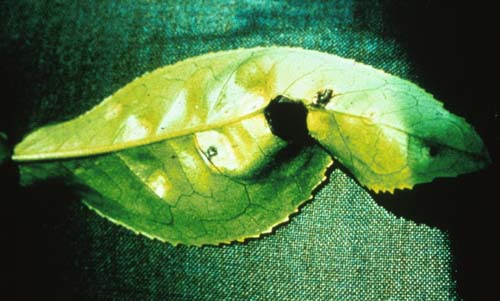
Photo at the top: Upper side of a tea leaf with pale, sunken blister blight spots, Photo: Jürgen Kranz, CC BY-SA 3.0
Quick answer
Blister blight of tea is a fungus disease caused by Exobasidium vexans. It attacks the young leaves and shoots that are plucked, making pale spots that swell into white blisters under the leaf. It spreads fast in cloudy, wet weather. Keep a short plucking round, let sunlight in, and spray a tea-labelled fungicide at the first spots.
How to identify blister blight of tea
In Hindi it is called phaphola jhulsa (फफोला झुलसा), and in Telugu bobba tegulu (బొబ్బ తెగులు). Many planters simply say "blister". The fungus lives only on tea. It needs a living tea leaf to grow and has no other host plant.
The disease hits leaves that are less than a month old, so look at the bud and the top two or three leaves, the part you pluck. The signs change in stages:
- Stage 1, small spots: tiny, pinhole-size spots appear on young leaves. They look pale, pinkish or clear when you hold the leaf up to the light. As the leaf grows, the spots grow too, to about 3 to 12 mm across, and turn light brown.
- Stage 2, blisters: after about a week, the spot pushes out on the lower side of the leaf as a round, raised blister. On the upper side the same spot looks sunken, like a shallow dent. A dark green, water-soaked ring often surrounds the blister.
- Stage 3, white powder: the blister turns white and velvety underneath. This white layer is the fungus making its spores (tiny seeds of the fungus). Wind carries them to other bushes.
- Stage 4, dead patches: the blister turns brown and dies. The leaf curls and becomes misshapen. If a young stem is infected, it bends, twists and may break off or die, so the whole shoot is lost.

Look-alikes and how to tell them apart
- Red rust of tea: raised, roughly round, purple to reddish-brown spots, mostly on the upper side of older leaves and stems. It is caused by an alga, not a fungus, and it never makes white blisters underneath.
- Grey blight and brown blight: oval, yellow-green spots that turn brown or grey, with rings and scattered tiny black dots. They are found mostly on mature leaves. Blister blight stays on young leaves and makes a raised blister, not a flat spot with black dots.
- Tea mosquito bug: many small dark spots on buds and shoots, one for each feeding puncture, and dried shoot tips. There are no blisters. See our tea mosquito bug guide for tea, cashew and guava.
- Mites: leaves turn bronze, rusty, pale or dull over a large area, with no round spots. See how to spot red spider mite in tea and other crops, our pink mite guide for tea and our purple mite guide for tea.
Life cycle and when blister blight attacks
Spores land on a young leaf, sprout and enter it. The IntechOpen review notes that, in good weather for the fungus, the first spots show about 3 days after the spore enters. The full cycle, from spore to new spores, can take only 11 days, though it can stretch to about 28 days. So many rounds of infection can happen in one rainy season.
The fungus needs wet leaves and shade. Infection is heaviest when:
- the sky stays cloudy and there is rain or mist for days at a time;
- the air is very humid and the leaf surface stays wet for long hours. The Food Chemistry: X study lists relative humidity above 80%, less than 4 hours of sun a day and more than 11 hours of leaf wetness as conditions that favour the spores;
- there is plenty of soft new flush, for example on bushes that were recently pruned.
Sunshine works against the fungus. The IntechOpen review notes that the disease falls as hours of sunshine rise, and that strong sunlight and heat harm the spores and slow spore making. That is why the disease is worst in hilly tea areas with long monsoons, and why sunny dry spells slow it down.
The timing differs by region. A review in Diagnostics of Plant Diseases (IntechOpen) reports that in Darjeeling the disease starts with the monsoon in June and is most severe from August to October. In Assam it can start with early rain in February and peak in March and April. In South India it spread to the Anamallais, Nilgiris, Wayanad, Kerala and Chikmagalur, carried by the south-west and north-east monsoon winds. Between seasons the fungus survives in old diseased leaves and stems, and in fallen leaves.
Crops it attacks
Tea: tea is the only crop this fungus attacks. It damages exactly the leaf that becomes made tea: the bud and the top leaves. Infected shoots curl, wither and fall, and cannot be plucked. A blister-blight study in Food Chemistry: X notes that, without control, losses in South India have been reported as high as 50%. Tea made from infected leaves is also of lower quality: it breaks easily and its taste and aroma change.
In India, tea grows mainly in Assam, North Bengal, the Nilgiris, Kerala and Karnataka, and blister blight is found in all these regions.
When to spray: checking your tea field
We could not confirm an economic threshold (the disease level at which a spray starts to pay for itself) for blister blight from ICAR, a state agricultural university or TNAU, so we do not give one here.
The AESA-based IPM package for tea from NIPHM (National Institute of Plant Health Management, Government of India) gives a simple way to measure the disease. At every plucking round, pick 100 shoots of the same age (three leaves and a bud) at random from the harvest. Count a shoot as infected if it has even one blister spot, at any stage. The number of infected shoots out of 100 is your disease level in per cent. Write it down each round so you can see if it is rising.
The Saaf Fungicide label says to spray as soon as disease symptoms appear. Watch most closely in cloudy, wet weeks and after pruning, when there is much new flush. For local spray timing in your area, ask the advisory service of the Tea Board or your regional tea research institute.
Control without chemicals
- Keep the plucking round short: NIPHM advises keeping to the plucking interval. Regular plucking takes away young infected shoots before their blisters turn white and release spores.
- Let sunlight in: lop or thin shade trees so that sun reaches the tea bushes. Sunlight kills the spores on the leaf.
- Time your pruning: the new flush after pruning is very easily infected. NIPHM says pruning in November or December helps reduce the disease, so the new growth comes in drier, sunnier weather.
- Stop spread by workers: NIPHM advises that workers from an infected section should not enter healthy sections. This helps stop the disease moving from one section to the next.
- Plant tolerant clones: no tea variety is fully resistant, but some suffer much less. NIPHM advises avoiding broad-leaved Assam types. In a study cited in the IntechOpen review, clone SA-6 resisted the disease better than clone TES-34. Ask your tea research institute which clones do well in your area.
- Bio-products: research has tested plant extracts and bacteria such as Pseudomonas fluorescens, with mixed results. Ask your tea research institute or agriculture officer before you rely on one, and use only a registered product.
Blister blight control with fungicides in tea
Only the products below have tea and blister blight on their official label. Doses are per acre, converted from the label's per-hectare dose. Each of these four products has two active ingredients in one pack. They are ready-mixed products approved on the label, not a tank mix. Use one product at a time and do not mix products in one tank. Spray the young flush well, top and bottom of the leaves.
Tea
| Product | Contains | Label dose per acre | Water per acre | Wait before plucking |
|---|---|---|---|---|
| Avtar Fungicide | Hexaconazole 4% + Zineb 68% WP | 253 g | 100–200 L | 7 days |
| Companion Fungicide | Carbendazim 12% + Mancozeb 63% WP | 506 g | 100–200 L | 7 days |
| Saaf Fungicide | Carbendazim 12% + Mancozeb 63% WP | 506–607 g | 100–200 L | 7 days |
| Saafilizer Systemic and Contact Fungicide | Carbendazim 12% + Mancozeb 63% WP | 506–607 g | 100–200 L | 7 days |
Notes from the labels:
- Avtar: label dose 625 g per hectare in 250–500 L water.
- Companion: label dose 1250 g per hectare in 250–500 L water.
- Saaf: label dose 1250–1500 g per hectare in 250–500 L water. Spray as soon as disease symptoms appear.
- Saafilizer: label dose 1250–1500 g per hectare in 250–500 L water.
- Companion, Saaf and Saafilizer have the same two active ingredients. Choose one of them. Switching between these three is not a rotation.
Rotate to avoid resistance
Fungicides are grouped by how they act on the fungus. This is called the mode of action, and the international FRAC (Fungicide Resistance Action Committee) gives each group a code. If you use the same group again and again, the fungus can become resistant and the spray stops working.
| FRAC group | Active ingredient | Products in this article |
|---|---|---|
| 3 (DMI, triazoles) | Hexaconazole | One part of Avtar |
| 1 (benzimidazoles) | Carbendazim | One part of Companion, Saaf and Saafilizer |
| M03 (dithiocarbamates) | Zineb, mancozeb | Other part of Avtar; other part of Companion, Saaf and Saafilizer |
FRAC rates group 1 as high risk for resistance and group 3 as medium risk. Group M03 acts on many points inside the fungus at once, so its risk is low. In tea, a simple plan is to alternate Avtar with one of the carbendazim + mancozeb products. That way the group 1 and group 3 parts are not used back to back. Keep to the number of sprays each label allows.
Safety and waiting period
- The waiting period before plucking (PHI, pre-harvest interval) is 7 days for all four products on tea, counted from the last spray. Plan sprays so the next plucking round falls after this gap.
- Wear gloves, a mask, full-sleeve clothes and boots while mixing and spraying. Do not eat, drink or smoke while you work. Wash well afterwards.
- Do not spray just before rain, as it can wash the fungicide off. Spray in calm weather, not in strong wind.
- Keep sprays and washings away from ponds, streams and wells. Store products locked away from children, animals and food.
- Read the label and leaflet before use.
Blister blight of tea: farmer questions
What causes blister blight in tea?
A fungus called Exobasidium vexans. It lives only on tea and spreads by spores carried in the wind. Cloudy, wet, humid weather and lots of soft new flush let it build up fast.
How do I know it is blister blight and not red rust?
Turn the leaf over. Blister blight makes a raised, round blister on the lower side that turns white and velvety, and it is found on young leaves. Red rust makes reddish-brown spots mostly on the upper side of older leaves, with no white layer below.
Which fungicide is labelled for blister blight in tea?
On our store, Avtar (253 g per acre), Companion (506 g per acre), Saaf (506–607 g per acre) and Saafilizer (506–607 g per acre) list blister blight on tea, each in 100–200 L water per acre. Alternate Avtar with one of the other three, and wait 7 days before plucking.
Can I pluck the leaf after spraying?
Wait at least 7 days after the last spray of any of these four products before you pluck. This waiting period is printed for tea on each label.
Why is blister blight worse after pruning?
Pruned bushes put out a lot of soft new growth at once, and that young tissue is exactly what the fungus attacks. If the new flush comes in a cloudy, wet spell, infection can be heavy. Timing the pruning so the flush comes in drier weather helps.
Related reading
- Tea mosquito bug: identify and control Helopeltis in tea, cashew and guava
- Red spider mite: symptoms, treatment and control in crops
- Pink mite in tea: how to identify and control it
- Purple mite in tea: symptoms, treatment and control
- All fungicides
Sources
- Directorate of Plant Protection, Quarantine and Storage and NIPHM, Government of India: AESA based IPM package for tea
- Vikaspedia (Government of India): Tea diseases
- Chaliha and Kalita, Diagnostics of Plant Diseases, IntechOpen, 2021: Blister blight disease of tea: an enigma
- Food Chemistry: X, 2024: Effect of blister blight disease caused by Exobasidium on tea quality
- Fungicide Resistance Action Committee (FRAC): FRAC code list
- Product labels and leaflets of the fungicides listed above.
పంట వారీగా దీన్ని నియంత్రించే ఉత్పత్తులు
తేయాకు
- అవతార్-శిలీంద్రనాశని253 g ఎకరానికి
- సహచర-శిలీంద్రనాశని506 g ఎకరానికి
- Saaf Fungicide506–607 g ఎకరానికిSpray as soon as disease symptoms appear.
- Saafilizer Systemic and Contact Fungicide506–607 g ఎకరానికి
ఒకే ఉత్పత్తిని మళ్లీ మళ్లీ పిచికారీ చేయవద్దు. పురుగు లేదా తెగులు నిరోధకత పెంచుకోకుండా, వేరే పనితీరు (లేబుల్పై గ్రూప్ నంబర్) ఉన్న ఉత్పత్తికి మార్చండి.
బ్రాండ్ అధికారిక లేబుల్ ప్రకారం. వాడే ముందు లేబుల్ చదవండి.


ఈ వ్యవసాయ సమాచారం నచ్చిందా? Googleలో AgriVruddhi ను ఇష్టమైన సోర్స్గా ఎంచుకోండి
పంట ఆరోగ్య గైడ్ కి తిరిగి వెళ్ళండి