
Bacterial leaf spot of chilli and tomato: symptoms, spread and control
· రచయిత: AgriVruddhi
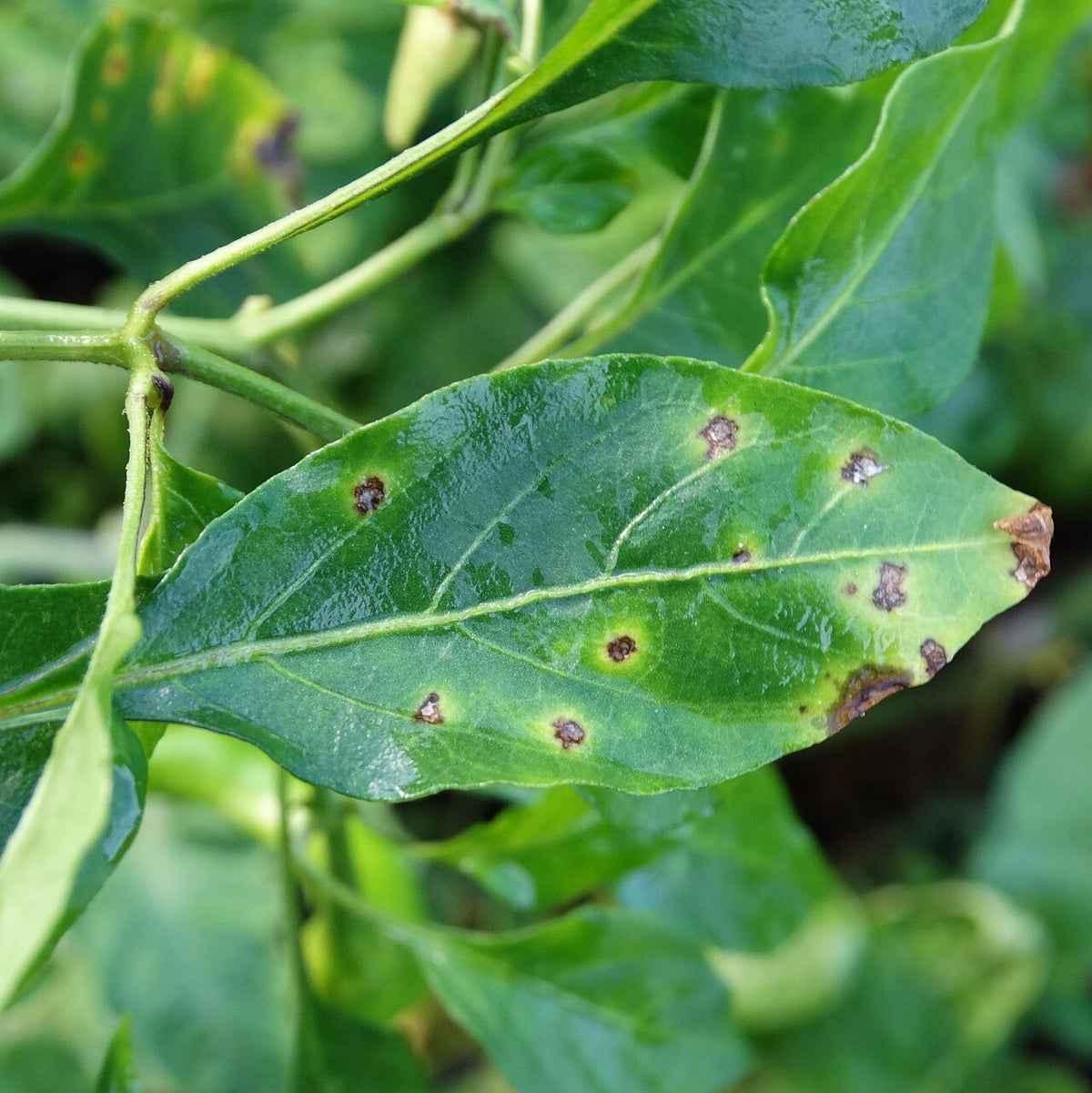
Photo at the top: Small dark spots, each with a yellow ring, on a Capsicum leaf, Photo: Scot Nelson, CC0
Quick answer
Bacterial leaf spot is a disease of chilli, capsicum and tomato caused by Xanthomonas bacteria. It makes small, dark, greasy leaf spots with a yellow ring, scabby spots on fruit, and leaf drop. It comes in with seed, seedlings and crop waste and spreads in rain. No spray cures it. Use clean seed and seedlings, crop rotation and field hygiene.
How to identify bacterial leaf spot
In Hindi the disease is called jivanu patti dhabba (जीवाणु पत्ती धब्बा), and in Telugu bacteria aakumachcha tegulu (బాక్టీరియా ఆకుమచ్చ తెగులు). On tomato it is often called bacterial spot. Tamil Nadu Agricultural University (TNAU) and NIPHM (National Institute of Plant Health Management) name the germ Xanthomonas campestris pv. vesicatoria. Newer books split it into four Xanthomonas species. For a farmer, it is the same disease.
The disease attacks leaves, stems and fruit. Look at the leaves first, on both sides.
- Young leaf spots: small, round, water-soaked spots. They look wet or greasy, as if a drop of oil fell on the leaf. NIPHM notes they are slightly raised on the underside of the leaf.
- Older leaf spots: the spots turn dark brown or black, often with a yellow ring (halo) around them. TNAU notes that as they grow, the centre gets lighter, with a dark band around it. On tomato, North Carolina State University (NC State) notes the spots rarely grow larger than 3 mm.
- Spots join: many spots run together into larger, uneven dead patches. The leaf looks burnt in places.
- Leaf drop: leaves with many spots turn yellow and fall. On a badly hit plant the fruit is left without shade and can get sunburnt.
- Stems and leaf stalks: narrow, long dark streaks. On chilli, TNAU notes cankers (rough, cracked spots) on stems, and branches can wilt.

Spots on chilli and tomato fruit
On chilli, TNAU describes round, raised, water-soaked spots with a pale yellow border. They turn brown and sink in the middle. In wet weather you may see shiny drops of bacterial ooze in the centre.
On tomato, NIPHM says the clearest signs are on green fruit. Small, water-soaked spots become raised and grow to about 3 to 6 mm. The centre turns light brown, slightly sunken, with a rough, scabby surface. Ripe tomato fruit does not get infected.
Look-alikes and how to tell them apart
- Cercospora leaf spot (frog-eye): a fungal disease of chilli. The spots are larger and round, with a grey or white centre and a dark ring, like a frog's eye. Bacterial spots are smaller, greasy when young and have no pale centre at first. See our guide to Cercospora leaf spot of chilli and its frog-eye symptoms.
- Early blight of tomato: a fungal disease. Its brown spots are larger and show rings inside, like a target, and start on the oldest leaves. Read our guide to early blight of tomato and potato.
- Anthracnose (fruit rot) of chilli: a fungal disease. It makes large, sunken, dark patches on ripe fruit, often with rings of black dots. Bacterial spots on fruit are small, raised and scabby. See our guide to anthracnose and fruit rot of chilli.
- Bacterial speck of tomato: another bacterial disease, caused by a different germ. NC State notes it is easy to confuse with bacterial spot on leaves. Its spots are tiny black specks. A lab or your KVK (Krishi Vigyan Kendra, the farm science centre) can confirm which one you have.
A simple check: fungal spots often show powder, fuzz or tiny black dots in wet weather. Bacterial spots do not. They look wet and greasy instead. Under a microscope, bacteria stream out of a cut spot, as NC State explains. Your KVK or plant clinic can do this test.
How it spreads and when it attacks
The bacteria live on and inside seed, in leaves and stems left in the field, and on chilli or tomato plants that come up on their own. NIPHM also names black nightshade (Solanum nigrum, called makoi in Hindi), a common weed, as a host. NC State reports that in North Carolina, most outbreaks can be traced back to infected seed or sick seedlings from the nursery.
Once a few plants have spots, rain does most of the spreading. Raindrops splash the bacteria from leaf to leaf and plant to plant. Wind-driven rain, sprinkler water and people or tools moving through a wet crop also carry them. The bacteria enter the leaf through its tiny breathing pores and through wounds. The longer the leaves stay wet, the more infection takes place.
NIPHM lists moderate temperature, high humidity, persistent dew and on-and-off rain as the conditions that favour the disease. NC State gives about 24 to 30 °C with heavy rain as the risky weather. In Telangana and Andhra Pradesh, chilli is mostly sown in kharif and transplanted during the monsoon. So nurseries and young plants grow through the riskiest months. Tomato grown in the rainy season faces the same risk.
Crops it attacks
Bacterial leaf spot of chilli and capsicum
Chilli can be hit from the nursery to the fruiting stage. In the nursery, spotted seedlings carry the disease into the main field. After transplanting, leaf spots and leaf drop weaken the plant during flowering and fruit set. Spots on green chillies lower their market value, and plants that lose many leaves give smaller and fewer fruits. Capsicum (bell pepper) gets the same disease.
Bacterial spot of tomato
On tomato, the disease starts on seedlings and lower leaves. NIPHM notes that on older plants the spots are mostly on older leaves and can cause serious leaf drop. Green fruit gets scabby spots, which make it hard to sell. Ripe fruit is not infected, but fruit spotted while green keeps its marks.
When to act
We could not find an economic threshold (the level of disease at which control starts to pay) for this disease from a recognised public source, so we do not give one here. Act on the first spots you see, because NC State notes that once a field is infected, the disease is hard to control in wet weather.
Check the nursery every few days. In the main field, walk the crop once or twice a week, and more often after heavy rain. Turn leaves over and look for small, greasy, water-soaked spots with a yellow ring. Check green fruit for raised, scabby spots. Note which part of the field shows it first.
How to control bacterial leaf spot without chemicals
- Start with clean seed: TNAU advises using seed from disease-free plants. NIPHM says seed should be collected from healthy fruits. Do not save seed from a field that had spots. Buy certified seed from a trusted dealer.
- Raise or buy healthy seedlings: look at every tray or nursery bed before transplanting. Throw away seedlings with spots, even your own. Do not water the nursery more than needed, and do not handle seedlings when they are wet.
- Ask about seed treatment: NC State notes that some seed treatments, including hot water, can lower the germs on seed, but can also lower germination. Ask your KVK or agriculture officer for the method and test it on a small lot of seed first.
- Rotate crops: NC State advises not to plant chilli or tomato in a field that had them within the last year, especially if it had this disease. Rotate to a crop outside the tomato family, such as maize or a pulse. Chilli, capsicum, tomato, brinjal and potato all belong to that family, so do not follow one with another.
- Clean up crop waste and weeds: TNAU calls field sanitation important. After harvest, remove and destroy spotted plants and fallen leaves, or plough them deep so they rot. Pull out self-sown chilli and tomato plants, and remove black nightshade in and around the field.
- Keep leaves dry: drip irrigation or furrow irrigation keeps the leaves drier than sprinklers. Drain standing water after heavy rain. Use the recommended spacing so the crop dries faster.
- Stay out of a wet crop: NC State warns against spraying, tying, harvesting or handling wet plants, as this spreads the bacteria. Work in sick patches last, and clean hands and tools after.
- Remove early spots: in a small plot, pick off the first spotted leaves on a dry day and take them out of the field.

Chemical control: no spray cures the disease
No spray heals leaves or fruit that already have spots. This is a disease caused by bacteria, not a fungus, so most fungicides do not act on it. NC State notes that the products used against bacterial spot protect well only when sprayed before infection, and none of them cures it. A spray can at most protect new growth and slow the spread.
No product on our store has this disease on its label, so we do not suggest one here. Ask your local agriculture officer or KVK for a product labelled for your crop and this disease. Then use only that product, at the dose and water volume printed on its label.
If you do spray:
- Use one product at a time. Do not mix products in one tank.
- Follow the waiting period before harvest printed on the label, counted from the last spray. Green chillies and tomatoes are picked often, so plan sprays around picking.
- Wear gloves, a mask, full-sleeve clothes and boots. Spray in the cool part of the morning or evening, not in wind or just before rain.
- Do not spray over flowers when bees are working.
- Read the label and leaflet before use.
Frequently asked questions
What causes bacterial leaf spot in chilli?
It is caused by Xanthomonas bacteria. They come into the field with infected seed, sick seedlings, old crop waste or weeds such as black nightshade. Rain splash then spreads them from plant to plant.
How do I know if leaf spots are bacterial or fungal?
Bacterial spots are small and look wet or greasy at first, often with a yellow ring. They show no powder or fuzz. Fungal spots are often larger, with rings or a pale centre, and may show powder or black dots. For a sure answer, take a fresh sample to your KVK or plant clinic.
Will a fungicide cure bacterial leaf spot?
No. Most fungicides do not act on bacteria, and no spray heals spots that are already there. Clean seed, healthy seedlings, crop rotation and field hygiene are the main control. For a spray, ask your agriculture officer or KVK for a product labelled for this disease on your crop.
Can I save seed from a chilli crop that had spots?
It is better not to. The bacteria can live on and inside seed, so the disease comes back in your next nursery. Use seed from healthy fruit or buy certified seed.
Is it the same as bacterial wilt?
No. Bacterial wilt is caused by a different germ that blocks the water pipes inside the stem, so the whole plant wilts while still green. Leaf spot makes spots on leaves and fruit. Read our guide to bacterial wilt in tomato, brinjal and chilli.
Related reading
- Cercospora leaf spot of chilli: frog-eye symptoms and control
- Anthracnose of chilli, mango and grapes: symptoms and control
- Early blight of tomato and potato: symptoms and control
- Bacterial wilt in tomato, brinjal and chilli
- Damping off of tomato and chilli seedlings in the nursery
- Products for chilli
- Products for tomato
Sources
- Tamil Nadu Agricultural University (TNAU) Agritech Portal: Diseases of chilli: bacterial leaf spot
- National Institute of Plant Health Management (NIPHM) and Directorate of Plant Protection, Quarantine and Storage, Government of India: AESA based IPM package for chillies and capsicum
- NIPHM and Directorate of Plant Protection, Quarantine and Storage, Government of India: AESA based IPM package for tomato
- North Carolina State University Extension: Bacterial spot of pepper and tomato
ఈ వ్యవసాయ సమాచారం నచ్చిందా? Googleలో AgriVruddhi ను ఇష్టమైన సోర్స్గా ఎంచుకోండి
పంట ఆరోగ్య గైడ్ కి తిరిగి వెళ్ళండి