
Fall armyworm in maize: how to identify and control it
· By AgriVruddhi
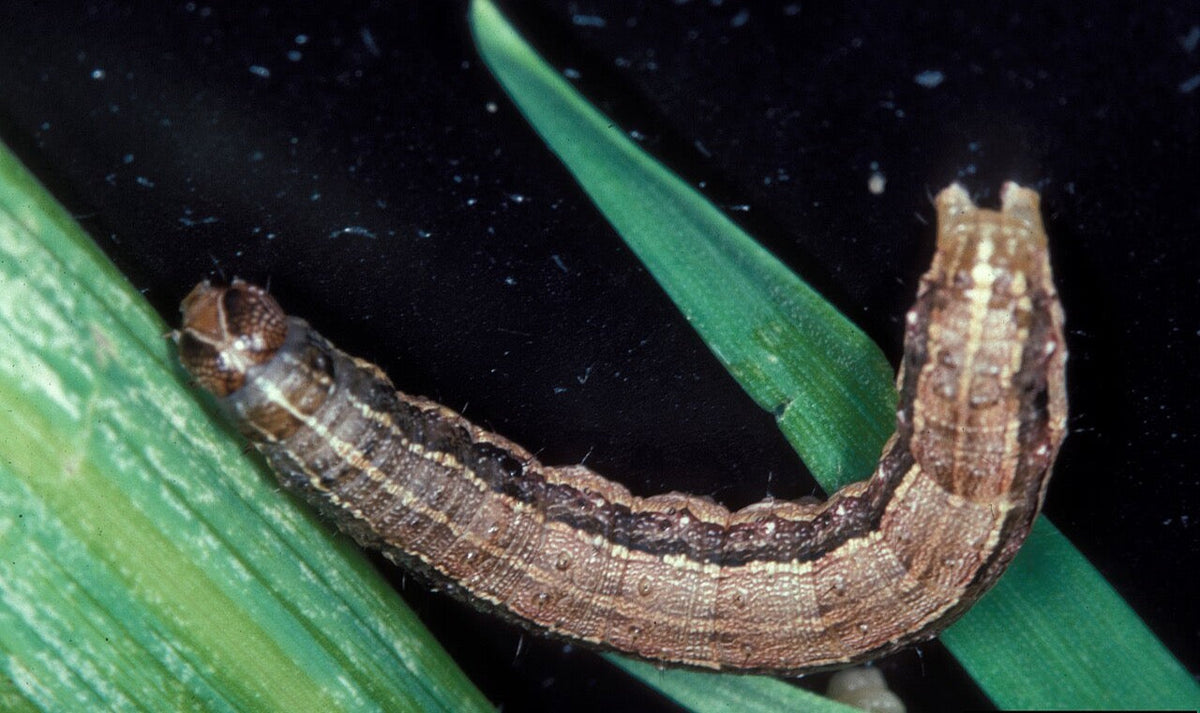
Photo at the top: Fall armyworm caterpillar. Note the pale "Y" on the head. Photo: Frank Peairs, Colorado State University, Bugwood.org, CC BY 3.0 US (cropped)
Quick answer
Fall armyworm (Spodoptera frugiperda) is a caterpillar that eats maize leaves inside the whorl (the funnel of new leaves at the centre of the plant), and later the tassel and cobs. To control fall armyworm in maize, check the crop every week from emergence, crush egg masses, and spray a label-approved insecticide into the whorl once damage crosses the threshold.
How to identify fall armyworm
Caterpillar
The colour changes from light green to brown or almost black, so do not go by colour. Check these two marks on a grown caterpillar:
- A pale, upside-down "Y" on the dark head.
- Four dark dots that form a square on the top of the second-last body segment, near the tail.
- Three pale lines running down the back, with dark spots on each body segment.
A grown caterpillar is about 3 to 4 cm long. You will usually find only one or two big caterpillars in each whorl, because they eat each other when crowded.
Fall armyworm damage signs in maize
- Papery windows: young caterpillars scrape one side of the leaf, leaving thin, see-through patches.
- Ragged holes: older caterpillars feed deep in the whorl. When the leaves open, they show rows of large, ragged holes.
- Droppings: wet, sawdust-like droppings in the whorl and on upper leaves are a strong sign that a caterpillar is inside.
- Tassel and cob damage: at later stages they feed on the tassel and bore into the cob from the side or tip.

Eggs and moth
The moth lays eggs in groups, mostly on the underside of the leaves, covered with a grey, hairy layer. One female can lay many such groups in her life. The moth is grey-brown and flies at night. The male has a small white patch near the tip of each front wing. Moths can fly long distances, which is how the pest spreads quickly from one area to the next. Tiny caterpillars also hang on silk threads and the wind carries them to nearby plants.
Look-alikes
- Maize stem borer: makes small "shot holes" in a line across the leaf and bores into the stem, so the central shoot dries (dead heart). Fall armyworm leaves large, ragged holes and droppings in the whorl.
- Tobacco caterpillar (Spodoptera litura): has a row of dark triangles along the back and no "Y" on the head. It is more common on groundnut, cotton and vegetables.
Fall armyworm life cycle and when it attacks
Fall armyworm is native to the Americas. In India it was first found in May 2018, in maize fields in Karnataka, and within a year it had spread to most maize-growing states, including Telangana and Andhra Pradesh.
In warm weather the full cycle takes about a month. Eggs hatch in two to three days. The caterpillar feeds for about two to three weeks, then drops to the ground and turns into a pupa in the soil. The moth comes out about a week or more later. Because the cycle is short, several generations come in one season. In cool weather each stage takes longer, so the cycle can stretch to two months or more.
The moths fly and lay eggs at night. During the day the caterpillars hide deep inside the whorl, which is why you see the damage more often than the pest.
The pest attacks from the seedling stage to the cob stage. The whorl stage, roughly two to seven weeks after the crop comes up, is when most leaf damage happens. In Telangana and Andhra Pradesh, both kharif and rabi maize are attacked.
Crops it attacks
Maize: the main host. Damage is worst from seedling to late whorl stage. Later, it feeds on tassels and cobs, and cob damage lets in rots.
Sorghum (jowar): attacked in the same way as maize, with feeding in the whorl and later on the earhead.
Paddy: attack is less common than in maize. Caterpillars eat the leaves of young plants.
It can also feed on sugarcane, millets and some vegetables, mostly when maize is not available.
When to spray for fall armyworm (economic threshold)
Start checking the crop every week from the day seedlings come up. Walk through the field in a "W" pattern and look at 20 plants at five points. Count how many plants show fresh damage, and work out the percentage.
ICAR-Indian Institute of Maize Research (ICAR-IIMR) advises spraying when the average infestation reaches 10% of plants from the seedling to mid-whorl stage, and 20% of plants after the mid-whorl stage. ICAR-IIMR does not advise chemical sprays at the tassel and cob stage, because the caterpillars are hidden in the cob where the spray cannot reach. Pick them out by hand at that stage.
Sprays give better results on young caterpillars. The largest caterpillars, which are near the end of their feeding, are hard to control, so act early.
How to control fall armyworm without chemicals
- Deep ploughing before sowing exposes pupae in the soil to sun and birds.
- Sow on time and together: when farmers in a village sow within a short window, the pest has fewer young plants to move to.
- Border and intercrops: TNAU advises three border rows of cowpea, sesame, redgram or sunflower in irrigated land, or fodder sorghum in dry land.
- Neem cake: TNAU advises 250 kg per hectare (about 100 kg per acre) at the last ploughing.
- Pheromone traps: TNAU advises 12 fall armyworm traps per hectare (about 5 per acre). They show when moths arrive, so you know when to look closely.
- Remove egg masses and young larvae: crush egg masses and leaves with groups of tiny larvae.
- Dry sand in the whorl: ICAR-IIMR advises putting dry sand into the whorl of damaged plants soon after you first see the pest.
- Bio-pesticides: TNAU advises neem-based azadirachtin 1500 ppm at the early stage, and the fungus Metarhizium anisopliae at the late whorl stage.
- Natural enemies and birds: egg wasps (such as Trichogramma and Telenomus), earwigs, spiders and birds attack this pest. Put up bird perches (T-shaped sticks) and avoid needless sprays.
Chemical control, crop by crop
Use only a product whose label lists your crop and fall armyworm. A few practical points help the spray reach the pest:
- Aim the nozzle into the whorl, where the caterpillars feed. A spray that only wets the outer leaves misses them.
- Spray in the early morning or evening, when caterpillars are more active and the spray does not dry too fast.
- Measure the product and water for each tank. Do not add more than the label dose: it raises cost and risk, not control.
- Check the field again a few days after spraying. Count fresh damage only, since old holes stay on the leaves.
Maize
- Incipio Insecticide (isocycloseram 18.1% SC): label dose 121 ml per acre in 200 L water. The label advises the first spray when the pest reaches ETL (5% plant damage in the field), and one more spray after 10–15 days depending on pest pressure.
- Alecto Insecticide (broflanilide 20% SC): label dose 51 g per acre in 200 L water, as printed on the label.
Sorghum and paddy
None of the products in our range has a label for fall armyworm in sorghum or paddy. Use the non-chemical steps above and ask your local agriculture officer or Krishi Vigyan Kendra (KVK) for an approved product.
Never mix two insecticides in one tank.
Rotate to avoid resistance
IRAC, the international body that groups insecticides by how they act on the pest, places both Incipio (isocycloseram) and Alecto (broflanilide) in group 30. They work in the same way. So do not use Alecto right after Incipio, or Incipio right after Alecto, and count them as one choice.
Fall armyworm builds resistance quickly. If a second spray is needed, ask your agriculture officer for a label-approved product from a different IRAC group, and keep up the non-chemical steps so that sprays are needed less often.
Safety and waiting period
| Product | Crop | Waiting period before harvest |
|---|---|---|
| Incipio Insecticide | Maize | 48 days |
| Alecto Insecticide | Maize | 29 days |
- If you harvest green cobs or cut maize for fodder, count the waiting period up to that day.
- Wear gloves, a mask, goggles and full-sleeve clothes while mixing and spraying. Spraying into the whorl brings the nozzle close to your body, so take extra care.
- Keep products away from children, animals, food and water sources.
- Read the label and leaflet before use.
Frequently asked questions
How do I identify fall armyworm in maize?
Look for papery windows and ragged holes in the whorl, with sawdust-like droppings. Open the whorl and check the caterpillar for a pale "Y" on the head and four dots in a square near the tail.
Which insecticide is used for fall armyworm in maize?
Use only a product whose label lists maize and fall armyworm. The two products in our range with this label, their doses and waiting periods are listed in the chemical control and safety sections above. Spray only after damage crosses the threshold.
When should I start checking my maize for fall armyworm?
From the day the seedlings come up. Check every week, using the "W" walk and 20 plants.
Can I spray at the tassel and cob stage?
ICAR-IIMR does not advise chemical sprays at this stage, because the caterpillars hide inside the cob. Pick and destroy them by hand.
Does fall armyworm attack paddy?
Sometimes, but much less often than maize. Our range has no product labelled for fall armyworm in paddy, so ask your agriculture officer.
Why is it called fall armyworm?
The name comes from the Americas, where the pest is native and is most damaging in autumn, which is called "fall" there. "Armyworm" refers to the way large numbers of caterpillars move across fields, like an army, when food runs out.
Will one spray be enough?
Not always. New moths keep arriving and laying eggs, so check the field every week even after a spray. Spray again only if fresh damage crosses the threshold, and follow the label for the gap between sprays.
Related reading
- Tobacco caterpillar (Spodoptera litura): identification and control
- Helicoverpa armigera: fruit borer, pod borer and American bollworm control
- Stem borer in paddy: dead heart, white ear and how to control it
- Termite control in field crops: how to identify and stop termites
- All insecticides
- Paddy products
Sources
- ICAR-Indian Institute of Maize Research (ICAR-IIMR): fall armyworm scouting, action threshold and management advice for maize.
- TNAU Agritech Portal, Tamil Nadu Agricultural University: crop protection, fall armyworm
- IRAC Mode of Action Classification
- Product labels and leaflets of the insecticides named in this guide.
Products that control it, by crop
Maize
- Incipio Insecticide121 ml per acreFirst spray at the action level (ETL): 5% of plants damaged. One more spray after 10-15 days if pest attack is still high.
- Alecto Insecticide51 g per acre
Do not spray the same product again and again. Change to a product with a different mode of action (the group number on the label) so the pest or disease does not build resistance.
As printed on the brand's official label. Read the label before use.


Like these farming tips? Add AgriVruddhi as a preferred source on Google
Back to Crop Health Guide