
Spodoptera litura (tobacco caterpillar): identification and control
· By AgriVruddhi
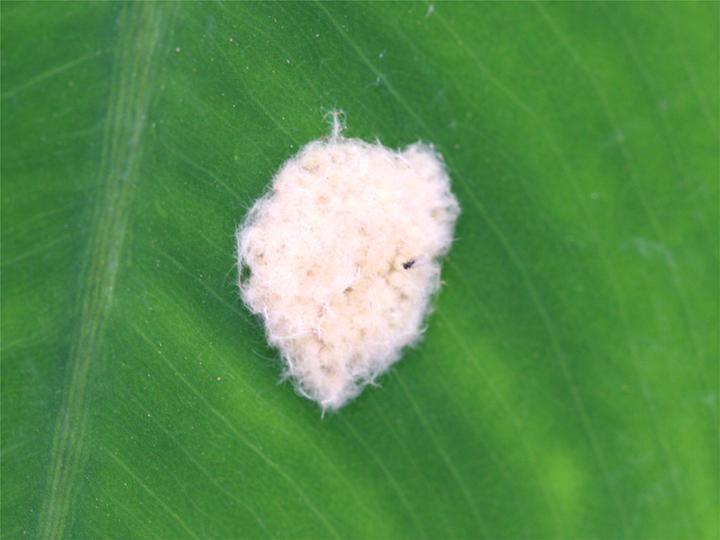
Photo at the top: An egg mass of the tobacco caterpillar, covered with hairs. Photo: Amy Carmichael, Queensland University of Technology, CC BY 3.0 AU
Quick answer
Spodoptera litura, the tobacco caterpillar, is a moth whose caterpillars eat the leaves of groundnut, cotton, soybean, chilli, cabbage and pulses. Young larvae scrape leaves in groups. Older ones eat whole leaves, pods and bolls at night. Control it early: destroy egg masses, use pheromone traps, and spray a label-approved product only above the threshold.
It is also called the tobacco cutworm, common cutworm or leaf-eating caterpillar. Older books use the name Prodenia litura.
How to identify Spodoptera litura
Damage signs in the field
- Papery patches: young larvae scrape the green layer, so the leaf turns thin, whitish and net-like.
- Holes and bare plants: older larvae eat large holes and can leave only the stems and veins.
- Droppings: small dark pellets on the leaves and on the ground under the plant.
- No caterpillars by day: grown larvae hide in the soil or under the plant in the daytime. Check with a torch after dark, or dig gently around the base of damaged plants.
Eggs
The moth lays eggs in groups of a few hundred on the underside of leaves. The group is covered with buff or light brown hairs from the moth's body, so it looks like a small tuft of cotton wool on the leaf.
Young caterpillars (larvae)
Newly hatched caterpillars are very small, pale green to grey, with a dark head. They stay together on the leaf where they hatched and scrape off the green layer. This leaves thin, papery, whitish patches. A leaf with many tiny larvae and a papery patch is the easiest sign to catch early.

Older caterpillars
As they grow, the caterpillars spread out over the field. A full-grown caterpillar is about 3.5–4 cm long, smooth, and grey-brown to dark brown or greenish. Look for a row of dark, triangle-shaped spots along each side of the back and pale lines along the body. Older caterpillars hide in the soil or at the base of the plant by day and come out to feed at night.

Pupa and moth
The caterpillar turns into a brown pupa inside the soil. The moth is brown, with wavy white or cream lines on the front wings. Its back wings are whitish with a brown edge. It flies at night and comes to lights.

Look-alikes
- Helicoverpa (gram pod borer, American bollworm): bores into pods, bolls and fruits with its head inside and its body outside. It has no row of dark triangles on the back. See Helicoverpa armigera: fruit borer, pod borer and American bollworm control.
- Fall armyworm: mainly on maize. It has a pale upside-down "Y" on the head and four dark dots in a square near the tail.
- Semilooper: green, and moves by looping its body up like a bridge.
Spodoptera litura life cycle and when it attacks
In warm weather, one generation takes about a month, from egg to moth. Eggs hatch in a few days, the caterpillar feeds for about two to three weeks, and the pupa rests in the soil for about a week or more. So several generations come in one season, and numbers can rise fast.
Warm, humid weather after rains favours this pest. In Telangana and Andhra Pradesh, damage is common in kharif from July to October, mostly in groundnut, cotton, soybean and chilli. It also attacks rabi groundnut, vegetables and pulses where there is irrigation.
Crops it attacks
Groundnut: caterpillars strip the leaves. In heavy attack, only the stems and veins are left, and the plant cannot fill its pods well.
Cotton: caterpillars eat leaves and can also feed on squares (flower buds) and young bolls.
Soybean: leaves are eaten from the edges, and plants can be stripped bare in a bad year.
Chilli: caterpillars eat leaves, flowers and young fruits.
Cabbage and cauliflower: young larvae scrape the leaves. Older ones make large holes and can bore into the head or curd, which spoils it for sale.
Bengal gram and black gram: caterpillars eat leaves and feed on pods.
When to spray (economic threshold)
The economic threshold is the level of pest at which spraying pays for itself. For groundnut, the IPM package from ICAR-National Centre for Integrated Pest Management (NCIPM) and the Directorate of Plant Protection, Quarantine and Storage gives the threshold as 2 larvae per plant, or 20–25% leaf loss at 40 days. Check the field every week. Pheromone trap catches tell you when moths are active, so you know when to look for egg masses.
For cotton, TNAU Agritech (Tamil Nadu Agricultural University) gives the threshold as 8 egg masses per 100 metres of row.
For other crops, ask your local agriculture officer for the threshold used in your area. In all crops, act when you see egg masses and groups of young larvae, because they are easy to remove and easy to control at this stage.
Control without chemicals
- Deep summer ploughing exposes pupae in the soil to sun and birds.
- Hand-pick egg masses and young larvae. Remove leaves with egg masses or papery patches and destroy them. It costs only time and is most useful early, before the larvae spread.
- Pheromone traps: the ICAR-NCIPM groundnut package advises 5 traps per hectare (2 per acre) to watch moth numbers, and 25 traps per hectare (10 per acre) to catch moths in large numbers.
- Light traps or small bonfires at night attract moths.
- Trap and border crops: castor and sunflower attract the moth. A few castor plants around groundnut show early where the pest is laying eggs; check them and destroy egg masses.
- Bio-pesticides: sprays of SlNPV (a virus that infects only this caterpillar), Bt, or 5% neem seed kernel extract are most useful on eggs and young larvae.
- Natural enemies: small wasps that live in the eggs (for example Telenomus), spiders, ground beetles and birds all feed on this pest. Bird perches (T-shaped sticks) help birds hunt in the field. Avoid needless sprays that kill these helpers.
- Varieties: the ICAR-NCIPM groundnut package lists ICGV 86590 as resistant to Spodoptera. Ask your seed dealer what is available in your area.
Insecticides for tobacco caterpillar, crop by crop
Use only a product whose label lists your crop and this pest. Doses below are per acre, from each product's official label. Spray in the evening, when caterpillars come out to feed, and cover both sides of the leaves.
Groundnut
- Aston Insecticide (chlorantraniliprole 18.5% SC): label dose 61 ml per acre in 200 L water, foliar spray at ETL.
- OMG Insecticide (chlorantraniliprole 18.5% SC): label dose 61 ml per acre in 200 L water.
- Simodis Insecticide (isocycloseram 9.2% DC): its label lists "leaf feeders" on groundnut. Label dose 202–243 ml per acre in 200 L water. First spray at ETL, one more after 10–15 days if needed, and no more than two sprays in a season.
Cotton
- Aston: label dose 61 ml per acre in 200 L water.
- OMG: label dose 61 ml per acre in 200 L water.
- Hamla 550 Insecticide (chlorpyrifos 50% + cypermethrin 5% EC): a ready-mixed product with two actives, approved on the label. Label dose 405 ml per acre in 200–400 L water, when the pest is at a level that causes economic loss.
Soybean
- Simodis: its label lists "leaf worm" on soybean. Label dose 243 ml per acre in 200 L water, no more than two sprays in a season.
Chilli
- Aston: label dose 61 ml per acre in 200 L water.
- OMG: label dose 61 ml per acre in 200 L water.
- Alecto Insecticide (broflanilide 20% SC): label dose 51 g per acre in 200 L water, as printed on the label.
- Evicent Insecticide (emamectin benzoate 5% + lufenuron 40% WG): a ready-mixed product with two actives, approved on the label. Label dose 24 g per acre in 200 L water. First spray at ETL, then 1–2 more at 10–15 day gaps if needed.
- Rimon Insecticide (novaluron 10% EC): label dose 152 g per acre in 200 L water, as printed on the label, when the pest attacks.
Cabbage and cauliflower
- Cabbage, Alecto: label dose 51 g per acre in 200 L water.
- Cabbage, Simodis: its label lists "leaf feeder" on cabbage. Label dose 81–121 ml per acre in 200 L water, no more than two sprays in a season.
- Cauliflower, Evicent: label dose 24 g per acre in 200 L water.
Bengal gram and black gram
- Bengal gram, Aston or OMG: label dose 51 ml per acre in 200 L water, at ETL. OMG's label adds: preferably at the vegetative stage or when flowering starts.
- Black gram, Aston or OMG: label dose 40 ml per acre in 200 L water.
Aston and OMG have the same active ingredient at the same strength. Pick one. Never mix two products in one tank.
Rotate to avoid resistance
This caterpillar becomes resistant to insecticides quickly when the same kind is sprayed again and again. IRAC, the international body that groups insecticides by how they act, gives each active ingredient a group number. Do not spray the same group twice in a row. Change to a different group for the next spray.
| IRAC group | Products |
|---|---|
| 28 | Aston, OMG (chlorantraniliprole) |
| 30 | Alecto (broflanilide), Simodis (isocycloseram) |
| 6 + 15 | Evicent (emamectin benzoate + lufenuron) |
| 15 | Rimon (novaluron) |
| 1B + 3A | Hamla 550 (chlorpyrifos + cypermethrin) |
Note that Evicent and Rimon share group 15, so do not use one right after the other. For example, in chilli you could follow a group 28 spray with group 30, and later with Evicent.
Safety and waiting period
The waiting period (PHI) is the number of days between the last spray and harvest.
| Product | Crop | Waiting period |
|---|---|---|
| Aston, OMG | Groundnut | 28 days |
| Aston, OMG | Cotton | 9 days |
| Aston, OMG | Chilli | 3 days |
| Aston, OMG | Bengal gram | 11 days |
| Aston, OMG | Black gram | 20 days |
| Simodis | Groundnut | 48 days |
| Simodis | Soybean | 35 days |
| Simodis | Cabbage | 10 days |
| Hamla 550 | Cotton | 15 days |
| Alecto | Chilli, cabbage | 1 day |
| Evicent | Chilli, cauliflower | 3 days |
| Rimon | Chilli | 3 days |
- Wear gloves, a mask, goggles and full-sleeve clothes while mixing and spraying. Do not spray against the wind.
- Many insecticides harm bees. Do not spray flowering crops while bees are working; spray in the evening.
- Keep products away from children, animals, food, ponds and wells.
- Read the label and leaflet before use.
Tobacco caterpillar questions farmers ask
What is the life cycle of Spodoptera litura?
Egg, caterpillar, pupa and moth. In warm weather the whole cycle takes about a month. The caterpillar stage lasts about two to three weeks, and the pupa forms in the soil.
What do Spodoptera litura larvae look like?
Young larvae are small, pale green to grey, and feed in groups, leaving papery patches on leaves. Older larvae are smooth and brown to dark grey, with a row of dark triangles along each side of the back. They hide in the soil by day.
Which insecticide controls tobacco caterpillar?
Use a product whose label lists both your crop and this pest. The crop-by-crop list above gives each one with its label dose per acre. Change the IRAC group for the next spray. On eggs and young larvae, SlNPV, Bt or neem seed kernel extract also help.
Why should I spray in the evening?
Older caterpillars come out at night to feed. An evening spray reaches them on the leaves, and it also avoids the hours when bees are active.
Is tobacco caterpillar the same as fall armyworm?
No. Both are Spodoptera caterpillars, but fall armyworm is a different species that mainly attacks maize. It has an upside-down "Y" on the head and four dots in a square near the tail. See fall armyworm in maize: how to identify and control it.
Related reading
- Helicoverpa armigera: fruit borer, pod borer and American bollworm control
- Fall armyworm in maize: how to identify and control it
- Pink bollworm in cotton: symptoms, when to spray and control
- Leaf miner in tomato and groundnut: identification and control
- Thrips insecticide guide: control thrips in chilli, cotton and onion
- Cotton products
- Chilli products
- All insecticides
Sources
- ICAR-NCIPM and PPQS, Government of India: Integrated Pest Management Package for Groundnut
- Tamil Nadu Agricultural University, TNAU Agritech Portal: Tobacco cutworm (Spodoptera litura) in cotton
- IRAC: Mode of action classification
- Product labels and leaflets of the insecticides named above
Products that control it, by crop
Bengal gram (chana)
- Aston Insecticide51 ml per acreSpray on the leaves with a knapsack sprayer when the pest reaches the action level (ETL).
- OMG Insecticide51 ml per acreFoliar spray when the pest reaches the action level (ETL), ideally at early growth or when flowering starts.
Black gram (urad)
- Aston Insecticide40 ml per acreSpray on the leaves with a knapsack sprayer when the pest reaches the action level (ETL).
- OMG Insecticide40 ml per acreFoliar spray when the pest reaches the action level (ETL), ideally at early growth or when flowering starts.
Chilli
- Aston Insecticide61 ml per acreSpray on the leaves with a knapsack sprayer when the pest reaches the action level (ETL).
- OMG Insecticide61 ml per acreFoliar spray when the pest reaches the action level (ETL), ideally at early growth or when flowering starts.
- Alecto Insecticide51 g per acre
- Evicent Insecticide24 g per acreFoliar spray when the pest reaches the action level (ETL). Repeat 1-2 sprays at 10-15 day intervals.
- Rimon Insecticide152 g per acreSpray when the pest attack is seen; use a high-volume nozzle
Cotton
- Aston Insecticide61 ml per acreSpray on the leaves with a knapsack sprayer when the pest reaches the action level (ETL).
- OMG Insecticide61 ml per acreFoliar spray when the pest reaches the action level (ETL), ideally at early growth or when flowering starts.
- Hamla 550 Insecticide405 ml per acreSpray at any crop stage when the pest starts to cause crop loss. Keep people out of the field for 48 hours after spraying.
Groundnut
- Aston Insecticide61 ml per acreSpray on the leaves with a knapsack sprayer when the pest reaches the action level (ETL).
- OMG Insecticide61 ml per acreFoliar spray when the pest reaches the action level (ETL), ideally at early growth or when flowering starts.
- Simodis Insecticide202–243 ml per acreFirst spray when the pest reaches the action level (ETL). One more spray 10-15 days later if needed. Max 2 sprays per season.
Cabbage
- Simodis Insecticide81–121 ml per acreFirst spray when the pest reaches the action level (ETL). One more spray 10-15 days later if needed. Max 2 sprays per season.
- Alecto Insecticide51 g per acre
Soybean
- Simodis Insecticide243 ml per acreFirst spray when the pest reaches the action level (ETL). One more spray 10-15 days later if needed. Max 2 sprays per season.
Cauliflower
- Evicent Insecticide24 g per acreFoliar spray when the pest reaches the action level (ETL). Repeat 1-2 sprays at 10-15 day intervals.
Do not spray the same product again and again. Change to a product with a different mode of action (the group number on the label) so the pest or disease does not build resistance.
As printed on the brand's official label. Read the label before use.


Like these farming tips? Add AgriVruddhi as a preferred source on Google
Back to Crop Health Guide