
Leaf miner in tomato and groundnut: identification and control
· By AgriVruddhi
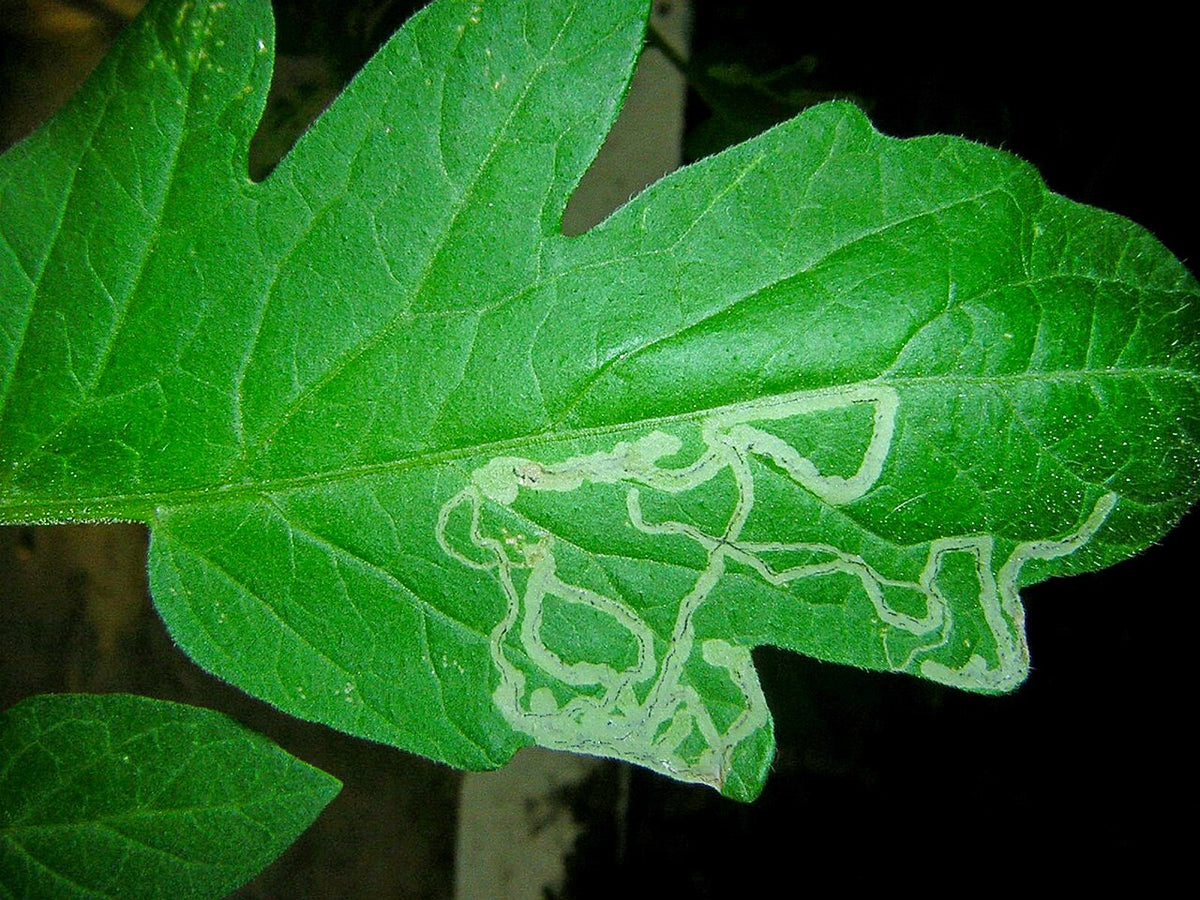
Photo at the top: Winding serpentine leaf miner trails on a tomato leaf, Photo: Flowersabc, CC BY-SA 2.0
Quick answer
Leaf miner in tomato is usually the serpentine leaf miner, a tiny fly whose maggot eats inside the leaf and leaves white, winding trails. Badly mined leaves dry and drop. Control it by removing mined leaves early, using yellow sticky traps and neem seed kernel extract (NSKE 5%), and protecting natural enemies.
In groundnut, a different pest, the groundnut leaf miner caterpillar, makes brown blotches and webs leaflets together. In our store, only one product has leaf miner on its label, and only for groundnut. For tomato and other crops, ask the store or your agriculture officer before you spray.
How to identify leaf miner in tomato and other crops
Leaf miners are tiny insect larvae that live and feed inside a leaf, between its upper and lower skin. In India, three different insects are called "leaf miner" by farmers: the serpentine leaf miner, the groundnut leaf miner and the tomato pinworm (Tuta absoluta). It helps to know which one you have.
Serpentine leaf miner (tomato, beans, gourds and many other crops)
- Trails: thin, white or pale, winding lines on the leaf, like a snake's path. The trail starts thin and gets wider as the maggot grows. You can often see a thin dark line of droppings inside.
- Small dots: the adult female pricks the leaf to feed and lay eggs, which leaves tiny pale dots on the leaf surface.
- Maggot: Tamil Nadu Agricultural University (TNAU) describes it as very small, orange-yellow and without legs. Hold the leaf up to the light to see it at the end of a fresh trail.
- Pupa: yellowish brown, formed in the trail or after the maggot drops to the soil.
- Adult: a tiny fly, about 2 mm long, black with yellow marks.
- Damage: heavily mined leaves dry and drop (TNAU). Young plants are set back the most.
The main species on tomato in India is Liriomyza trifolii.

Groundnut leaf miner
- Early damage: TNAU says young caterpillars mine into the leaflets and leave short, brownish blotches.
- Later damage: older caterpillars come out of the mine and web leaflets together, feeding inside. The leaflets roll, shrivel and dry. In a bad attack the field looks burnt from a distance.
- Caterpillar: green, with a pale brown head (TNAU).
- Adult: a tiny brown moth, about 6 mm long, with a white spot on the front edge of each forewing.
Its scientific name is Aproaerema modicella.
Tomato pinworm (Tuta absoluta), also called the tomato leaf miner
The Indian Council of Agricultural Research (ICAR) reports that this pest from South America was first found in India in October 2014, on tomato near Pune in Maharashtra. ICAR calls it a destructive invasive pest of tomato, in both open fields and polyhouses. It has since been reported from other tomato-growing states.
- Mines: wide, flat, pale blotches on the leaf, not thin winding lines. Later the blotches join and turn brown and dry.
- Caterpillar: it is a small caterpillar, not a legless maggot. You can often see it, or its black droppings, inside the blotch.
- Fruit and stem damage: it also bores into stems, buds and fruits, leaving tiny pin holes on the fruit. The serpentine leaf miner does not damage fruit.
- Other hosts: potato, brinjal and other crops of the tomato family.
If you see blotches and holed fruits, treat it as Tuta absoluta and ask your agriculture officer or Krishi Vigyan Kendra (KVK) for advice.
Other look-alikes and how to tell them apart
- Thrips and mites: cause silvery or speckled leaves, but there are no trails inside the leaf. See our thrips and red spider mite articles.
Life cycle and when it attacks
Serpentine leaf miner: the female fly lays eggs just under the leaf skin. The maggot feeds inside the leaf for about a week, then pupates. In warm weather a full cycle takes only about three weeks, so numbers can rise quickly. Numbers are usually higher in warm, dry weather and fall during heavy rain. Outbreaks often follow heavy use of broad-spectrum insecticides, because these kill the small wasps that normally attack leaf miner maggots.
Groundnut leaf miner: the moth lays eggs singly on the underside of leaflets. The caterpillar first mines, then webs leaflets, and pupates inside the webbed leaflets. Attacks are worse in dry spells, and TNAU advises avoiding water stress in irrigated groundnut. In Telangana and Andhra Pradesh it can affect both the kharif crop, during breaks in the rain, and the rabi or summer crop.
Crops it attacks
Tomato: serpentine leaf miner attacks from the nursery and young plant stage onwards. Heavy mining reduces leaf area, and badly mined leaves dry up. Seedlings with trails carry the pest from the nursery to the main field, so check them before transplanting.
Beans, cucumber and other gourds, cotton and castor: the serpentine leaf miner feeds on many crops and weeds, so it moves easily between fields.
Groundnut: the groundnut leaf miner can attack through the season. Dried, webbed leaflets lower the leaf area the plant needs to fill pods.
When to spray (economic threshold)
The economic threshold level (ETL) is the pest level at which spraying starts to pay for itself.
- Groundnut leaf miner: TNAU gives an ETL of 1 caterpillar per metre of crop row.
- Serpentine leaf miner on tomato: we could not confirm a published ETL. Ask your local agriculture officer or Krishi Vigyan Kendra (KVK).
Before you spray, check that the trails are fresh and still have live maggots at the end. Old, empty trails do not heal, and spraying them does nothing.
How to control leaf miner in tomato without chemicals
Tomato and vegetables
- Remove mined leaves: TNAU advises collecting and destroying mined leaves. Do this early, while only lower leaves are affected.
- Healthy seedlings: do not transplant seedlings that already carry trails.
- Neem spray: TNAU lists neem seed kernel extract (NSKE) 5%.
- Yellow sticky traps: the adult flies are drawn to yellow, so sticky yellow cards help you see and catch them.
- Protect natural enemies: small parasitic wasps kill many maggots inside the leaf. Avoid sprays that are not needed.
- Weeds and old crops: remove weeds and old crop plants that keep the pest going between seasons.
- If it is Tuta absoluta: pick and destroy blotched leaves and holed fruits, and use pheromone traps made for Tuta absoluta to catch the male moths and see when they arrive.
Groundnut
TNAU lists these steps:
- Sow early, and at the same time as nearby farms, in both the rainy and rabi seasons.
- Grow pearl millet as an intercrop, 4 rows of groundnut to 1 row of pearl millet.
- Where possible, spread straw mulch within 10 days of germination.
- Avoid water stress in irrigated groundnut.
- Keep fields and bunds free of weeds.
- Set up one light trap per hectare at ground level, lit from 8 to 11 pm, to catch the moths.
Chemical control, crop by crop
Only one product in our store has leaf miner on its official label, and that label is for groundnut. The dose is per acre, worked out from the label. Use one product per spray. Do not mix products in one tank.
Groundnut
- Simodis Insecticide (isocycloseram 9.2% DC). Label target: "Leaf miner, Leaf feeders, Thrips, Jassids". Label dose 202–243 ml per acre in 200 L water. Give the first spray when the pest reaches ETL, and one more after 10–15 days if needed. No more than two sprays per crop season. Waiting period before harvest: 48 days.
Tomato and other crops
No product in our store has leaf miner on its label for tomato or any crop other than groundnut. Please do not use the groundnut dose on tomato. For tomato, vegetables and other crops, ask the store or your local agriculture officer which product is approved for your crop, and use the non-chemical steps above in the meantime.
Rotate to avoid resistance
Insecticides are grouped by how they kill the insect. This is called the mode of action, and the international IRAC system gives each group a number. Simodis contains isocycloseram, which is in IRAC group 30: it acts on the insect's nerves in a newer way. Leaf miners breed fast, so they can become resistant if one group is used again and again. Follow the label limit of two Simodis sprays per season. If you need more control, ask for a label-approved product from a different IRAC group.
Safety and waiting period
The waiting period (pre-harvest interval, or PHI) is the number of days between the last spray and harvest. For Simodis on groundnut it is 48 days, as printed on the label.
- Wear gloves, a mask, full-sleeve clothes and boots while mixing and spraying. Wash well afterwards.
- Keep products locked away from children, animals and food.
- Many insecticides harm bees. Spray in the late evening, when bees are not flying, and follow any bee warning on the label.
- Do not wash sprayers in ponds or streams.
Read the label and leaflet before use.
Leaf miner in tomato: farmer questions
How do I control leaf miner in tomato?
Pick and destroy mined leaves early, use only healthy seedlings, use yellow sticky traps and neem (NSKE 5%), and avoid sprays that kill the pest's natural enemies. No product in our store has tomato leaf miner on its label, so ask the store or your agriculture officer before using any insecticide.
What are the white winding lines on my tomato leaves?
They are trails made by the maggot of the serpentine leaf miner as it eats inside the leaf. Wide, flat blotches instead of thin lines may point to the tomato pinworm (Tuta absoluta).
Which product controls leaf miner in groundnut?
Simodis has groundnut leaf miner on its label. The label dose is 202–243 ml per acre in 200 L water, with no more than two sprays per season and a 48-day waiting period before harvest.
Is Tuta absoluta the same as tomato leaf miner?
Both names are used. The common tomato leaf miner in many fields is the serpentine leaf miner, a fly that makes thin winding trails. Tuta absoluta, also called the tomato pinworm or South American tomato leaf miner, is a moth whose caterpillar makes wide blotches and also bores into fruits.
Will the trails go away after spraying?
No. Old trails stay on the leaf. Judge control by whether new, fresh trails stop appearing on young leaves.
Related reading
- Thrips insecticide guide: control thrips in chilli, cotton and onion
- Jassids in cotton, okra and brinjal: how to identify and control leafhoppers
- Helicoverpa fruit borer in tomato and other crops: identification and control
- Tobacco caterpillar (Spodoptera litura) in groundnut and vegetables
- Tomato crop care products and all insecticides
Sources
- TNAU Agritech Portal (Tamil Nadu Agricultural University): Serpentine leaf miner on tomato
- TNAU Agritech Portal: Groundnut leaf miner
- Indian Council of Agricultural Research (ICAR): Tuta absoluta: a new invasive pest alert
- Insecticide Resistance Action Committee (IRAC): Mode of action classification
Products that control it, by crop
Groundnut
- Simodis Insecticide202–243 ml per acreFirst spray when the pest reaches the action level (ETL). One more spray 10-15 days later if needed. Max 2 sprays per season.
Do not spray the same product again and again. Change to a product with a different mode of action (the group number on the label) so the pest or disease does not build resistance.
As printed on the brand's official label. Read the label before use.

Like these farming tips? Add AgriVruddhi as a preferred source on Google
Back to Crop Health Guide