
Red spider mite: symptoms, treatment and control in crops
· By AgriVruddhi
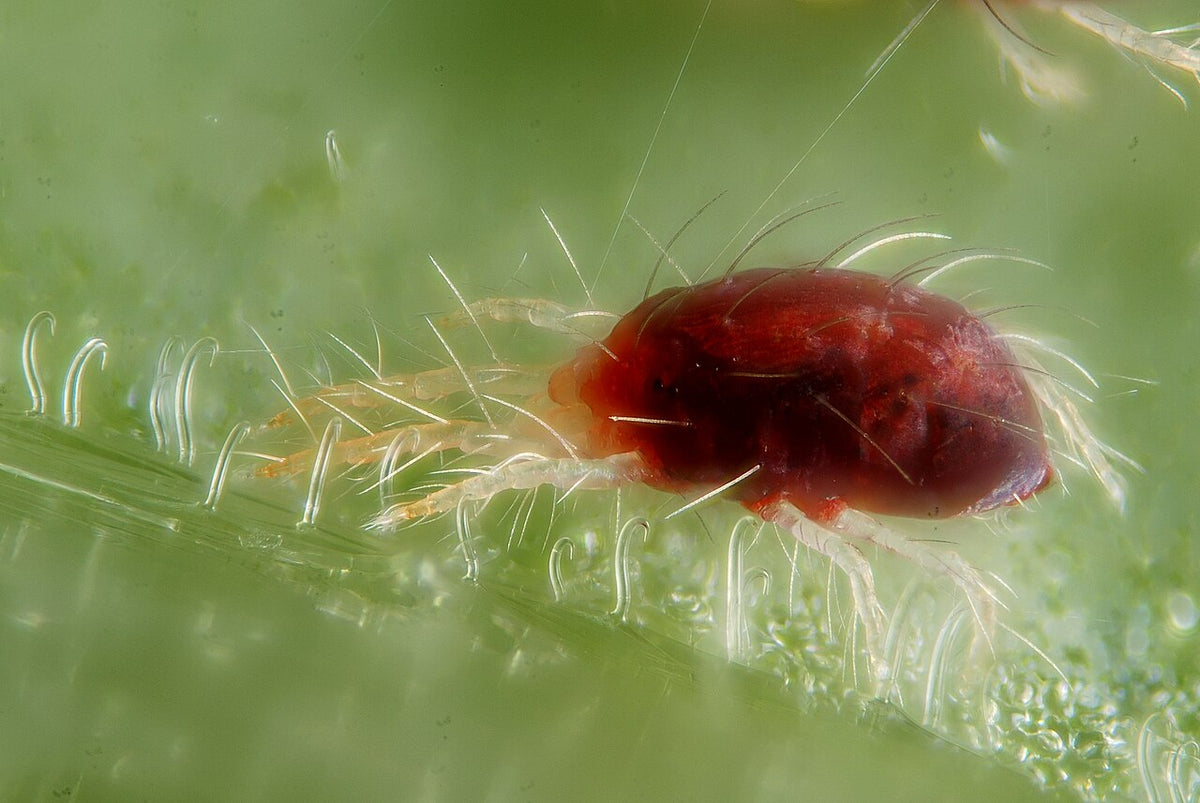
Photo at the top: An adult mite seen under a microscope. In the field it looks like a small red dot. Photo: Gilles San Martin, CC BY-SA 2.0
Quick answer
The red spider mite (Tetranychus urticae, also called the two-spotted spider mite) is a tiny pest that sucks sap from the underside of leaves. Leaves get pale speckles, turn bronze and dry, and fine webbing forms in heavy attacks. To control it, avoid water stress, protect natural enemies, and spray a label-approved miticide (mite killer) under the leaves early.
How to identify red spider mite
The mite
Mites are not insects. They are related to spiders and the adults have eight legs. An adult is about half a millimetre long, so it looks like a moving red or orange dot. Use a hand lens to see it clearly. Some are greenish-yellow with two dark spots on the body, which is where the name "two-spotted" comes from. They live in groups on the underside of leaves. In Hindi it is often called lal makdi, and in Telugu erra nalli.
Eggs and young
The eggs are round and white or cream, laid on the underside of the leaf, often under the webbing. Young mites look like small adults. The first stage has six legs, and the later stages have eight.
Damage signs
- Tiny white or yellow dots (speckles) on the upper side of the leaf, where mites have fed below.
- Leaves turn pale, then bronze, red-brown or rusty, and finally dry and fall.
- Fine silk webbing on the underside of leaves and between leaves and stems.
- In very heavy attacks, mites gather in large balls at the tips of shoots and drift on silk threads in the wind to new plants.
- Damage usually starts in patches, often near field edges, dusty roads or dry spots.

Quick field check: the white paper test
Hold a white sheet of paper or a plate under a leaf and tap the leaf a few times. If mites are present, tiny dots fall on the paper and start to crawl. Dust and soil do not move. Do this on a few plants in each corner of the field.
Look-alikes
- Yellow mite (broad mite) in chilli: too small to see, no webbing. Leaves curl downwards and become narrow and thick.
- Thrips: leave silvery streaks with small black dots of droppings, and leaves curl upwards in chilli.
- Jassids (leafhoppers): leaf edges turn yellow, then red and dry, with small green insects that run sideways. There is no webbing.
- Nutrient deficiency or dust: no moving dots and no webbing under the leaf.
Life cycle and when it attacks
A female lays eggs on the underside of leaves. Eggs hatch in two to four days. The young mite passes through a larva stage and two nymph stages before it becomes an adult. The whole cycle takes one to two weeks, and adults live for three to four weeks. Generations overlap, so all stages are present at once, and numbers can explode within days.
Hot, dry weather favours red spider mites. In heat the life cycle gets shorter, so each new generation comes faster. Dust on leaves and plants under water stress make attacks worse. Rain and high humidity slow them down. In crowded patches the mites gather in silk balls that the wind carries to new plants. NIPHM calls this "ballooning". Mites also travel on clothes, tools and animals that move from an infested field. In Telangana and Andhra Pradesh, attacks are common in the summer months and during long dry spells in kharif. Heavy use of some broad-spectrum insecticides can kill the mites' natural enemies, and mite numbers then rise faster.
Crops it attacks
Cotton: leaves turn reddish-brown and fall early, mostly during dry spells and late in the season. Bolls on stressed plants may not develop well.
Brinjal: a common summer problem. Leaves get speckled, then dry, and plants with heavy webbing grow poorly.
Okra (bhendi): leaves turn pale and bronzed in hot weather, and yield falls in heavy attacks.
Tomato: leaves turn bronze and dry from the bottom up. Webbing can cover the whole plant in hot, dry weather.
Tea: the red spider mite of tea is a close relative, Oligonychus coffeae. It feeds mostly on the upper side of mature leaves, which turn reddish-brown, and the bush loses vigour.
When to spray for red spider mite
We could not confirm a published economic threshold for red spider mite on these crops from a recognised Indian public source, so we do not give a number here. Ask your local agriculture officer for the level used in your area.
In practice, act early. Check the underside of leaves with a hand lens every week in hot, dry weather, mainly at field edges. Mites grow from a few patches to the whole field in a short time, and webbing makes later sprays less effective.
Control of red spider mite without chemicals
These steps follow the NIPHM IPM package for brinjal and work in other crops too.
- Avoid water stress: irrigate on time. Mulch and organic matter help the soil hold water.
- Raise clean seedlings: grow nurseries away from infested crops, and do not plant next to an infested field.
- Remove early patches: pull out and destroy the first infested plants when mites are still on only a few plants.
- Keep the field clean: remove weeds, which can carry mites, and destroy infested crop waste after harvest.
- Protect natural enemies: predatory mites, green lacewings, small black ladybird beetles (Stethorus), rove beetles and predatory thrips all feed on spider mites. Avoid needless insecticide sprays that kill them.
- Neem: a 5% neem seed kernel extract (NSKE) spray can help in light attacks.
- Reduce dust: dusty leaves near roads and paths favour mites.
- Visit infested fields last: mites ride on clothes and tools, so walk through clean fields first.
- Border hedges: the NIPHM package notes that pigeon pea (red gram) hedges are said to encourage predatory mites.
Red spider mite treatment: chemical control, crop by crop
Mites are not insects, so many insecticides do not control them. Use a product whose label lists your crop and mites. Spray so that the mix reaches the underside of the leaves, where the mites live.
Cotton
- Mitigate Insecticide (fenpyroximate 5% EC): dose 300 ml per acre, as printed in the company's product sheet for mites on cotton. The sheet gives no water volume, so follow the pack leaflet.
Brinjal
- Simodis Insecticide (isocycloseram 9.2% DC): label dose 81 ml per acre in 200 L water. First spray when pests reach ETL, one more after 10–15 days if needed, and no more than two sprays in a season.
Tea
- Mitigate: dose 120–240 ml per acre, as printed in the company's product sheet.
- Mit 505 Insecticide (ethion 50% EC): label dose 202 ml per acre in 200–400 L water, as a foliar spray right after plucking.
Okra and tomato
None of the products in our range has a label for red spider mite in okra or tomato. Ask your local agriculture officer or Krishi Vigyan Kendra (KVK) for an approved miticide, and use the steps above.
Never mix two products in one tank.
Rotate to avoid resistance
Red spider mites build resistance faster than most pests, because they have many generations in one season. IRAC, the international body that groups pesticides by how they act, gives each active ingredient a group number. Do not spray the same group twice in a row.
| IRAC group | Products |
|---|---|
| 21A | Mitigate (fenpyroximate) |
| 1B | Mit 505 (ethion) |
| 30 | Simodis (isocycloseram) |
In tea, for example, if you need a second spray after Mitigate, the next one can be Mit 505, which is from a different group. Keep the gap and number of sprays within each label.
Safety and waiting period
| Product | Crop | Waiting period before harvest |
|---|---|---|
| Simodis | Brinjal | 5 days |
| Mitigate | Cotton, tea | Not given in the product sheet: check the pack label |
| Mit 505 | Tea | Not given on the leaflet: check the pack label |
- Wear gloves, a mask, goggles and full-sleeve clothes while mixing and spraying. Spraying the leaf underside brings the spray close to your face, so take care.
- Do not spray flowering crops while bees are working; spray in the evening.
- Keep products away from children, animals, food and water sources.
- Read the label and leaflet before use.
Frequently asked questions
Which insecticide controls red spider mite?
Mites are not insects, so you need a product that acts on mites (a miticide or acaricide) and whose label lists your crop. In our range: Simodis on brinjal, Mitigate on cotton and tea, and Mit 505 on tea.
Why do mites come back after I spray?
Eggs often survive a spray and hatch a few days later. Mites also build resistance fast, and some insecticides kill their natural enemies. Spray the underside of leaves, follow the label for a second spray, and change the IRAC group.
How can I control red spider mite without chemicals?
Irrigate on time, keep weeds down, pull out the first infested plants, and protect predatory mites, lacewings and ladybird beetles. A 5% neem seed kernel extract spray helps in light attacks.
How do I tell red spider mite from yellow mite in chilli?
Red spider mite causes speckles, bronzing and webbing, and you can see moving red dots under a lens. Yellow mite cannot be seen without a microscope, leaves no webbing, and makes chilli leaves curl down and turn narrow.
Is red spider mite an insect?
No. It is a mite, a relative of spiders, with eight legs as an adult. This is why many common insecticides do not control it, and why the product label must name mites.
Does rain help against red spider mites?
Yes, to some extent. Rain and high humidity slow down their growth, and heavy rain washes some mites off. Attacks often fade in a wet spell and return when hot, dry weather comes back, so keep checking.
Related reading
- Thrips insecticide guide: control thrips in chilli, cotton and onion
- Jassids in cotton, okra and brinjal: how to identify and control leafhoppers
- Whitefly: how to identify it and choose a whitefly insecticide
- Aphid insecticide guide: control aphids in cotton, chilli and vegetables
- Cotton crop protection products
- All insecticides and miticides
Sources
- NIPHM, DPPQS and ICAR-NCIPM: AESA based IPM package for brinjal
- IRAC (Insecticide Resistance Action Committee): Mode of action classification
- Product labels, leaflets and company product sheets for Simodis, Mitigate and Mit 505
Products that control it, by crop
Brinjal
- Simodis Insecticide81 ml per acreFirst spray when the pest reaches the action level (ETL). One more spray 10-15 days later if needed. Max 2 sprays per season.
Tea
- Mitigate Insecticide120–240 ml per acre
- Mit 505 Insecticide202 ml per acreFoliar spray right after plucking.
Cotton
- Mitigate Insecticide300 ml per acre
Do not spray the same product again and again. Change to a product with a different mode of action (the group number on the label) so the pest or disease does not build resistance.
As printed on the brand's official label. Read the label before use.


Like these farming tips? Add AgriVruddhi as a preferred source on Google
Back to Crop Health Guide