
Whitefly insecticide guide: control whitefly in cotton, brinjal, okra
· By AgriVruddhi
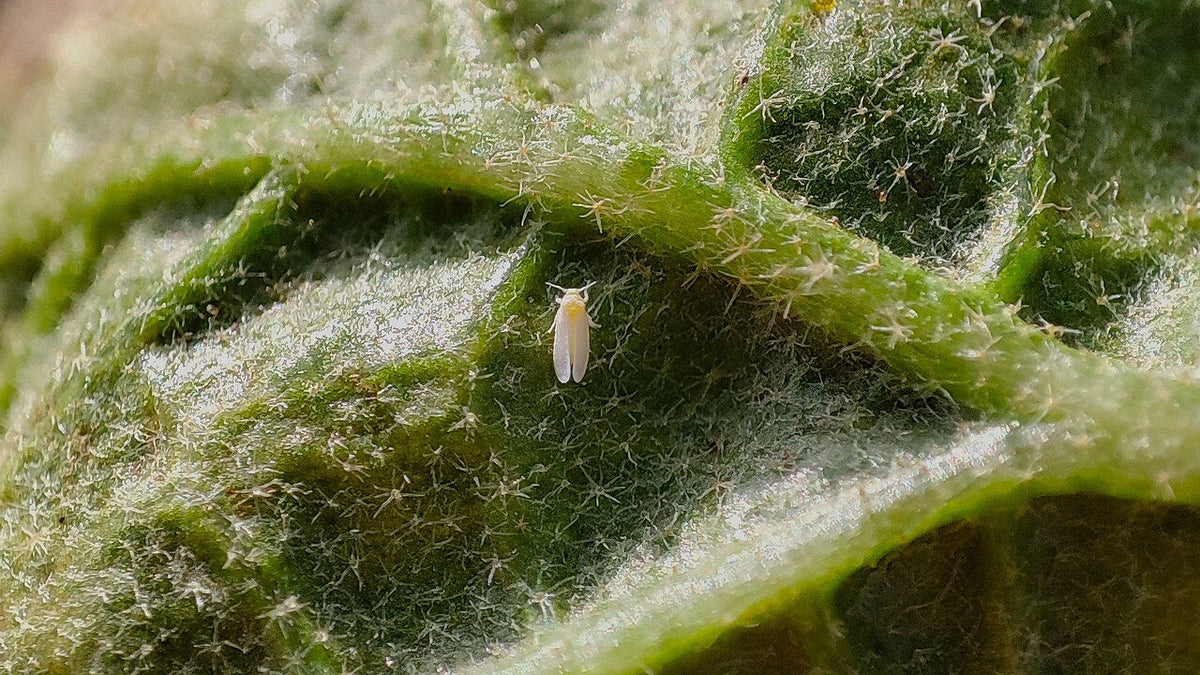
Photo at the top: An adult whitefly on the underside of a brinjal leaf, Photo: Wee Hong, CC BY-SA 4.0
Quick answer
Whitefly (Bemisia tabaci) is a white insect that sucks sap under the leaves of cotton, brinjal, okra, chilli and tomato. Leaves turn yellow, curl and get black sooty mould, and it spreads leaf curl and yellow vein mosaic viruses. Start with yellow sticky traps. At the threshold, spray a whitefly insecticide labelled for your crop, and rotate insecticide groups.
How to identify whitefly
Whitefly is called safed makhi in Hindi and tella doma in Telugu. Some books call this species the silverleaf or sweet potato whitefly. Turn a leaf over. Whitefly lives on the underside, mostly on young leaves near the top of the plant. Shake the plant and the adults fly up like a small white cloud, then settle again.
- Adult: about 1 mm long, with a yellow body and white, waxy wings held like a roof over the back.
- Egg: very small, yellowish white, laid one by one on the underside of the leaf.
- Nymph (young stage): flat, oval and greenish yellow, like a tiny scale stuck to the leaf. After the first few hours it does not move. It sucks sap from that one spot.
- Last stage (often called the pupa): also oval and flat, on the underside of the leaf. The adult comes out of it.

Damage signs
- Yellow spots on the leaves, then yellowing of the whole leaf.
- Leaves curl upward, and in cotton they turn reddish and brittle.
- Sticky honeydew on leaves and bolls. Black sooty mould grows on it, so leaves look dirty black.
- Leaves, flowers and young bolls or fruits drop early. In cotton the lint gets sticky and loses quality.
- Virus spread: leaf curl in cotton, chilli and tomato, and yellow vein mosaic in okra. Plants with virus stay stunted and do not recover.
Look-alikes and how to tell them apart
- Jassids (leafhoppers): green and wedge-shaped. They walk sideways when touched. Leaf edges turn yellow, then red, and curl downward. See how to identify and control jassids in cotton, okra and brinjal.
- Aphids: soft, pear-shaped, green or black, mostly without wings. They sit in groups on tender shoots and do not fly up in a cloud. See our aphid insecticide guide.
- Mealybugs: covered in white cotton-like wax, and they crawl slowly. They do not fly.
- Thrips: very thin and long, yellow or brown. They leave silvery scars, and chilli leaves curl upward like a boat. See our thrips guide for chilli, cotton and onion.
Life cycle and when it attacks
A female lays eggs on the underside of young leaves. The eggs hatch in 3 to 5 days, as TNAU (Tamil Nadu Agricultural University) notes. The young nymph walks a short way, settles and feeds in one place until it becomes an adult. In warm weather one full generation takes only a few weeks, and each female lays many eggs. So numbers can jump within a short time.
Whitefly likes warm, dry weather. Long dry spells between rains help it build up, and heavy rain knocks numbers down for a while. Too much nitrogen and too much water make the plant soft and leafy, which whitefly prefers. It also moves from crop to crop: from cotton to brinjal, okra, tomato and weeds, and back.
In Telangana and Andhra Pradesh it is a pest of cotton during kharif and of vegetables in most seasons. Across India it is a major pest of cotton, vegetables and pulses.
Crops it attacks
Cotton: attacked from the vegetative stage to boll formation. Sap loss, sooty mould and early leaf and boll drop reduce lint quality. Whitefly also spreads cotton leaf curl virus.
Brinjal: attacked from soon after transplanting. Leaves turn yellow and get sooty mould, and plant growth slows.
Okra (bhindi): whitefly spreads yellow vein mosaic virus. Leaf veins turn yellow, then the whole leaf, and pods become pale and tough. Early infection does the most harm.
Chilli and tomato: whitefly spreads leaf curl virus. Leaves curl, plants stay small and fruit set drops. Young plants in the nursery and the first weeks after transplanting are most at risk.
When to spray (economic threshold)
The economic threshold is the pest level at which spraying starts to pay for itself. For whitefly in cotton, TNAU gives it as 5 to 10 whiteflies per leaf. Check leaves from the upper part of the plant, on several plants across the field, once or twice a week. Count the insects on the underside of each leaf.
For vegetables we could not confirm a threshold from a recognised public source, so we do not give one here. Because whitefly spreads viruses, keep a close watch on young vegetable plants and use yellow sticky traps from the start.
Whitefly control without chemicals
- Yellow sticky traps: whiteflies are drawn to yellow. TNAU advises setting the traps about 1 foot above the crop canopy. They catch adults and show you when numbers are rising.
- Remove weed hosts: TNAU names weeds such as Abutilon indicum and Solanum nigrum (black nightshade). Keep the field and bunds clean.
- Plan neighbouring crops: TNAU advises not growing brinjal, okra, tomato, tobacco or sunflower next to cotton, as whitefly moves between them. Rotate cotton with crops whitefly does not like, such as sorghum, ragi or maize.
- Sowing and spacing: sow on time and use the recommended spacing, so plants are not crowded.
- Nitrogen and water: do not overuse urea or over-irrigate. A soft, lush crop draws more whitefly.
- Remove virus plants: in chilli, tomato and okra, pull out plants with leaf curl or yellow vein mosaic early and destroy them away from the field.
- Tolerant varieties: in okra, chilli and tomato, ask your KVK or state agricultural university which local varieties tolerate yellow vein mosaic or leaf curl virus, and grow those.
- Healthy nursery: raise vegetable seedlings under fine insect-proof net where you can, so they are free of whitefly at transplanting.
- Protect natural enemies: small parasitic wasps, lacewings and ladybird beetles feed on whitefly. Avoid sprays that are not needed, so these friends survive.
Chemical control: whitefly insecticide by crop
Only the products below have that crop and whitefly on their official label. Doses are per acre, as printed on the label or converted from the label's per-hectare dose. Use one product at a time. Do not mix products in one tank. Spray the underside of the leaves well, because that is where whitefly lives.
Cotton
| Product | Contains | Label dose per acre | Water per acre | Wait before harvest |
|---|---|---|---|---|
| Ulala Insecticide | Flonicamid 50% WG | 61 g | 200 L | 25 days |
| Hogger Insecticide | Dinotefuran 70% WG | 35 g | 200 L | 17 days |
| Ronfen Insecticide | Pyriproxyfen 8% + Dinotefuran 5% + Diafenthiuron 18% SC | 243 ml | 200 L | Not given in our label record |
| Prudens Insecticide | Pyriproxyfen 10% + Bifenthrin 10% EC | 243 ml | 200 L | 19 days |
| Mit 505 Insecticide | Ethion 50% EC | 607–809 ml | 200–400 L | Not given in our label record |
| Mahaveer Insecticide | Fipronil 5% SC | 607–809 ml | 200 L | 6 days |
| Kite Insecticide | Indoxacarb 14.5% + Acetamiprid 7.7% SC | 162–202 ml | 200 L | 30 days |
| Sapper Insecticide | Dinotefuran 4% + Acephate 50% SG | 223 g | 200 L | 15 days |
| Hamla 550 Insecticide | Chlorpyrifos 50% + Cypermethrin 5% EC | 405 ml | 200–400 L | 15 days |
Notes from the labels:
- Ulala: from the vegetative to the reproductive stage, after the pest appears. Two or three sprays, depending on pest level.
- Hogger: spray when the pest reaches ETL (economic threshold level), in the morning or evening. No more than two sprays.
- Ronfen: spray when the pest is above ETL.
- Prudens: spray as soon as the pest appears, before it reaches ETL, with a knapsack sprayer and hollow cone nozzle. Up to three sprays, 15 days apart.
- Mahaveer: first spray 30–35 days after sowing or when the pest appears. Two or three sprays, rotated with other groups.
- Kite: from the early vegetative to the reproductive stage. Two or three sprays, depending on pest pressure.
- Sapper: spray when the pest reaches ETL, in the morning or evening, with a hollow cone nozzle. No more than two sprays.
- Hamla 550: spray at any crop stage when the pest is seen at a level that causes economic loss.
- Ronfen (three active ingredients) and Prudens, Kite, Sapper and Hamla 550 (two each) are ready-mixed products approved on the label. They are not tank mixes.
- The Government of India's plant protection directorate (PPQS) advises against synthetic pyrethroids such as cypermethrin, and against acephate and acetamiprid, in cotton at the flowering and boll stage, because whitefly can come back in larger numbers after them. Hamla 550 (cypermethrin), Prudens (bifenthrin, a pyrethroid), Sapper (acephate) and Kite (acetamiprid) contain these, so use them before flowering, or choose another product at boll stage.
Brinjal
| Product | Contains | Label dose per acre | Water per acre | Wait before harvest |
|---|---|---|---|---|
| Ulala Insecticide | Flonicamid 50% WG | 81 g | 200 L | 15 days |
| Hogger Insecticide | Dinotefuran 70% WG | 35 g | 200 L | 7 days |
| Ronfen Insecticide | Pyriproxyfen 8% + Dinotefuran 5% + Diafenthiuron 18% SC | 243–334 ml | 200 L | Not given in our label record |
Ulala: from the vegetative to the reproductive stage, after the pest appears, two or three sprays. Hogger: at ETL, no more than two sprays. Ronfen: about 15 days after transplanting, once the pest is above ETL. In brinjal you pick fruit often, so check the waiting period before each picking.
Okra (bhindi)
| Product | Contains | Label dose per acre | Water per acre | Wait before harvest |
|---|---|---|---|---|
| Ulala Insecticide | Flonicamid 50% WG | 81 g | 200 L | 10 days |
Ulala: from the vegetative to the reproductive stage, after the pest appears, two or three sprays.
Chilli and tomato
None of the products in our store has whitefly on chilli or tomato on its label, so we do not suggest one here. Use the non-chemical steps above, and ask your local agriculture officer or Krishi Vigyan Kendra (KVK) for a product labelled for your crop.
Rotate to avoid resistance
Whitefly builds resistance fast. If you use the same whitefly insecticide group again and again, it stops working. Insecticides are grouped by how they work, using the IRAC group number (IRAC is the international Insecticide Resistance Action Committee). Change the group from one spray to the next.
| IRAC group | Active ingredient | Products in this article |
|---|---|---|
| 29 | Flonicamid | Ulala |
| 4A (neonicotinoids) | Dinotefuran, acetamiprid | Hogger; one part of Ronfen, Sapper and Kite |
| 7C | Pyriproxyfen | One part of Ronfen and Prudens |
| 12A | Diafenthiuron | One part of Ronfen |
| 2B | Fipronil | Mahaveer |
| 22A | Indoxacarb | One part of Kite |
| 1B (organophosphates) | Ethion, acephate, chlorpyrifos | Mit 505; one part of Sapper and Hamla 550 |
| 3A (pyrethroids) | Bifenthrin, cypermethrin | One part of Prudens and Hamla 550 |
Group 4A is in four of the products. So after Hogger, do not follow with Ronfen, Sapper or Kite. Choose a product without group 4A, such as Ulala (group 29). Keep to the number of sprays each label allows.
Safety and waiting period
- The waiting period before harvest (PHI, pre-harvest interval) for each product and crop is in the tables above. Count the days from the last spray. For Ronfen and Mit 505 our label record does not give a waiting period, so check the pack label before use.
- Wear gloves, a mask, full-sleeve clothes and boots while mixing and spraying. Do not eat, drink or smoke while you work. Wash well afterwards.
- Spray in the morning or evening, not in strong wind or hot afternoon sun.
- Bees: neonicotinoids (group 4A), fipronil, organophosphates and pyrethroids are toxic to bees. Do not spray on open flowers when bees are working, and tell beekeepers nearby before you spray.
- Fish: keep sprays and washings away from ponds, canals and wells.
- Read the label and leaflet before use.
Frequently asked questions
Which whitefly insecticide should I use in cotton?
Use one whose label lists cotton and whitefly. On our store these are Ulala, Hogger, Ronfen, Prudens, Mit 505, Mahaveer, Kite, Sapper and Hamla 550. The doses are in the cotton table above. Change the IRAC group from one spray to the next, and at boll stage avoid the products with pyrethroids, acephate or acetamiprid.
What is the insecticide for whitefly control in chilli?
None of the products in our store lists whitefly on chilli on its label, so we cannot suggest one. Use yellow sticky traps, remove leaf curl plants early and keep weeds down. Ask your local agriculture officer for a product labelled for chilli.
Why are my cotton leaves turning black?
Whitefly gives out a sticky liquid called honeydew. A black fungus, sooty mould, grows on it. Control the whitefly and the mould stops spreading.
Do yellow sticky traps control whitefly on their own?
They catch many adults and show you when numbers rise, but in a heavy attack they are not enough on their own. Use them with the other steps in this article, and spray at the threshold.
Can I cure leaf curl virus by spraying?
No. No spray cures a plant that already has the virus. Sprays only control the whitefly that spreads it. Pull out infected plants early so they do not act as a source for the rest of the field.
Why does whitefly come back after spraying?
Eggs and the fixed young stages under the leaf often survive a spray, so new adults come out a few days later. A spray that misses the underside of the leaf leaves many insects alive. Using the same group again and again builds resistance. PPQS also warns that pyrethroids, acephate and acetamiprid in cotton at the flowering and boll stage can make whitefly come back in larger numbers.
Related reading
- Jassids in cotton, okra and brinjal: identify and control leafhoppers
- Aphid insecticide guide: control aphids in cotton, chilli and vegetables
- Thrips insecticide guide: control thrips in chilli, cotton and onion
- Red spider mite: how to identify and control it
- Pink bollworm in cotton: symptoms, when to spray and control
- Products for cotton
- Products for chilli
- All insecticides
Sources
- Tamil Nadu Agricultural University, TNAU Agritech Portal: Whitefly of cotton
- Directorate of Plant Protection, Quarantine and Storage (DPPQS), Government of India: Management of whitefly in cotton
- Insecticide Resistance Action Committee (IRAC): Mode of action classification
- Product labels and leaflets of the insecticides listed above.
Products that control it, by crop
Cotton
- Ulala Insecticide61 g per acreFoliar spray from the growing stage to the flowering stage, once the pest appears. Give 2-3 sprays as needed.
- Hogger Insecticide35 g per acreFoliar spray when the pest reaches the action level (ETL). Spray in the morning or evening. Maximum 2 sprays.
- Ronfen Insecticide243 ml per acreSpray when the pest is above the action level (ETL).
- Prudens - Insecticide243 ml per acreSpray as soon as the pest appears, before it reaches the action level (ETL). Up to 3 sprays, 15 days apart. Use a hollow cone nozzle.
- Mit 505 Insecticide607–809 ml per acreFoliar spray.
- Hamla 550 Insecticide405 ml per acreSpray at any crop stage when the pest starts to cause crop loss. Keep people out of the field for 48 hours after spraying.
Okra (bhindi)
- Ulala Insecticide81 g per acreFoliar spray from the growing stage to the flowering stage, once the pest appears. Give 2-3 sprays as needed.
Brinjal
- Ulala Insecticide81 g per acreFoliar spray from the growing stage to the flowering stage, once the pest appears. Give 2-3 sprays as needed.
- Hogger Insecticide35 g per acreFoliar spray when the pest reaches the action level (ETL). Spray in the morning or evening. Maximum 2 sprays.
- Ronfen Insecticide243–334 ml per acreSpray about 15 days after transplanting, once the pest is above the action level (ETL).
Do not spray the same product again and again. Change to a product with a different mode of action (the group number on the label) so the pest or disease does not build resistance.
As printed on the brand's official label. Read the label before use.


Like these farming tips? Add AgriVruddhi as a preferred source on Google
Back to Crop Health Guide