
Pink bollworm in cotton: symptoms, when to spray and control
· By AgriVruddhi
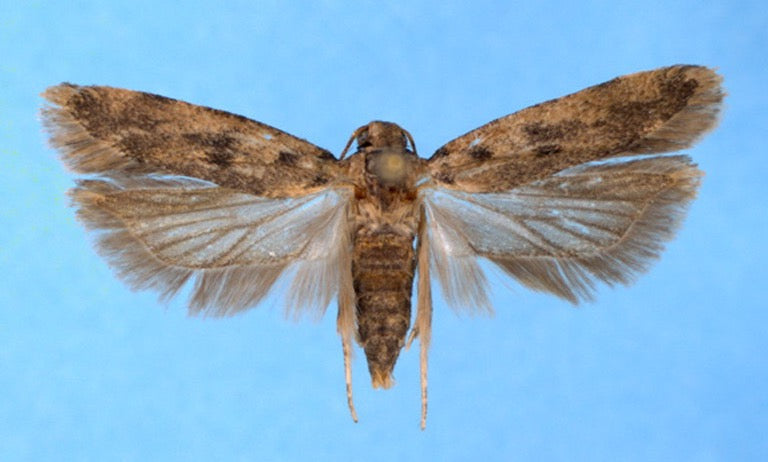
Photo at the top: Adult pink bollworm moth with wings spread. It is a small moth that flies at night, Photo: Mississippi State University Archive, Mississippi State University, Bugwood.org, CC BY 3.0 US (cropped)
Quick answer
Pink bollworm (Pectinophora gossypiella) is a small moth whose caterpillar feeds inside cotton flowers and green bolls. It causes rosette flowers, boll drop, eaten seed and stained lint. Bt cotton no longer controls it well. Use pheromone traps and weekly boll checks, remove rosette flowers, end the crop on time, and spray a label-approved insecticide only above the threshold.
How to identify pink bollworm in cotton
Farmers call it gulabi sundi in Hindi and gulabi rangu purugu in Telugu, after the pink colour of the grown caterpillar. The caterpillar lives hidden inside flowers and bolls, so you will see the damage before you see the pest.
Pink bollworm symptoms
- Rosette flowers: the first sign. The young caterpillar spins silk inside the flower bud, so the petals stay twisted together and the flower does not open properly. Open one and you will often find a tiny caterpillar inside.
- Green bolls: bolls 10–20 days old are entered from under the bracts (the green leafy parts round the boll). The entry hole is tiny and closes up, so the outside can look healthy. Cut the boll open to see the damage inside: eaten seeds, stained lint and caterpillars moving between the locks (the separate sections of cotton in the boll).
- Exit holes: small round holes on the boll wall where grown caterpillars leave. They are smaller than the holes made by American bollworm or spotted bollworm.
- Droppings at the hole: TNAU Agritech notes that you can often see the caterpillar's droppings (excreta) at the bore hole.
- Bud and boll drop: attacked flower buds and young bolls often fall off the plant.
- Open bolls: bolls may open early and badly, the lint is stained and weak, and the seeds are hollow or joined together ("double seeds").
Pink bollworm stages: egg, caterpillar, pupa and moth
The stages, as described in the cotton IPM package from NCIPM and NIPHM:
- Eggs: pearly white, flat and oval, about half a millimetre long. They are laid singly or in small groups on buds, flowers, leaf undersides and young bolls.
- Caterpillar: white in its first two stages, then pink from the third stage. It has a dark brown head. A grown caterpillar is about 1 cm long.
- Pupa: light brown, turning dark brown, up to 7 mm long, inside a loose silk cocoon.
- Moth: small, greyish brown, with dark marks on the front wings and silvery grey hind wings with long fringes. It flies at night and hides in soil cracks and crop waste by day.
Look-alikes and how to tell them apart
- American bollworm (Helicoverpa armigera): a much bigger caterpillar, green to brown with stripes. It bores a large round hole and feeds with half its body outside the boll. See our American bollworm (Helicoverpa) control guide.
- Spotted bollworm (Earias): a brown caterpillar with spots and small bumps. It bores into shoot tips, which then droop and dry, as well as into bolls.
- Boll rot: bolls turn black or brown from outside because of fungus or bacteria. There is no caterpillar or exit hole, though rot often follows bollworm damage.
Pink bollworm life cycle and when it attacks
According to the cotton IPM package, eggs hatch in 3–6 days. The caterpillar feeds for 9–14 days in hot regions, then pupates for 8–13 days. One full cycle takes 3–6 weeks, so several generations overlap in one season and numbers rise as the crop gets older.
Late in the season some caterpillars stop growing and rest in the seed or in crop waste for months. This resting stage carries the pest to the next season through left-over bolls, cotton stalks, seed stores and ginning mills. In north and central India this rest is common. In south India most caterpillars keep breeding, which is why a long-standing crop gives the pest more time to multiply.
In Telangana and Andhra Pradesh the pest appears with the first flowers, often about 60 days after sowing, and builds up through boll formation from September to December. Long-duration hybrids, cotton kept in the field after December, and fields that suffered heavy damage last year face the highest risk. ICAR-CICR (Central Institute for Cotton Research) has warned that pink bollworm has become resistant to Bt cotton toxins, so Bt cotton alone does not protect the crop.
Crops it attacks
Cotton: pink bollworm is a cotton pest. It attacks flower buds (squares), flowers and green bolls, from first flowering to the last picking. Damage is highest in the later part of the season, when many generations overlap and bolls are plentiful. It cuts both yield and the price you get for the lint, because stained, weak cotton sells for less.
When to spray for pink bollworm (economic threshold)
The economic threshold (ETL) is the pest level at which spraying starts to pay for itself. ICAR-CICR's pink bollworm management strategy (2019) and the cotton IPM package give three checks. Act when any one is crossed:
- Traps: 8 moths per pheromone trap per night, for 3 nights in a row. Set traps at 5 per hectare (about 2 per acre) from 45 days after sowing.
- Flowers: 10% of flowers are rosette flowers, at the squaring and flowering stage.
- Green bolls: pick 20 green bolls from 20 different plants at random and cut them open. If 2 or more (10%) have white or pink caterpillars or exit holes, the threshold is crossed. CICR advises doing this once a week from mid-September to December.
Pink bollworm control without chemicals
- Short-duration hybrids: ICAR-CICR advises early-maturing, short-duration Bt hybrids or varieties, sown together across the village. They finish before the pest builds up.
- Refuge: sow the non-Bt refuge seed that comes in the packet, as instructed. It slows down resistance to Bt.
- Pheromone traps: traps with a pink bollworm lure attract male moths. Use them to watch moth numbers from 45 days after sowing. Change the lures at the interval printed on the pack.
- Remove rosette flowers: pick and destroy rosette flowers by hand. Each one holds a caterpillar.
- Neem: CICR suggests a spray of 5% neem seed kernel extract with neem oil and a little soap at 50–60 days after sowing.
- Natural enemies: CICR advises releasing the egg parasite Trichogramma bactrae at 60,000 per acre, three times at weekly intervals, between 90 and 120 days after sowing. Do not spray insecticides for at least 10 days after a release.
- End the crop on time: CICR advises ending the cotton crop by December or mid-January in central and south India. Do not keep a ratoon crop. After the last picking, let animals graze the field, then shred the stalks or remove them and destroy the left-over bolls. Do not stack stalks near the field.
- Store and sell carefully: pick clean and damaged cotton separately. Do not store damaged or stained cotton at home or in godowns, as moths come out of it.
- Rotate crops: growing a non-cotton crop breaks the pest's life cycle.
Chemical control in cotton
Only the products below have cotton and pink bollworm on their official label. Doses are per acre, worked out from the label's per-hectare dose. Spray one product at a time. Do not mix products in one tank.
Cotton
| Product | Contains | Label dose per acre | Water per acre | Wait before harvest |
|---|---|---|---|---|
| Bakeel Insecticide | Fipronil 15% + Imidacloprid 5% SC | 243 ml | 200 L | 6 days |
| Guru Insecticide | Fipronil 10% + Diafenthiuron 30% WG | 304 g | 200 L | 21 days |
| Hamla 550 Insecticide | Chlorpyrifos 50% + Cypermethrin 5% EC | 405 ml | 200–400 L | 15 days |
Notes from the labels:
- All three hold two active ingredients in one pack. These are ready-mixed products approved on the label. They are not tank mixes.
- Bakeel: first spray when the pest first appears. Repeat 1–2 sprays at 15-day intervals.
- Guru: first spray when the pest first appears, then one or two more at 15-day intervals depending on pest pressure. No more than 3 sprays. Use a knapsack sprayer with a hollow cone nozzle, in the morning or evening.
- Hamla 550: spray at any crop stage when the pest is seen to cause economic loss.
- Hamla 550 contains chlorpyrifos. Chlorpyrifos is a restricted insecticide in India. It is not banned for cotton, but its use is limited to the crops and doses on the label. Follow the Hamla 550 label strictly: use it only on the crops, pests and doses it lists, and keep to the waiting period.
- Hamla 550 also contains cypermethrin, a pyrethroid. ICAR-CICR advises against pyrethroid sprays on cotton before November, because they can trigger whitefly and aphid outbreaks.
How to spray: pink bollworm caterpillars live inside flowers and bolls, so a spray works mainly on eggs, newly hatched caterpillars and moths. Spray as soon as the threshold is crossed, and cover the fruiting parts of the plant well. CICR advises picking the fully open bolls first, then spraying to protect the green bolls.
Rotate to avoid resistance
Pink bollworm has already shown that it can beat Bt cotton, and it can also stop responding to insecticides used again and again. Insecticides are grouped by how they work, using the IRAC code (IRAC is the international Insecticide Resistance Action Committee). Change the group from one spray to the next.
| IRAC group | Active ingredient | Products in this article |
|---|---|---|
| 2B | Fipronil | One part of Bakeel and Guru |
| 4A (neonicotinoids) | Imidacloprid | One part of Bakeel |
| 12A | Diafenthiuron | One part of Guru |
| 1B (organophosphates) | Chlorpyrifos | One part of Hamla 550 |
| 3A (pyrethroids) | Cypermethrin | One part of Hamla 550 |
Bakeel and Guru both contain fipronil (group 2B), so do not follow one with the other. If your first spray was Bakeel or Guru, make the next one Hamla 550, keeping in mind the CICR advice on pyrethroids before November. Keep to the number of sprays each label allows.
Safety and waiting period
- The waiting period before harvest (PHI, pre-harvest interval) for each product is in the table above. For cotton, count the days from the last spray to the next picking.
- Wear gloves, a mask, full-sleeve clothes and boots while mixing and spraying. Do not eat, drink or smoke while spraying. Wash well afterwards.
- Stay out of the sprayed field for at least 24 hours after Bakeel, and 48 hours after Guru or Hamla 550, as their labels advise.
- Bees and fish: Guru's label warns that it is very toxic to honey bees, fish and water life. Do not spray it while bees are visiting the flowers, and keep it away from ponds.
- Read the label and leaflet before use.
Frequently asked questions
What are the symptoms of pink bollworm in cotton?
Rosette flowers that do not open, small exit holes on green bolls, eaten seeds and stained lint inside the bolls, and bolls that open badly. Cut a green boll open to check.
Does Bt cotton control pink bollworm?
Not reliably any more. ICAR-CICR reports that pink bollworm has become resistant to Bt cotton in India. Bt cotton still needs traps, field checks and timely action.
How do I check bolls for pink bollworm?
Pick 20 green bolls from 20 different plants across the field and cut them open. If 2 or more have caterpillars or exit holes, it is time to act.
Which insecticide is used for pink bollworm control?
Use one whose label lists cotton and pink bollworm. In our store these are Bakeel, Guru and Hamla 550. The doses are in the table above. Spray only after the threshold is crossed.
How many pheromone traps are needed for pink bollworm per acre?
ICAR-CICR advises 5 traps per hectare, about 2 per acre, to watch moth numbers. Install them 45 days after sowing.
Related reading
- American bollworm (Helicoverpa armigera) control in cotton
- Whitefly in cotton: how to identify it and choose an insecticide
- Jassids in cotton: how to identify and control leafhoppers
- Thrips control in chilli, cotton and onion
- Aphid control in cotton, chilli and vegetables
- All cotton crop protection products
- All insecticides
Sources
- ICAR-Central Institute for Cotton Research (CICR), Nagpur: Pink bollworm management strategies (2019)
- Cotton IPM package, ICAR-National Centre for Integrated Pest Management (NCIPM) and National Institute of Plant Health Management (NIPHM)
- TNAU Agritech Portal, Tamil Nadu Agricultural University: Cotton pests: pink bollworm
- Insecticide Resistance Action Committee (IRAC): Mode of action classification
- Official labels and leaflets of the insecticides named above
Products that control it, by crop
Cotton
- Bakeel Insecticide243 ml per acreFirst spray when the pests first appear; then 1-2 more sprays at 15-day gaps
- Hamla 550 Insecticide405 ml per acreSpray at any crop stage when the pest starts to cause crop loss. Keep people out of the field for 48 hours after spraying.
Do not spray the same product again and again. Change to a product with a different mode of action (the group number on the label) so the pest or disease does not build resistance.
As printed on the brand's official label. Read the label before use.


Like these farming tips? Add AgriVruddhi as a preferred source on Google
Back to Crop Health Guide