
Root borer (sugarcane): dead heart signs, ratoon risk and control
· By AgriVruddhi
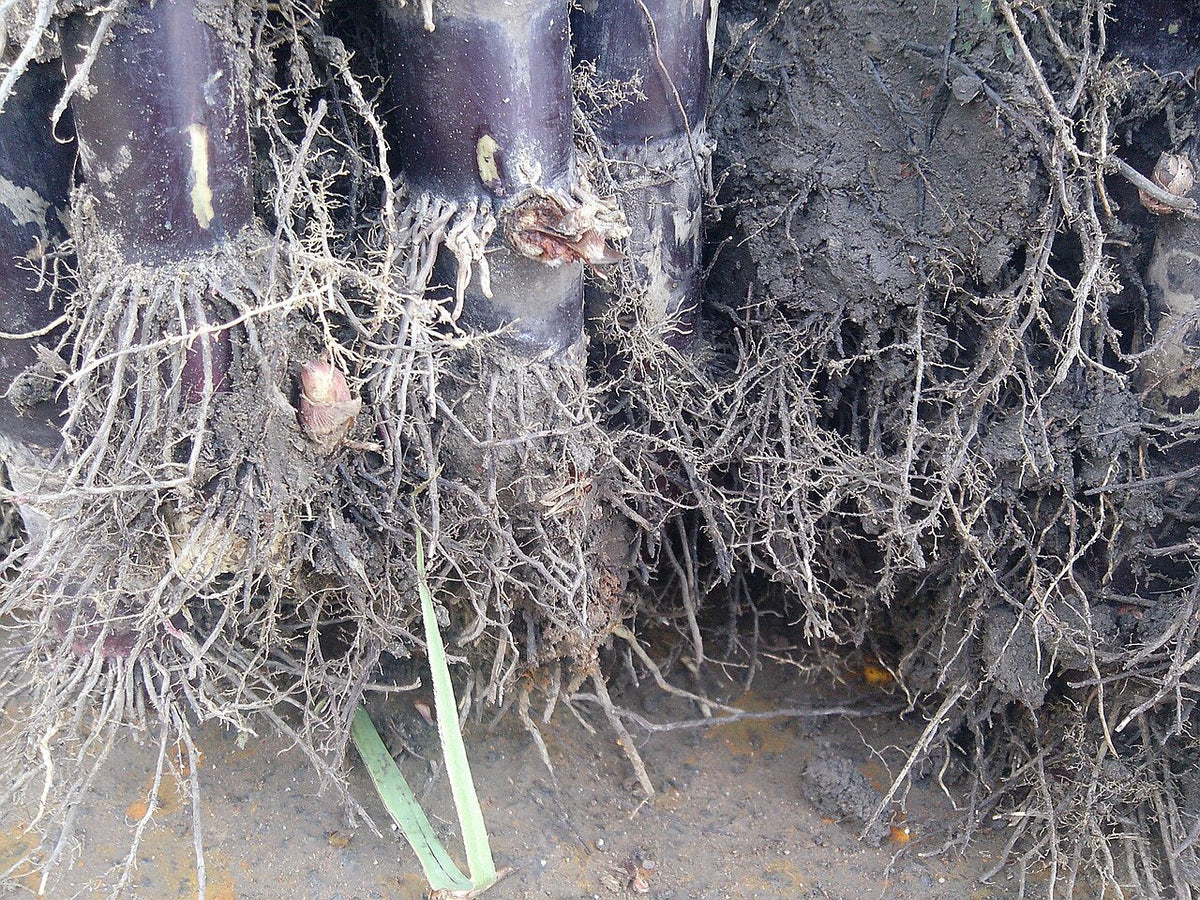
Photo at the top: The base of sugarcane stalks and their roots. Root borer feeds in this underground part of the shoot, so you must dig to find it, Photo: Thamizhpparithi Maari, CC BY-SA 4.0
Quick answer
Root borer (sugarcane) is a moth caterpillar (Emmalocera depressella) that bores into the underground part of young shoots. The central leaf dries into a dead heart that does not pull out easily and does not smell bad. Grown cane turns yellow. Irrigate on time, destroy affected shoots and stubble, avoid ratooning badly hit fields, and use a label-approved insecticide.
How to identify root borer in sugarcane
Farmers call it jad chhedak (जड़ छेदक) in Hindi and veru toliche purugu (వేరు తొలిచే పురుగు) in Telugu. The sugarcane root borer is the only cane borer that lives in the part of the plant below the soil. That is why it is easy to miss. The moth does no harm. Only the caterpillar feeds, and it stays hidden in the base of the shoot.
Root borer damage signs in young cane
These signs are from the Cane Advisory Services of the Sugarcane Research Institute, Dr. Rajendra Prasad Central Agricultural University, Pusa.
- Dead heart: the rolled central leaf of a young shoot dries up. One or two leaves next to it often dry too.
- Pull test: the dead heart does not come out easily when you pull it, and it has no bad smell.
- One fine hole below the soil: dig out the shoot and look at its underground base. You will see a single small hole where the caterpillar went in.
- Yellow leaves in older cane: in a grown-up crop the main sign is yellowing of the leaves, not dead hearts.
- Loss of cane and sugar: attacked fields give less cane, and the juice has less sugar.
To check, dig up a few shoots with dead hearts or yellow leaves. Split the underground part with a knife. A pale caterpillar inside the tunnel, below soil level, points to root borer.
Look-alikes and how to tell them apart
- Early shoot borer: also makes dead hearts in young cane, but its dead heart pulls out easily and the rotten base smells bad. Its entry hole is just above the soil, not below it. See our guide to early shoot borer and dead hearts in sugarcane.
- Termites (white ants): they eat the planted setts and the base of the shoots, often with soil packed into the damage. You find white ants, not one caterpillar. See our termite control guide for sugarcane and other field crops.
- White grub (root grub): a fat, white, C-shaped grub that eats the roots in the soil. Whole clumps turn yellow and wilt, and the canes come off easily. You find the grubs in the soil around the roots, not inside the shoot. See our white grub guide for sugarcane and groundnut.
Root borer (sugarcane): life cycle and when it attacks
The adult is a small moth that flies at night and comes to light. The young caterpillars enter the shoot below the soil and feed inside it, which kills the growing point and makes the dead heart. The caterpillar grows and turns into a pupa (the resting stage) in the underground part. Larvae and pupae also stay in the stubble left in the field after harvest. That stubble carries the pest into the next crop.
The Pusa Cane Advisory Services notes these points about when and where the pest does most harm:
- It is active at high temperatures with moderate humidity.
- It attacks the underground part of the shoot in the early stages of the crop. In north India this is in May and June.
- Ratoon cane (the crop that regrows from the stubble after harvest) is attacked more than the plant crop.
- Fields without irrigation, and sandy or sandy loam soils, have more of it.
The same source says the pest is found in the north Indian sugarcane belt and in parts of Gujarat, Maharashtra, Karnataka and Andhra Pradesh. In Telangana and Andhra Pradesh, cane planted in late winter and spring is young during the hot, dry months. Check young shoots closely in that period, and check ratoons from the start.
Crops it attacks
Sugarcane: this pest is a sugarcane borer. The danger time is the early months of the crop, when the young shoots come up. Each dead heart is one shoot lost. In older cane the attack shows as yellow leaves and weaker canes, with less sugar in the juice. Ratoon crops are at higher risk than the plant crop.
Root borer also matters for disease. Tamil Nadu Agricultural University (TNAU) lists managing root borer as one of the steps to manage wilt in sugarcane. If your field had wilt before, take root borer more seriously.

When to spray (economic threshold)
The economic threshold is the level of damage at which the cost of control is worth it. We could not confirm a published threshold for root borer (sugarcane) from ICAR or a state agricultural university, so we do not give a number here. Count the dead hearts in a few rows, dig a few shoots to confirm the pest, and then ask your local agriculture officer or KVK (Krishi Vigyan Kendra) whether the level in your field needs treatment.
Control without chemicals
Most of the pest lives in the soil and in stubble, so field work matters more than for borers that live above the ground. The steps below come from the Pusa Cane Advisory Services and from the IPM package for sugarcane of NIPHM (National Institute of Plant Health Management), which groups root borer with early shoot borer.
Before planting
- Deep summer ploughing: it brings larvae and pupae to the surface, where heat and birds kill them.
- Clear old stubble: if the last crop was badly attacked, plough up the field, collect the old stubble with larvae in it, and destroy it.
- Choose the variety with care: a study at the CCS Haryana Agricultural University station at Karnal found large differences between sugarcane varieties in root borer attack. Ask your sugar mill cane officer or KVK which varieties suit your area.
In the growing crop
- Irrigate on time: dry, unirrigated fields have more of this pest. Do not let young cane suffer long dry spells.
- Remove dead hearts: dig out shoots with dead hearts together with the caterpillar, and destroy them. Pulling only the top leaves the caterpillar in the soil.
- Weeding and light earthing up: NIPHM lists hand weeding, inter-cultivation and light earthing up (pulling soil to the base of the plants) about three months after planting.
- Intercrops: NIPHM lists onion, garlic or coriander as intercrops for this pest group.
- Light trap: set up one light trap per acre to catch the moths. NIPHM advises a trap with an exit for natural enemies, so useful insects can escape.
- Natural enemies: for this pest group, NIPHM lists releases of the tachinid fly Sturmiopsis inferens (125 egg-laying females per acre) and the egg parasite Trichogramma chilonis (20,000 per acre at 10-day intervals when the pest appears). Ask your KVK where to get them.
At harvest and for ratoons
- Harvest close to the ground: if you plan to keep a ratoon, cut the canes low. This exposes the larvae and pupae in the stubble.
- Do not ratoon a badly attacked field: the pest carries over in the stubble and ratoons suffer more. Plough the field up instead.
Root borer control in sugarcane with insecticide
On our store, one product has sugarcane root borer on its official label. Use it only on the crop and pest the label lists, at the label dose.
Sugarcane
| Product | Active ingredient | Label dose per acre | Water per acre | Waiting period before harvest |
|---|---|---|---|---|
| Mahaveer Insecticide | Fipronil 5% SC | 607–809 ml | 200 L | Label prints 9 months |
- The label gives the dose per hectare: 1,500–2,000 ml in 500 L water. The per-acre figures above are that dose divided by 2.471 (one hectare is 2.471 acres).
- Our label record does not say how to apply it (spray or drench) or at what crop age. Follow the leaflet in the pack for the method and timing.
- Use it alone. Do not mix it with other products in the same tank.
Browse more products in our insecticides collection. Check the label of any product for "sugarcane" and "root borer" before you buy.
Rotate to avoid resistance
Insects can stop dying from a chemical when the same type is used again and again. Insecticides are grouped by mode of action, which means how they kill the insect. The groups below follow the IRAC (Insecticide Resistance Action Committee) classification.
| IRAC group | Active ingredient | Product in this article |
|---|---|---|
| 2B | Fipronil | Mahaveer |
Only one group is labelled for root borer on our store, so you cannot rotate inside this article. Do not use group 2B season after season in the same field. Keep the non-chemical steps going every year, and ask your agriculture officer for a product from a different group that is labelled for sugarcane root borer.
Safety and waiting period
- The Mahaveer label prints a waiting period of 9 months for sugarcane. Apply only at the crop stage the leaflet gives, never late in the crop.
- Wear gloves, a mask, full-sleeve clothes and boots while mixing and applying. Do not eat, drink or smoke while you work. Wash well afterwards.
- Fipronil is toxic to bees and to fish. Keep the product and its washings away from ponds, canals and wells, and do not apply when bees are active on flowering weeds nearby.
- Read the label and leaflet before use.
Frequently asked questions
How do I know if it is root borer or early shoot borer in sugarcane?
Pull the dead heart. If it comes out easily and smells bad, and the hole is just above the soil, it is early shoot borer. If it does not pull out, has no bad smell, and you find a single small hole below the soil when you dig, it is root borer.
Why does root borer attack ratoon cane more?
The larvae and pupae stay in the stubble after harvest. When the stubble sprouts again as a ratoon, the pest is already there. That is why low cutting at harvest and not ratooning badly attacked fields help.
Which insecticide is used for root borer in sugarcane?
On our store, Mahaveer Insecticide (fipronil 5% SC) has sugarcane root borer on its label. The label dose is 607–809 ml per acre in 200 L water, with a 9-month waiting period printed on the label. Follow the leaflet for how and when to apply it.
Is root borer linked to wilt in sugarcane?
Yes, the two are linked. TNAU lists managing root borer as one of the steps to manage sugarcane wilt, together with healthy seed, crop rotation and avoiding long drought or waterlogging.
Can I save a field already attacked by root borer?
Dig out and destroy shoots with dead hearts along with the caterpillars, and irrigate if the soil is dry. Ask your agriculture officer whether treatment is worth it at your crop's age. After harvest, do not keep a ratoon from a badly attacked field.
Related reading
- Early shoot borer of sugarcane: dead heart signs and control
- Termite control in field crops: how to identify and stop termites
- White grub in sugarcane and groundnut: how to identify and control it
- All insecticides
Sources
- Cane Advisory Services, Sugarcane Research Institute, Dr. Rajendra Prasad Central Agricultural University, Pusa: Root borer
- National Institute of Plant Health Management (NIPHM): AESA based IPM package for sugarcane
- Tamil Nadu Agricultural University, TNAU Agritech Portal: Expert system for sugarcane: crop protection
- Maan Singh, Y.P. Madan and B.S. Chhillar, CCS HAU Regional Research Station, Karnal, Agricultural Science Digest: Incidence of root borer in sugarcane genotypes
- Insecticide Resistance Action Committee (IRAC): Mode of action classification
- Product label and leaflet of Mahaveer Insecticide.
Like these farming tips? Add AgriVruddhi as a preferred source on Google
Back to Crop Health Guide