
Early shoot borer of sugarcane: dead heart signs and control
· By AgriVruddhi
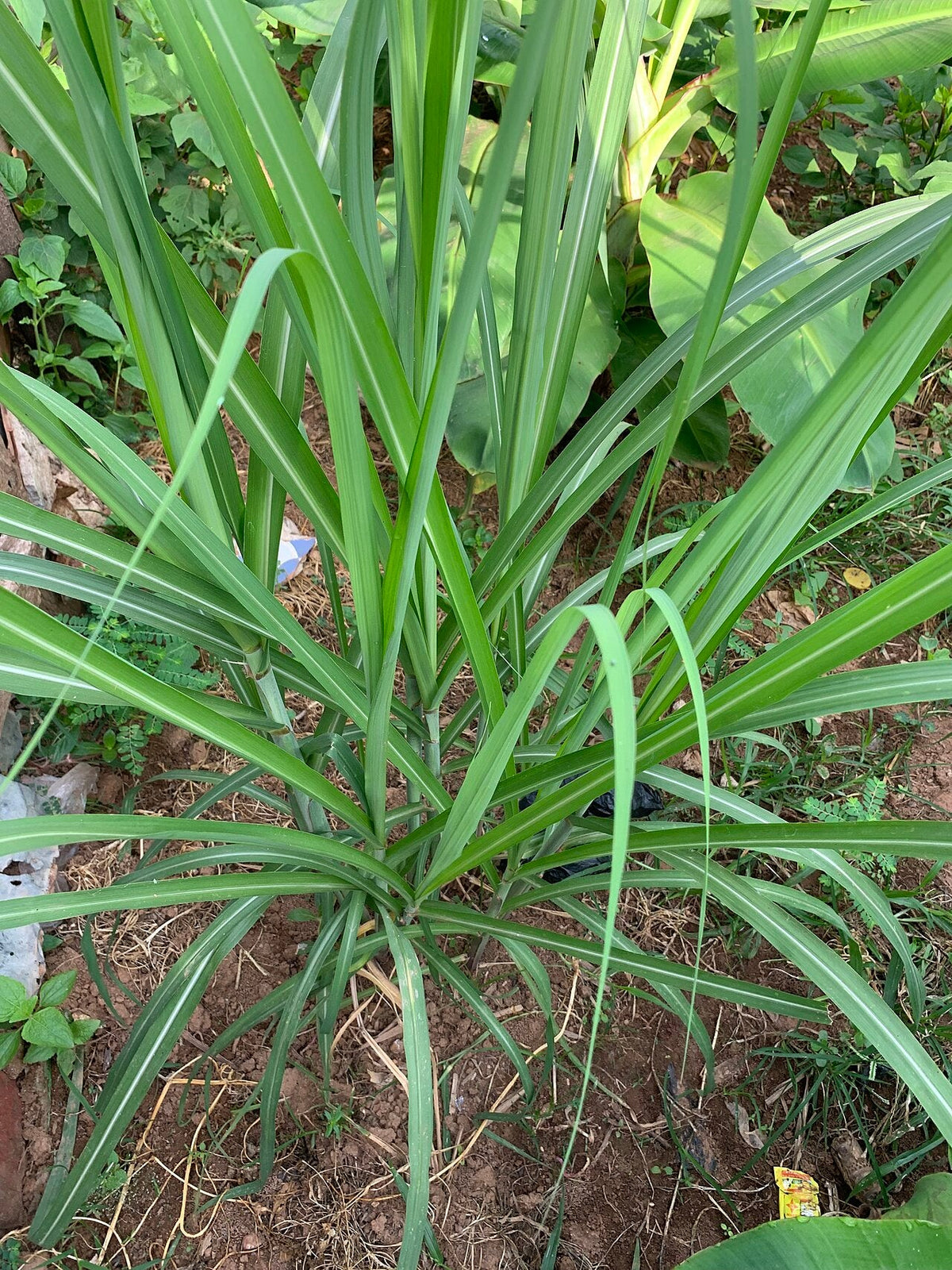
Photo at the top: A young sugarcane clump with several shoots, the age (first three months) when early shoot borer attacks, Photo: Deishini Mariam, CC BY-SA 4.0
Quick answer
The early shoot borer of sugarcane (Chilo infuscatellus) is a caterpillar that bores into young shoots in the first three months after planting. The central leaf dries into a "dead heart" that pulls out easily and smells bad. Mulch with trash, keep the soil moist, pull out dead hearts, and use a label-approved drench or granule at planting.
How to identify early shoot borer in sugarcane
Farmers call it ageti tana chhedak (अगेती तना छेदक) in Hindi and peeka purugu (పీక పురుగు) in Telugu. It is a moth. Only the caterpillar does the damage. Walk through the field from the time the shoots come up, and look closely at the young shoots near the soil.
Dead heart in sugarcane: the damage signs
- Dead heart: the rolled central leaf of a young shoot turns yellow, then dry and straw coloured. The outer leaves stay green for a while.
- Pull test: the dead heart comes out with a gentle pull. The rotten part at its base has a bad smell.
- Bore holes: small holes in the shoot just above the soil, where the caterpillar went in.
- Side shoots: when the main shoot dies, the clump sends up new side shoots. These can be attacked too.
- Gaps: in a heavy attack many shoots die, so the field has fewer canes at harvest.
The insect at each stage
These details are from TNAU (Tamil Nadu Agricultural University).
- Egg: flat and scale-like, laid in groups of 4 to 100 on the underside of the leaves. The eggs sit in 3 to 5 rows that overlap like roof tiles. They hatch in 4 to 6 days.
- Caterpillar (larva): dirty white, with five dark violet stripes along the body and a dark brown head. This stage lasts 16 to 30 days.
- Pupa (resting stage): formed inside the tunnel in the shoot. Before this, the caterpillar cuts a large exit hole and closes it with silk.
- Adult moth: pale greyish brown, with small black dots near the front edge of the forewings, and white hind wings.
Look-alikes and how to tell them apart
- Top shoot borer: attacks older, grown-up cane, not just young shoots. Its dead heart is reddish brown and does not pull out easily. Look for rows of small shot holes in the new leaves, red tunnels in the leaf midrib, and a bunchy top from side shoots.
- Internode borer: attacks cane after about three months. The joints (internodes) become short and narrow, with bore holes and fresh droppings near the nodes, and the inside turns red.
- Termites (white ants): they eat the planted setts and the base of the shoots from below, often with soil packed into the damage. You find white ants, not a striped caterpillar. See our guide to termite control in sugarcane and other field crops.
- Root borer: also kills young cane, but it enters the base of the plant below the soil. Dig up a damaged clump to check. See our sugarcane root borer guide.
Early shoot borer of sugarcane: life cycle and when it attacks
The moth lays her egg masses under the leaves of young cane. After hatching, the small caterpillars first feed between the leaf sheath and the stem. Then they bore into the shoot near the soil and eat the growing point. That is what kills the central leaf. The caterpillar turns into a pupa inside the tunnel, and the new moth comes out through the exit hole. One generation is short, so there can be several in one season.
The pest attacks crops that are 1 to 3 months old. Hot, dry weather favours it. TNAU notes that enough soil moisture lowers the soil temperature and raises the humidity, and the pest does not like those conditions.
In Telangana and Andhra Pradesh, cane planted from late winter to spring passes its first three months in the hot, dry summer. That is when early shoot borer damage is usually heaviest. Damage usually falls once the monsoon rains start.
Crops it attacks
Sugarcane: this is the main crop the early shoot borer of sugarcane attacks. The danger time is the first three months, from the first shoots to the start of cane formation. The young shoots of a ratoon (the crop that regrows after harvest) are also at risk. Each dead heart is one shoot lost, so heavy early damage leaves a thin, patchy crop.
Dead hearts are also the main sign of a different pest in rice. If you grow paddy too, see our guide to stem borer in paddy: dead heart and white ear.
When to act: economic threshold for early shoot borer
The economic threshold is the pest level at which control starts to pay for itself. For early shoot borer, TNAU gives it as 15% dead hearts. To check, pick several spots across the field. At each spot, count all the shoots in a few metres of row and count the dead hearts among them. Divide dead hearts by total shoots and multiply by 100. For example, 30 dead hearts out of 200 shoots is 15%.
Most of the products below go on at planting, before any dead hearts show. So the choice to use one is made at planting, based on how bad the pest was in your field or area in past seasons. Use the TNAU threshold of 15% dead hearts during the first three months to see if your other steps are holding the pest. If you cross it, talk to your agriculture officer before you treat again.
Early shoot borer control without chemicals
- Planting time: TNAU advises early planting in December and January, which escapes much of the attack in Tamil Nadu. Ask your KVK (Krishi Vigyan Kendra) or sugar factory for the right planting window in your area.
- Trash mulch: TNAU advises spreading dry cane trash along the ridges, 10 to 15 cm thick, 3 days after planting.
- Intercrops: green gram, black gram or daincha between the cane rows help check the pest. TNAU found the lowest attack in cane intercropped with daincha.
- Irrigation: keep the soil moist in the hot months, so it stays cool and humid near the base of the shoots.
- Pull out dead hearts: pull them out as soon as you see them and destroy them away from the field, so the caterpillars inside die.
- Resistant varieties: TNAU names CO 312, CO 421, CO 661, CO 917 and CO 853 as resistant varieties. Ask your sugar factory or KVK which varieties suit your area.
- Natural enemies: TNAU advises a granulosis virus spray (a virus that kills the caterpillars) at 35 and 50 days after planting, or releases of the parasitic fly Sturmiopsis inferens at 30 and 45 days after planting. Ask your KVK or sugar factory if they supply these.
Chemical control: early shoot borer insecticides for sugarcane
Of the products in our store, only the ones below have sugarcane and early shoot borer on their official label. Doses are per acre, converted from the label's per-hectare dose. Use one product at a time. Do not mix products in one tank.
Sett drenching means pouring the mixed solution evenly over the setts in the furrow at planting. Soil drenching means pouring it into the soil at the base of the young shoots.
| Product | Contains | How the label says to apply | Label dose per acre | Water per acre | Wait before harvest |
|---|---|---|---|---|---|
| Coragen Insecticide | Chlorantraniliprole 18.5% SC | Sett or soil drench at planting, or soil drench at the base of seedlings before the 1st or 2nd irrigation | 152 ml | 400 L | 208 days |
| Aston Insecticide | Chlorantraniliprole 18.5% SC | Sett or soil drench | 152 ml | 400 L | 208 days |
| OMG Insecticide | Chlorantraniliprole 18.5% SC | Sett or soil drench at planting, or soil drench at the base of seedlings before the 1st or 2nd irrigation | 152 ml | 400 L | 208 days |
| Mokin Insecticide | Chlorantraniliprole 18.5% SC | Sett or soil drench | 152 ml | 400 L | 208 days |
| Shenzi SC Insecticide | Chlorantraniliprole 18.5% SC | Sett or soil drench | 152 ml | 400 L | 208 days |
| Virtako Insecticide | Thiamethoxam 1.0% + Chlorantraniliprole 0.5% GR | Granules in the furrow on the setts at planting, one application, then cover the setts with soil | 4.0 kg | None (granules) | 270 days |
| Mahaveer Insecticide | Fipronil 5% SC | As per the label leaflet | 607–809 ml | 200 L | Label prints 9 months |
Notes from the labels:
- Coragen, Aston, OMG, Mokin and Shenzi are five brands of the same active ingredient at the same label dose. Pick one. Using two of them in the same crop is the same chemical twice. The Coragen label allows one application.
- Virtako has two active ingredients. It is a ready-mixed product approved on the label, not a tank mix. Spread the granules by hand with gloves, or with a granule applicator, and cover the setts with soil as the label says.
- Mahaveer: the label dose is 1,500–2,000 ml per hectare in 500 L water. Our label record does not say whether it is sprayed or drenched, or at what crop age, so follow the leaflet in the pack.
- Some of these labels also list termites in sugarcane, at a higher dose. See the termite guide linked above, and do not apply the same product twice in one crop unless the label allows it.
Rotate to avoid resistance
If the same insecticide group is used on the same field season after season, the pest can stop responding to it. Insecticides are grouped by how they work, using the IRAC group number (IRAC is the international Insecticide Resistance Action Committee).
| IRAC group | Active ingredient | Products in this article |
|---|---|---|
| 28 (diamides) | Chlorantraniliprole | Coragen, Aston, OMG, Mokin, Shenzi; one part of Virtako |
| 4A (neonicotinoids) | Thiamethoxam | One part of Virtako |
| 2B | Fipronil | Mahaveer |
Six of the seven products contain group 28. The same group is also used against termites and top borer in sugarcane, and against borers in many other crops. So do not rely on group 28 every season in the same field. Switch to a different group, such as Mahaveer (group 2B), in some seasons, and keep the non-chemical steps going every year.
Safety and waiting period
- The waiting period before harvest (PHI, pre-harvest interval) for each product is in the table above. It is long: 208 days for the chlorantraniliprole products, 270 days for Virtako, and 9 months printed on the Mahaveer label. Apply only at the crop stage the label gives, never late in the crop.
- Wear gloves, a mask, full-sleeve clothes and boots while mixing, drenching or spreading granules. Do not eat, drink or smoke while you work. Wash well afterwards.
- Bees and water life: the Virtako label warns that it is highly toxic to bees and to small water animals, and fipronil (in Mahaveer) is also known to be highly toxic to bees. Keep all products and washings away from ponds, canals and wells.
- Silkworms: the Coragen label warns that chlorantraniliprole is toxic to silkworms. Keep it away from mulberry gardens.
- Read the label and leaflet before use.
Frequently asked questions
What causes dead heart in young sugarcane?
In a crop 1 to 3 months old, the usual cause is the early shoot borer. Its caterpillar eats the growing point inside the shoot, so the central leaf dries. If the dead heart pulls out easily and smells bad, and there is a bore hole just above the soil, it is this pest. In older cane, a dead heart that will not pull out points to top shoot borer.
Which insecticide is used for early shoot borer in sugarcane?
On our store, Coragen, Aston, OMG, Mokin, Shenzi, Virtako and Mahaveer have sugarcane early shoot borer on their label. The first five are drenched at planting at 152 ml per acre in 400 L water. Virtako is 4.0 kg of granules per acre on the setts at planting. The doses and waiting periods are in the table above.
I already see dead hearts. Can I still treat the crop?
Pull out and destroy the dead hearts, and irrigate if the soil is dry. Count dead hearts against the 15% threshold given by TNAU. Most products here are applied at planting, so do not use them outside the timing on the label. Ask your agriculture officer what is allowed at your crop's age.
Does trash mulching really help against shoot borer in sugarcane?
TNAU advises it. A 10 to 15 cm layer of dry trash along the ridges, laid 3 days after planting, covers the base of the young shoots and keeps the soil cooler and moister. Use it with the other steps, not alone.
Is early shoot borer the same as top borer?
No. They are different insects. Early shoot borer attacks young shoots near the soil, and its dead heart pulls out easily. Top shoot borer attacks the top of grown-up cane, its dead heart is reddish brown and hard to pull out, and it leaves rows of shot holes in the leaves.
Related reading
- Termite control in field crops: how to identify and stop termites
- Root borer in sugarcane: signs and control
- White grub in sugarcane and groundnut: how to identify and control it
- Stem borer in paddy: dead heart, white ear and how to control it
- All insecticides
Sources
- Tamil Nadu Agricultural University, TNAU Agritech Portal: Early shoot borer of sugarcane
- Tamil Nadu Agricultural University, TNAU Agritech Portal: Organic farming: pest management in sugarcane
- Tamil Nadu Agricultural University, TNAU Agritech Portal: Top shoot borer of sugarcane
- Insecticide Resistance Action Committee (IRAC): Mode of action classification
- Product labels and leaflets of the insecticides listed above.
Products that control it, by crop
Sugarcane
- Coragen Insecticide152 ml per acreDrench the setts or soil at planting, or drench at the base of young plants before the 1st or 2nd irrigation.
- Aston Insecticide152 ml per acreDrench the setts or the soil.
- OMG Insecticide152 ml per acreDrench the setts or soil at planting, or drench the soil at the base of young plants before the 1st or 2nd watering.
- Mokin Insecticide152 ml per acreDrench the setts or the soil.
- Shenzi SC Insecticide152 ml per acreDrench the setts or the soil.
- Virtako Insecticide4.0 kg per acreApply the granules in the furrow over the setts at planting, then cover with soil. One application only.
Do not spray the same product again and again. Change to a product with a different mode of action (the group number on the label) so the pest or disease does not build resistance.
As printed on the brand's official label. Read the label before use.


Like these farming tips? Add AgriVruddhi as a preferred source on Google
Back to Crop Health Guide