
Root knot nematode in tomato, chilli, brinjal and okra: signs and control
· By AgriVruddhi
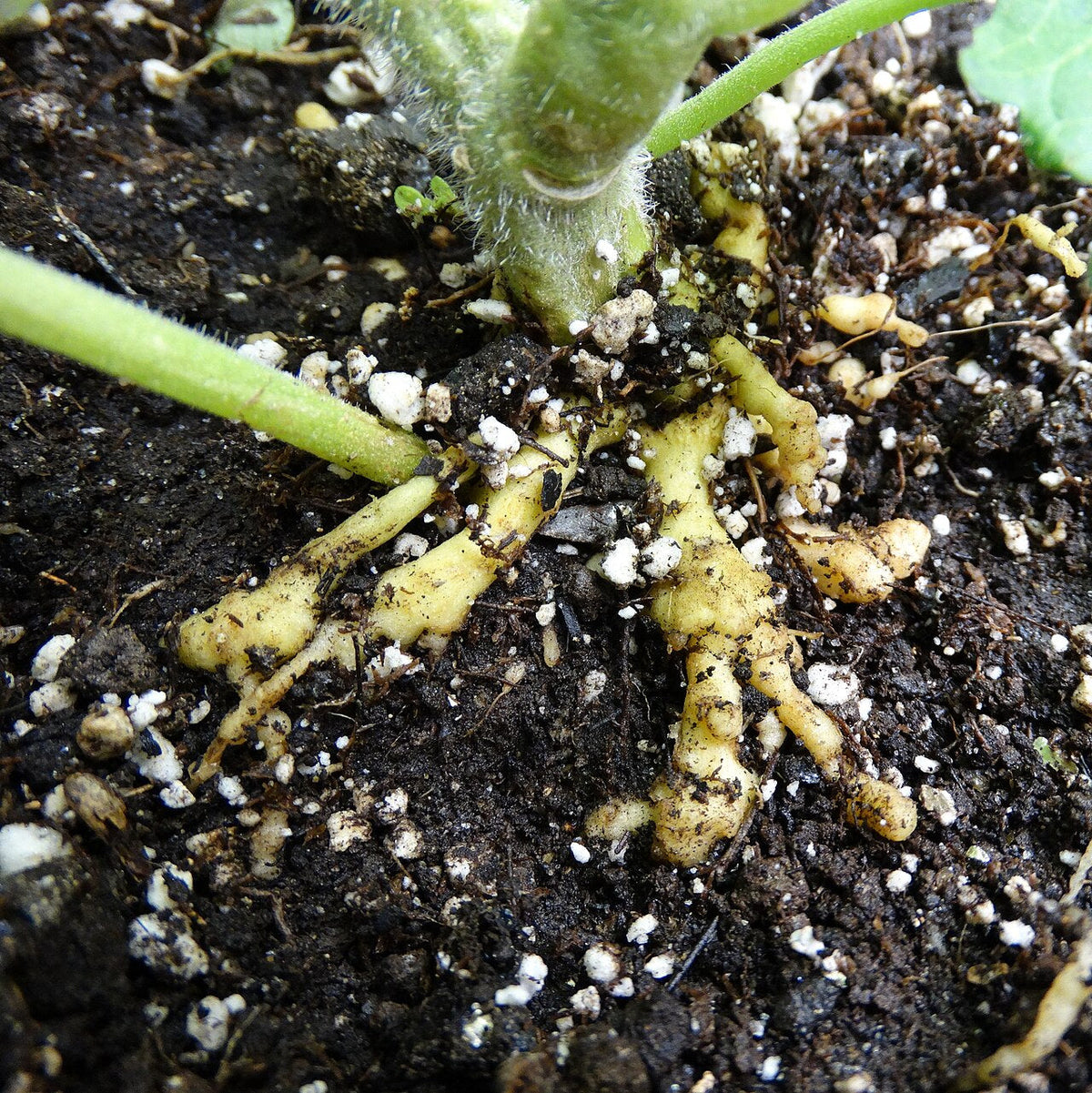
Photo at the top: Tomato roots swollen with galls after nematode attack, Photo: Plant pests and diseases, CC0
Quick answer
Root knot nematode (Meloidogyne, mainly Meloidogyne incognita) is a tiny worm in the soil that enters the roots of tomato, chilli, brinjal and okra. The roots swell into knots, so plants turn yellow, wilt at midday and stay small. Control it before planting: a clean nursery, summer ploughing, crop rotation and organic matter in the soil.
How to identify root knot nematode
In Hindi it is called jad gaanth sutrakrimi (जड़ गांठ सूत्रकृमि), and in Telugu verumudi nulipurugu (వేరుముడి నులిపురుగు). A nematode is a very small, thin worm, too small to see with the naked eye. It lives in the soil and feeds inside the roots. You will not see the worm itself. You see what it does to the roots and to the plant.
Signs above the ground
- Patches in the field: plants in one part of the field grow less than the rest. TNAU (Tamil Nadu Agricultural University) notes that the damage shows up in patches.
- Midday wilting: plants droop in the hot part of the day even when the soil is wet, and look better in the evening. TNAU calls this "day wilting".
- Yellow, small leaves: leaves turn pale or yellow and the plant stays stunted. This looks like a shortage of nutrients, but fertilizer does not fix it.
- Fewer flowers and fruits: plants that survive give fewer flowers and smaller fruits.
- Nursery losses: infected seedlings often die in the nursery bed or fail to grow after transplanting.
Signs on the roots
Dig out a plant that looks weak, with the soil around it. Shake off the soil gently or wash the roots in a bucket of water. Healthy roots are thin and smooth. Roots with this nematode have swellings called galls (knots). At first the galls are small and round. Later they join and form long, lumpy, thick roots. The root system becomes short, with few fine roots. In old galls the root may rot, because fungi and bacteria enter the damaged tissue.
TNAU notes that gall size differs by crop: large and firm galls in most vegetables, and very small galls in chilli. So look closely at chilli roots.

Look-alikes and how to tell them apart
- Nodules on pulses: beans, cowpea and groundnut have useful nodules that hold nitrogen-fixing bacteria. Nodules sit on the side of the root and rub off easily. A nematode gall is part of the root itself and does not come off.
- Wilt diseases: fusarium wilt and bacterial wilt also make plants droop. Cut the stem near the base: a brown ring inside points to a wilt disease. In wilt the roots have no galls. See our guides on fusarium wilt in tomato and vegetables and bacterial wilt of tomato, brinjal and chilli. The nematode and the wilt fungus can also attack the same plant together.
- Nutrient shortage: yellow leaves can come from low nitrogen. Then the whole field looks pale and the roots are clean. See nitrogen deficiency symptoms in crops.
- Damping off in the nursery: seedlings fall over with a soft, rotten stem at soil level. With nematodes the stem is firm and the roots carry galls. See damping off of seedlings.
Life cycle of root knot nematode
The University of Georgia gives this life cycle. The female lays 150 to 1,500 eggs in a jelly-like mass on the root surface. A young worm, called the second-stage juvenile, hatches when the soil is warm. This is the only stage that can enter a root. It swims through the film of water in the soil and gets into a root near the tip.

Inside the root, the worm makes a few root cells grow very large and feeds on them. The root swells around it and forms the gall. The female stops moving, becomes pear-shaped and lays her eggs. The males are worm-shaped and leave the root. The University of Georgia notes that in warm soil, at 25 to 30°C, one full cycle from egg to egg takes 3 to 5 weeks. So there are several generations in one crop, and numbers rise with every generation.
What helps it:
- Warm soil. In Telangana and Andhra Pradesh the soil stays warm most of the year, so the nematode can build up in kharif, rabi and summer crops.
- Light, sandy soil, where the young worms move easily.
- The same host crop on the same land season after season. Tomato after brinjal after chilli feeds the same pest.
- Infected seedlings. TNAU notes that it spreads through seedlings, irrigation water and farm tools that carry infected soil.
Crops it attacks
TNAU lists tomato, brinjal, chilli, okra (bhindi) and gourds as hosts. It also attacks many other crops and weeds.
Root knot nematode of tomato
Tomato is one of the most affected crops. TNAU gives a yield loss of 11 to 35% in tomato. Seedlings attacked in the nursery may not survive transplanting. Older plants wilt in the afternoon and give fewer, smaller fruits.
Chilli
Galls on chilli roots are small, so the attack is easy to miss. Plants stay short and yellow, and fruit set drops. Check nursery seedlings before transplanting.
Brinjal
Brinjal stays in the field for many months, so the nematode has time for many generations. Plants slowly turn weak and pale, and fruit size falls.
Okra (bhindi)
Okra is sown directly in the field, so the attack starts from the soil, not from the nursery. Plants are stunted and give fewer pods.
When to act
We could not confirm a field threshold for this nematode in vegetables from ICAR, a state agricultural university or TNAU, so we do not give one here. The number that causes loss changes with the soil, the crop and the weather.
Act on what you see. Pull out a few weak plants and check the roots. If the last crop on that land had galls, treat the field as infested before the next crop. If you want a count, take a soil sample before planting and ask your KVK (Krishi Vigyan Kendra) or state agricultural university where to get it tested.
Control without chemicals
Once the roots have galls, nothing makes them normal again. So prevention before and at planting matters most. These steps come from the TNAU nematode pages unless stated.
Clean nursery
- Raise seedlings in soil that has no nematodes, and plant only seedlings whose roots have no galls.
- Soil solarisation: in the summer months, wet the nursery bed and cover it with a thin, clear (transparent) plastic sheet for some weeks. The sun heats the soil and kills many nematodes. TNAU advises a 25 gauge clear LLDPE sheet.
Field steps
- Remove old roots: after harvest, pull out the roots of the old crop and destroy them away from the field. Galled roots hold thousands of eggs.
- Deep summer ploughing: plough deep in the hot months. This exposes the young worms and eggs to the sun and dry air.
- Crop rotation: do not grow tomato, brinjal, chilli or okra one after another on the same land. TNAU suggests non-host crops like mustard, sesame, maize, wheat and millets in between.
- Marigold: for tomato, TNAU advises growing marigold as an intercrop, one row of marigold to four rows of tomato.
- Organic matter: TNAU advises neem cake in the soil. Well-rotted farmyard manure also helps the roots and the soil life that attacks nematodes. Ask your KVK for the right quantity for your soil.
- Clean tools and water: wash soil off ploughs and tools before you move from an infested field to a clean one. Do not let water from an infested field run into a clean field.
- Weeds: keep weeds down, because many weeds also carry the nematode.
- Resistant varieties: some tomato varieties and hybrids resist this nematode. Ask your KVK or state agricultural university which ones grow well in your area. The University of Georgia advises still rotating crops, because resistance can weaken if the same variety is grown every year.
Biological control
TNAU lists useful fungi and bacteria for the nursery and the field: Pseudomonas fluorescens, arbuscular mycorrhizal fungi, and Purpureocillium lilacinum (earlier called Paecilomyces lilacinus) mixed with farmyard manure. If you use one, buy a product registered for nematodes and follow the rate on its label.
Chemical control
None of the products in our store has this nematode on its official label for tomato, chilli, brinjal or okra. So we do not suggest a product here. Ask your local agriculture officer or KVK for a product labelled for your crop. Use it only at the label dose, and keep to the waiting period before harvest that the label gives.
Frequently asked questions
What are nematicides for root knot nematode?
A nematicide is a product that kills nematodes. In India, a nematicide can be used on a crop only if the Central Insecticides Board and Registration Committee (CIB&RC) has approved it for that crop and that pest. Our store does not stock one labelled for it. Ask your agriculture officer or KVK for an approved product for your crop.
Can I see the nematode with my eyes?
No. The young worm is less than 1 mm long and as thin as a hair. You see the galls on the roots, not the worm. The swollen females inside the galls can be seen with a hand lens.
Will extra fertilizer or water cure the yellow plants?
No. The galls stop the roots from taking up water and food. Extra fertilizer does not reach the plant well. Light, frequent irrigation can reduce the midday wilting, but it does not remove the nematode.
Can I grow tomato again in a field that had galls?
It is better not to. Grow a non-host crop such as maize, a millet, mustard or sesame first, plough deep in summer and destroy the old roots. Then plant healthy seedlings from a clean nursery.
Does the nematode spread from field to field?
Yes, but slowly on its own. It mainly spreads through infected seedlings, irrigation water and soil stuck to tools, tractors and footwear.
Related reading
- Fusarium wilt in tomato and vegetables: symptoms and control
- Bacterial wilt of tomato, brinjal and chilli
- Damping off of seedlings in the nursery
- Nitrogen deficiency symptoms in crops
- Products for tomato
- Products for chilli
Sources
- Tamil Nadu Agricultural University, TNAU Agritech Portal: Nematode pests of vegetables: tomato
- Tamil Nadu Agricultural University, TNAU Agritech Portal: Root knot nematode of vegetables
- Tamil Nadu Agricultural University, TNAU Agritech Portal: Tomato: root-knot nematode
- University of Georgia, Integrated Pest Management: Root-knot nematode
- Utah State University Extension, Utah Vegetable Production Guide: Root-knot nematodes
- Directorate of Plant Protection, Quarantine and Storage, CIB&RC: Major uses of pesticides
Like these farming tips? Add AgriVruddhi as a preferred source on Google
Back to Crop Health Guide