
Fusarium wilt in tomato, chilli, chickpea and cotton: symptoms and control
· By AgriVruddhi
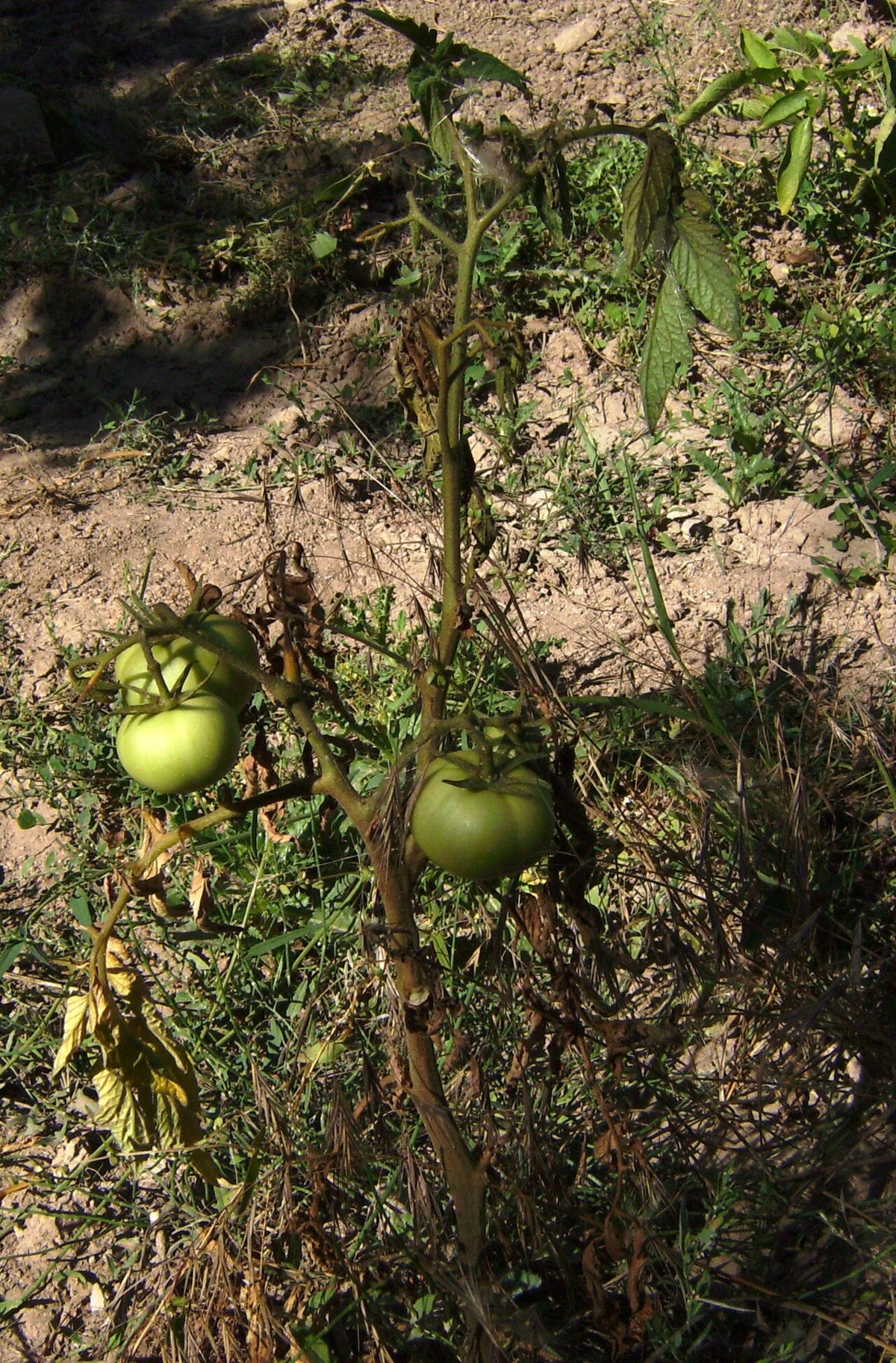
Photo at the top: A tomato plant with Fusarium wilt. The lower leaves have dried, the stem has turned brown and the plant is dying with green fruits still on it, Photo: Victor M. Vicente Selvas, CC BY-SA 3.0
Quick answer
Fusarium wilt in tomato is a soil-borne fungal disease. The fungus enters the roots and blocks the water pipes inside the stem. Lower leaves turn yellow first. Then the plant wilts and dies, and a cut stem shows brown streaks inside. It also attacks chilli, chickpea and cotton. No spray cures a wilted plant, so prevention is the key.
How to identify fusarium wilt in tomato and other crops
The disease is caused by the fungus Fusarium oxysporum. Each crop has its own form of the fungus: one for tomato, one for chilli, one for chickpea and one for cotton. In Hindi it is called फ्यूजेरियम उकठा (Fusarium ukatha), and in Telugu ఫ్యుజేరియం ఎండు తెగులు (Fusarium endu tegulu). Many farmers simply call any sudden drying of plants "wilt", but not every wilt is Fusarium wilt. The signs below help you tell.
Fusarium wilt symptoms
- Yellow lower leaves: TNAU (Tamil Nadu Agricultural University) describes tomato plants whose small leaf veins clear first, then the lower leaves turn yellow and the younger leaves die one after another. The yellowing moves up the plant.
- One side first: often only one branch, or one side of the plant, turns yellow and wilts at first. The University of California calls this a "yellow flag".
- Drooping: the leaf stalks and leaves droop and hang down. Dead leaves often stay attached to the stem.
- Brown streaks inside the stem: this is the surest field sign. Cut the lower stem along its length with a clean knife. In a healthy plant the wood under the skin is white or pale green. In a wilt plant it has brown streaks, and the colour can run far up the stem.
- The plant does not recover: it stays wilted even after watering, and in the end the whole plant dies.
- Patches in the field: wilt plants often appear in groups, because the fungus lives in that part of the soil.
Look-alikes and how to tell them apart
- Bacterial wilt: the whole plant wilts quickly, often while the leaves are still green. TNAU notes a white bacterial ooze from the cut ends of the stem. A simple test: cut a piece of the lower stem and hang it in a clear glass of water. If milky white threads stream out of the cut end within a few minutes, it is bacterial wilt, not Fusarium wilt. See our guide to bacterial wilt in tomato, brinjal and chilli.
- Root-knot nematode: pull out the plant and look at the roots. Round knots (galls) on the roots point to nematodes. Plants are stunted and droop in the hot hours. Nematodes also wound the roots and make Fusarium wilt worse. See how to spot and manage root-knot nematode.
- Dry root rot (chickpea and cotton): the roots themselves rot. TNAU describes chickpea roots that turn brittle and dry, and cotton roots that rot so the plant pulls out easily. In Fusarium wilt the main sign is the brown colour inside the stem.
- Verticillium wilt (cotton): TNAU says it appears at the square and boll stage, in cool weather of 15 to 20 °C. The leaf area between the veins turns yellow, giving a "tiger stripe" look.
- Early blight (tomato): lower leaves also turn yellow, but they carry brown spots with rings like a target. Fusarium wilt has no leaf spots. See early blight of tomato: symptoms and control.
- Lack of water: plants droop in the afternoon and recover in the evening or after irrigation. The stem is clean inside.
Life cycle and when it attacks
The fungus lives in the soil for many years. It survives as thick-walled resting spores and on old crop remains. When you plant a host crop, the fungus enters through the young roots, often through small wounds. It then grows into the water pipes of the stem (the xylem). These pipes get blocked, so water cannot reach the leaves. That is why the plant wilts even when the soil is wet.
Wilt spreads from field to field in a few ways:
- Infected crop remains and soil.
- Irrigation water that flows from a sick patch to a healthy one.
- Soil stuck to ploughs, tools and boots.
- Infected seed and seedlings. TNAU notes that the cotton wilt fungus is carried both on and inside the seed.
Weather and soil matter. For tomato, TNAU lists dry weather with high soil temperature and low soil moisture as favourable. For cotton, TNAU lists a soil temperature of 20 to 30 °C, hot dry spells followed by rain, and heavy black soils with an alkaline reaction. Too much nitrogen and phosphate fertiliser also favours it. Wounds made by root-knot nematodes and by ash weevil grubs help the fungus get in.
In Telangana and Andhra Pradesh, cotton is grown in kharif and chickpea in rabi, mostly on black soils. Chilli and tomato are grown in more than one season. So the risk follows the crop through the year. Once a patch of soil has the fungus, it stays there for years.
Crops it attacks
Fusarium wilt in tomato
The lower leaves turn yellow, often on one side, and the plant wilts from the bottom up. The University of California notes that symptoms often first show when the fruits are filling. The stem shows dark brown streaks inside. Infected plants usually die.
Wilt in chilli
TNAU describes chilli leaves that roll upward and inward, then turn yellow and die. It starts with a slight yellowing and drooping of the upper leaves. Within a few days the wilt becomes permanent, while the dead leaves stay on the plant. By the time you see this, the inside of the lower stem and roots is already discoloured. Wilt often shows in patches where many plants die together.
Fusarium wilt of chickpea
Chickpea (Bengal gram, chana) can be attacked at any stage, says TNAU. At 3 to 5 weeks after sowing, whole seedlings collapse and lie flat on the ground. The leaves stay dull green and the stem shrinks. In older plants the leaf stalks and leaflets droop, and then the whole plant dries. Dead plants appear in patches. A split stem shows dark brown colour inside.
Fusarium wilt of cotton
TNAU describes yellowing and browning of the seed leaves first, then browning of the leaf stalks. Leaves go limp, turn yellow, droop and wilt. The water pipes in the stem turn brown or black. Plants that survive stay stunted and carry fewer bolls.
When to act
An economic threshold is the pest or disease level at which spraying starts to pay. We could not find a threshold for Fusarium wilt from a recognised public source, so we do not give one here. A wilted plant cannot be cured, so the real decision is about the next crop and the healthy plants around the sick ones.
Walk the field at least once a week, and more often in hot, dry spells. When you see the first wilted plant, cut the stem to check for brown streaks. Do the glass-of-water test to rule out bacterial wilt. Then remove the sick plant and mark the spot. If wilt keeps coming back in the same patch, take a soil sample and a sick plant to your KVK (Krishi Vigyan Kendra) or agriculture officer for a firm diagnosis.
Fusarium wilt control without chemicals
Because the fungus lives inside the plant and in the soil, prevention does most of the work. These steps come from TNAU and University of California advice.
- Wilt-resistant varieties: this is the cheapest and surest step. TNAU advises wilt-resistant varieties for chilli. For tomato, many hybrids resist Fusarium wilt; the seed packet usually lists the diseases a variety resists. Ask your KVK or state agricultural university which local tomato, chilli, chickpea and cotton varieties resist wilt in your area.
- Healthy seed and seedlings: use certified, disease-free seed. Do not keep seed from a field that had wilt. Raise tomato and chilli seedlings in clean soil, and do not transplant any seedling that looks yellow or weak.
- Crop rotation: do not grow the same crop on wilt-sick soil year after year. TNAU advises crop rotation for tomato, and for chickpea a long rotation of up to six years with sorghum. The fungus lives long in soil, so short breaks help only a little.
- Deep summer ploughing: TNAU advises ploughing deep in summer. It turns the soil to the hot sun and buries old crop remains.
- Soil solarisation: for nursery beds and small tomato plots, TNAU advises soil solarisation. Wet the soil, cover it with a thin clear plastic sheet, and seal the edges with soil. Leave it for several weeks in the hottest part of summer. The sun heats the soil and kills much of the fungus in the top layer.
- Remove sick plants: pull out wilted plants with their roots and the soil around them. Carry them out of the field and destroy them. Do not leave them on the bund or put them in compost.
- Clean up after harvest: remove and destroy crop remains, especially from patches that had wilt.
- Organic manure: TNAU advises well-rotted farmyard manure (FYM) or other organic manure for cotton and chickpea. It improves the soil and supports useful soil microbes.
- Useful microbes: TNAU recommends seed treatment and soil application with helpful fungi and bacteria, such as Trichoderma (often sold as Trichoderma viride or T. asperellum), Bacillus subtilis and Pseudomonas fluorescens. They are usually mixed with FYM before going into the soil. Use a registered product and follow the rate on its label, or ask your KVK.
- Balanced fertiliser: avoid heavy doses of nitrogen and phosphate. TNAU names excess of both as a reason cotton wilt gets worse. Go by a soil test.
- Control nematodes and root grubs: their wounds let the fungus in. The University of California also warns that nematode feeding can break down a tomato variety's resistance to wilt.
- Water with care: do not let irrigation water run from a wilt patch into healthy rows. Water the healthy part of the field first if you can.
- Clean tools: wash soil off ploughs, tools and boots before moving from a sick field to a clean one.
- Sowing time: for chickpea, TNAU advises against sowing when temperatures are high.
Chemical control: ask for a product labelled for wilt
No product in our store has Fusarium wilt in its label record, so we do not name one here. Keep in mind that a fungicide sprayed on the leaves does not reach the fungus in the roots and lower stem. It does not bring a wilted plant back.
Agricultural universities, including TNAU, advise chemical seed treatment before sowing for some crops, and spot drenching of the soil around sick plants. Ask your local agriculture officer or KVK for a product labelled for Fusarium wilt on your crop. Use the product and dose printed on its label. You can browse our fungicides, but use only a product whose label names Fusarium wilt on your crop.
If you do use a fungicide:
- Use one product at a time. Do not mix products in one tank.
- Treat the seed or the soil as the label says. Spraying the leaves alone will not stop wilt.
- If you need more than one treatment in a season, ask your KVK for a fungicide from a different group for the next one. This slows down resistance.
Safety
- Wear gloves, a mask, full-sleeve clothes and boots when you handle treated seed or mix and apply any fungicide. Do not eat, drink or smoke while you work. Wash well afterwards.
- Never use treated seed as food or animal feed. Keep it in a marked bag, away from children and animals.
- Keep the waiting period before harvest that is printed on the label of the product you use.
- Keep chemicals and washings away from ponds, canals and wells.
- Read the label and leaflet before use.
Frequently asked questions
How do I know if it is Fusarium wilt or bacterial wilt?
Cut a piece of the lower stem and hang it in a glass of clear water. Milky white threads coming out of the cut end mean bacterial wilt. With Fusarium wilt there is no ooze, but the inside of the stem has brown streaks. Fusarium wilt also tends to start with yellow lower leaves on one side, while bacterial wilt often makes a green plant collapse quickly.
Can a plant with Fusarium wilt recover?
No. Once the water pipes in the stem are blocked, the plant cannot recover, even with water or a spray. Remove it to protect the next crop, and focus on prevention.
Can I grow tomato again in a field that had Fusarium wilt?
The fungus lives in the soil for many years, so planting the same crop again carries a high risk. Rotate with crops from a different family, and when you return to tomato, choose a variety that resists Fusarium wilt. Solarisation helps for nursery beds and small plots.
Does Fusarium wilt spread through seed?
Yes, it can. TNAU notes that the cotton wilt fungus is carried on and inside the seed. Use certified, disease-free seed for every crop, and do not save seed from a field that had wilt.
Why does wilt show up in patches?
The fungus lives in the soil, and it is not spread evenly across the field. Plants growing over infected soil get sick first. Water and tools then carry the fungus outwards, so the patches can grow bigger each season.
Related reading
- Bacterial wilt in tomato, brinjal and chilli: the stem ooze test and control
- Root knot nematode in tomato, chilli, brinjal and okra: signs and control
- Damping off in the nursery: why seedlings collapse and how to prevent it
- Early blight of tomato and potato: symptoms and control
- Products for tomato, products for chilli and products for cotton
Sources
- Tamil Nadu Agricultural University, TNAU Agritech Portal: Tomato: Fusarium wilt
- Tamil Nadu Agricultural University, TNAU Agritech Portal: Tomato: Bacterial wilt
- Tamil Nadu Agricultural University, TNAU Agritech Portal: Chilli: Fusarium wilt
- Tamil Nadu Agricultural University, TNAU Agritech Portal: Chickpea: Fusarium wilt and Chickpea: Dry root rot
- Tamil Nadu Agricultural University, TNAU Agritech Portal: Cotton: Fusarium wilt, Cotton: Verticillium wilt and Cotton: Root rot
- University of California, Statewide IPM Program: Tomato: Fusarium wilt
Like these farming tips? Add AgriVruddhi as a preferred source on Google
Back to Crop Health Guide