
Early blight of tomato and potato: symptoms and control
· By AgriVruddhi
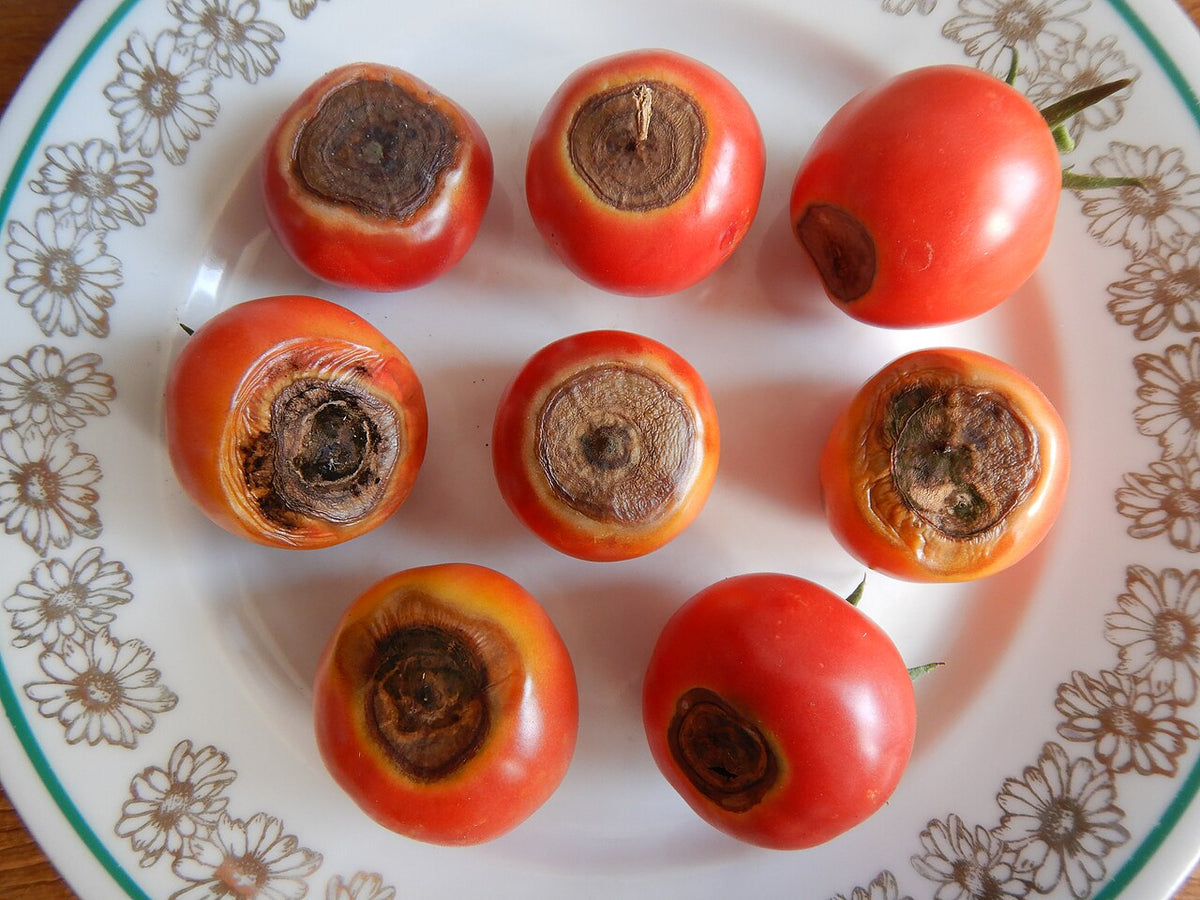
Photo at the top: Early blight on ripe tomatoes: dark, sunken patches with rings at the stalk end, Photo: Michal Maňas, CC BY 4.0
Quick answer
Early blight of tomato is a fungal disease caused by Alternaria solani, which also attacks potato. It makes brown spots with target-like rings on the oldest leaves first. Leaves turn yellow and drop, and fruits get dark sunken patches at the stalk end. Control it with clean seed, crop rotation, removing spotted leaves and a label-approved fungicide sprayed early.
How to identify early blight of tomato and potato
Start with the lowest, oldest leaves. Early blight almost always shows there first and then climbs up the plant. In Hindi the disease is often called agheti jhulsa.
On tomato
- Leaf spots: small dark brown spots that grow to about 1 cm. Inside each spot are rings, one inside another, like a target or bull's eye. Tamil Nadu Agricultural University (TNAU) notes a yellow edge around the spot.
- Leaf drop: the leaf around the spots turns yellow, then dries and falls. In a bad attack the lower half of the plant loses its leaves, and fruits get sunburnt.
- Stems: dark, sunken patches with rings. On young seedlings a dark patch at the base of the stem can kill the plant (collar rot).
- Fruit: TNAU notes that fruit is infected through the green cap (calyx) or the stalk end, at the green or ripe stage. The patch is dark, sunken and leathery, with rings, and may get a velvety black layer of spores. Infected fruits often drop.
On potato
- Leaves: dark brown spots on the older leaves, often angular because the leaf veins stop them spreading. Look closely and you will see the same rings inside.
- Tubers: sometimes dark, slightly sunken patches on the skin, with dry brown tissue under them.

Early and late blight of tomato: how they differ
Farmers often mix up these two diseases, but they need different care. For full details on the second one, read our guide to late blight of potato and tomato.
| Sign | Early blight | Late blight |
|---|---|---|
| Cause | A fungus, Alternaria solani | A water mould, Phytophthora infestans |
| Where it starts | Oldest, lowest leaves | Any leaves, often young leaves and stems |
| Spot | Small, dry, brown, with rings like a target | Large, greasy, water-soaked, no rings, white growth underneath |
| Weather | Warm and humid, with dew or rain | Cool and wet |
| Speed | Slow, climbs up the plant over weeks | Very fast, can spread over a field within days |
Other look-alikes and how to tell them apart
- Septoria leaf spot (tomato): many small round spots with grey-white centres, dark borders and tiny black dots in the centre. No rings.
- Bacterial spot: very small, dark, greasy-looking spots, without rings.
- Blossom end rot (tomato fruit): a dark, leathery patch at the bottom (flower end) of the fruit, not at the stalk end. It comes from a calcium and watering problem, not a fungus, and fungicides do not help.
Life cycle: how early blight spreads and when it attacks
The fungus lives in infected plant waste in the soil, and can come with infected seed, as TNAU notes. Spores are carried to the leaves by wind and rain splash. They need a wet leaf to start an infection, so dew, rain and wet weather help it a lot. Each spot then makes more spores, and the disease climbs up the plant.
TNAU lists warm, humid weather (24–29 °C) with rain and wet conditions as favourable. Plants under stress get it more: plants short of water, short of nutrients, or carrying a heavy fruit load. That is why the disease is often worse as the crop gets older.
In Telangana and Andhra Pradesh, tomato is grown in most seasons. Early blight shows up whenever warm days come with dew, rain or high humidity, in the rainy season and after it. Across India it is one of the most common leaf diseases of tomato and potato.
Crops it attacks
Tomato: from the nursery to the last picking. Seedlings can get collar rot. In the field, leaf loss from the lower leaves upward weakens the plant, reduces fruit size and exposes fruits to sunburn. Fruit spots make the harvest unsaleable.
Potato: mostly on older leaves from the middle of the crop onward. Leaf loss cuts tuber growth.
Chilli and other crops: related Alternaria fungi cause leaf spots on chilli and brinjal. None of the products in our store has early blight on chilli on its label, so we do not suggest one for chilli here.
When to spray for early blight
We could not confirm an economic threshold (the pest level at which spraying pays) for early blight from a recognised public source, so we do not give one here. The product labels say to spray as a preventive or when the disease first appears. Check the lower leaves twice a week from the time the first fruits set. When you find fresh ringed spots on several plants, start spraying.
How to prevent early blight without chemicals
- Resistant hybrid: ICAR-Indian Institute of Horticultural Research (IIHR), Bengaluru, lists its tomato hybrid Arka Rakshak as resistant to early blight, leaf curl virus and bacterial wilt. Ask your seed dealer about it.
- Clean seed and seedlings: use healthy seed and raise seedlings from a disease-free nursery. TNAU advises treating seed with Trichoderma asperellum at 4 g per kg of seed. Use a registered product and follow its label.
- Crop rotation: do not grow tomato, potato, brinjal or chilli on the same land season after season. Rotate with a crop from another family.
- Remove crop waste: TNAU advises removing and destroying crop debris after harvest. The fungus lives in it.
- Feed the crop well: give balanced fertiliser as per your soil test. Weak plants get more early blight.
- Water evenly: avoid water stress. Drip irrigation keeps the soil moist and the leaves dry. Avoid wetting the leaves late in the day.
- Stop soil splash: mulch the soil and stake tomato plants so the lower leaves do not touch the ground.
- Remove spotted leaves: pick off the lowest infected leaves early and take them out of the field.
- Spacing: use the recommended spacing so the crop dries quickly after rain or dew.
Fungicides for early blight of tomato and potato
Only the products below have the crop and early blight on their official label. Doses are per acre, as printed on the label or converted from the label's per-hectare dose. Where the label gives only a strength per litre, we say "dose as per label" and quote that strength. Use one product at a time. Do not mix products in one tank.
Tomato
| Product | Contains | Label dose per acre | Water per acre | Wait before harvest |
|---|---|---|---|---|
| Kavach Flo Fungicide | Chlorothalonil 40% + Difenoconazole 4% SC | 405 ml | 200 L | 7 days |
| Amistar Top Fungicide | Azoxystrobin 18.2% + Difenoconazole 11.4% SC | Dose as per label: 0.1%, or 1 ml per litre of water | 200 L | 5 days |
| Polyram Fungicide | Metiram 70% WG | 1012 g | 200–300 L | 6 days |
Notes from the labels:
- Kavach Flo: first spray as a preventive or at the first sign of disease, and one more after 10–15 days. No more than two sprays in a season.
- Amistar Top: one or two sprays when the disease appears.
- Polyram: its label lists this use as "Alternaria blight", which is early blight.
- Kavach Flo and Amistar Top each hold two active ingredients in one pack. These are ready-mixed products approved on the label, not tank mixes.
- Tomatoes are picked often. Check the waiting period before each picking.
Potato
| Product | Contains | Label dose per acre | Water per acre | Wait before harvest |
|---|---|---|---|---|
| Indofil M45 Fungicide | Mancozeb 75% WP | 0.6–0.8 kg | 300 L | 20 days |
| Polyram Fungicide | Metiram 70% WG | 809 g | 200–300 L | 21 days |
| Companion Fungicide | Carbendazim 12% + Mancozeb 63% WP | 708 g | 200 L | 47 days |
| Saaf Fungicide | Carbendazim 12% + Mancozeb 63% WP | 708 g | 200 L | 47 days |
| Saafilizer Systemic and Contact Fungicide | Carbendazim 12% + Mancozeb 63% WP | 708 g | 200 L | 47 days |
Notes from the labels:
- Indofil M45: foliar spray.
- Saaf: spray as soon as disease symptoms appear.
- Companion, Saaf and Saafilizer have the same two active ingredients in one pack. They are ready-mixed products approved on the label, not tank mixes. Treat them as one choice, not three. They need 47 days before harvest.
Rotate to avoid resistance
If you spray the same type of fungicide again and again, the fungus can stop responding to it. Fungicides are grouped by how they work, using the FRAC code (FRAC is the international Fungicide Resistance Action Committee). Change the group from one spray to the next.
| FRAC group | Active ingredient | Products in this article |
|---|---|---|
| M03 (multi-site contact) | Mancozeb, metiram | Indofil M45; Polyram; one part of Companion, Saaf and Saafilizer |
| M05 (multi-site contact) | Chlorothalonil | One part of Kavach Flo |
| 3 (triazoles) | Difenoconazole | One part of Kavach Flo and Amistar Top |
| 11 (strobilurins) | Azoxystrobin | One part of Amistar Top |
| 1 | Carbendazim | One part of Companion, Saaf and Saafilizer |
Kavach Flo and Amistar Top share group 3 (difenoconazole). So on tomato, a good order is to put Polyram (group M03 only) between them, for example Kavach Flo, then Polyram, then Amistar Top. Multi-site contact fungicides (groups M03 and M05) carry a low risk of resistance. Groups 3 and 11 carry a higher risk, so do not use the same one for two sprays in a row. Keep to the number of sprays each label allows.
Safety and waiting period
- The waiting period before harvest (PHI, pre-harvest interval) for each product and crop is in the tables above. Count the days from the last spray.
- Wear gloves, a mask, full-sleeve clothes and boots while mixing and spraying. Do not eat, drink or smoke while you work. Wash well afterwards.
- Spray in the morning or evening, in calm weather. Cover the lower leaves well, as the disease starts there.
- Keep sprays and washings away from ponds, canals and wells.
- Read the label and leaflet before use.
Frequently asked questions
What causes early blight of tomato?
A fungus called Alternaria solani. It lives in old crop waste and can come with seed. Warm, humid weather with rain or dew, and stressed plants, let it spread.
What is the difference between early and late blight of tomato?
Early blight spots are small and brown with rings inside, like a target, and start on the oldest leaves. Late blight makes large, greasy, water-soaked patches with no rings and white growth underneath, and it spreads very fast in cool, wet weather.
Which fungicide works on both early and late blight of tomato?
In our store, the labels of Kavach Flo and Amistar Top list both early blight and late blight on tomato. The doses are in the tomato table above.
Does watering affect early blight?
Yes. TNAU notes that plants under water stress are more likely to get early blight. Water evenly, and keep the leaves dry where you can, for example with drip irrigation.
Is there a tomato variety resistant to early blight?
Yes. ICAR-IIHR, Bengaluru, lists its hybrid Arka Rakshak as resistant to early blight, leaf curl virus and bacterial wilt. Resistant plants still need clean fields, rotation and regular checks.
Should I remove the spotted leaves?
Yes. Pick off the lowest spotted leaves early and take them out of the field. This removes a source of spores. Do it on a dry day, and wash your hands before you touch healthy plants.
Related reading
- Late blight of potato and tomato: symptoms, causes and control
- Helicoverpa fruit borer in tomato: identification and control
- Leaf miner in tomato: identification and control
- Boron deficiency in tomato, chilli and other crops
- Anthracnose of chilli, mango and grapes
- Products for tomato
- All fungicides
Sources
- Tamil Nadu Agricultural University, TNAU Agritech Portal: Tomato diseases, early blight
- ICAR-Indian Institute of Horticultural Research, Bengaluru: Tomato Arka Rakshak
- Fungicide Resistance Action Committee: FRAC code list
- Official product labels and leaflets of the fungicides named above
Products that control it, by crop
Tomato
- Kavach Flo Fungicide405 ml per acreFoliar spray as prevention or at the first sign of disease; one more spray after 10-15 days; max 2 sprays per season
- Amistar Top FungicideSpray 1 ml per litre of water (0.1%) when the disease appears; 1-2 sprays
- Polyram - Fungicide1012 g per acre
Potato
- Polyram - Fungicide809 g per acre
- Indofil M45 Fungicide0.6–0.8 kg per acreFoliar spray.
- Companion Fungicide708 g per acre
- Saaf Fungicide708 g per acreSpray as soon as disease symptoms appear.
- Saafilizer Systemic and Contact Fungicide708 g per acre
Do not spray the same product again and again. Change to a product with a different mode of action (the group number on the label) so the pest or disease does not build resistance.
As printed on the brand's official label. Read the label before use.


Like these farming tips? Add AgriVruddhi as a preferred source on Google
Back to Crop Health Guide