
Late blight of potato and tomato: symptoms, causes and control
· By AgriVruddhi
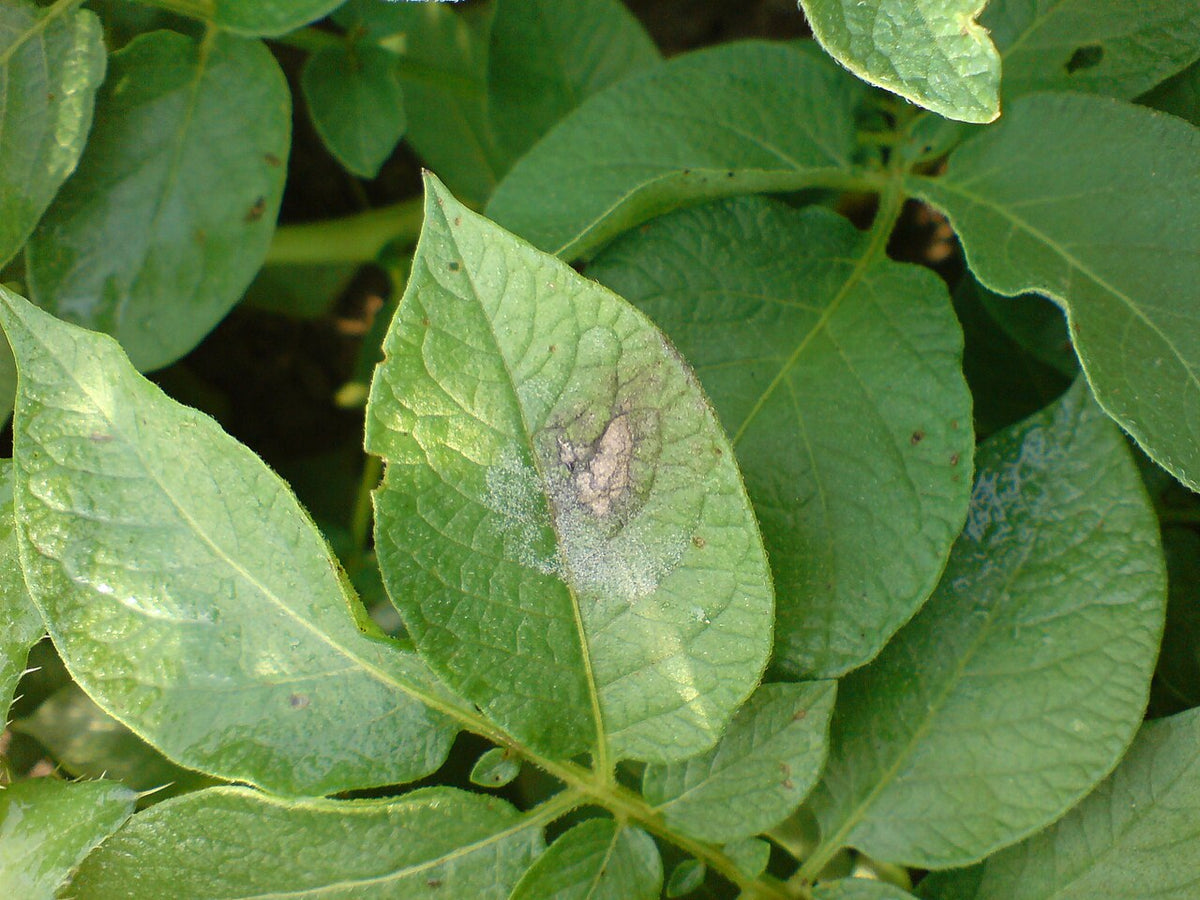
Photo at the top: Late blight on a potato leaf: a brown patch with white downy growth around it, Photo: Björn Andersson (SLU), CC BY-SA 4.0
Quick answer
Late blight of potato is caused by Phytophthora infestans, a water mould that also attacks tomato. It makes dark, water-soaked leaf patches with white growth underneath, then rots stems, tubers and fruits. Cool, wet weather lets it ruin a field within two weeks. Plant healthy seed, keep air moving, and start protective fungicide sprays before or at the first spots.
A water mould is a fungus-like organism that spreads by spores in water and wet air. Late blight caused the Irish potato famine of the 1840s, and it is still one of the most serious potato diseases in India.
How to identify late blight of potato and tomato
In Hindi the disease is called pachheti jhulsa. Check the crop early in the morning, when leaves are still damp. That is when the signs are easiest to see.
Symptoms of late blight of potato
- Leaves: pale green, water-soaked spots, often at the tip or edge of the leaf. Tamil Nadu Agricultural University (TNAU) describes them growing and turning purple brown, then black.
- Under the leaf: a thin ring of white, downy growth around the edge of the dark patch, easiest to see in humid mornings. This is the mould making spores.
- Stems: brown to black patches. Stems often break at the joints, and the plant falls over.
- Tubers: brown patches on the skin. When you cut the tuber, a rusty brown rot runs from the skin towards the centre. Other rots often follow in storage.
- In the field: blighted plants look scorched, and a badly hit field has a rotten smell.

Symptoms of late blight of tomato
- Leaves: large, uneven, grey-green to brown patches that look greasy or water-soaked. In humid weather there is white growth under the leaf.
- Stems and leaf stalks: long dark brown patches. The stem can collapse above the patch.
- Fruit: firm, greasy, olive to dark brown patches, mostly on green fruit and often on the upper half. The patch stays firm at first and may later rot.

Look-alikes and how to tell them apart
- Early blight: small brown spots with rings inside, like a target, and a yellow edge. It starts on the older, lower leaves and spreads slowly. Late blight spots are bigger, water-soaked, have no rings, show white growth underneath, and can spread over the whole field within days in cool, wet weather. See our guide to early blight of tomato and potato.
- Buckeye rot of tomato: affects fruits that touch the soil. The brown patch on the fruit has clear rings. Late blight fruit patches have no rings and are often on the upper side of the fruit.
- Frost or sun scald: damage appears all at once after one cold night or hot day, with no white growth and no further spread.
Causes of late blight and the weather that spreads it
The disease starts from infected seed tubers, plant waste and volunteer potato plants left from the last crop. TNAU names infected tubers and infected soil as the first source. From the first infected plants, spores spread through the air and by rain splash to nearby leaves. In wet conditions each spot makes huge numbers of new spores, so the disease spreads very fast.
TNAU lists the weather that favours it:
- air humidity above 90%
- temperature of 10–25 °C, with nights around 10 °C
- cloudy weather before rain, and rain on the following days
In India, potato in the plains is grown in the cool rabi season. Late blight is most feared in the cold, foggy and drizzly spells of winter, and in the hills during the rainy season. In Telangana and Andhra Pradesh, watch tomato and potato most closely during cool, cloudy and wet spells in the winter months, and in cooler, higher areas.
Crops it attacks: potato and tomato
Potato: leaves, stems and tubers are all attacked. Leaf loss cuts tuber growth. Infected tubers rot in the field and in storage, and carry the disease to the next crop if used as seed.
Tomato: leaves, stems and fruits are attacked. The disease can strike at any stage, but losses are worst when it reaches the plants after fruit set, because green fruits rot and cannot be sold.
When to spray for late blight
We could not confirm an economic threshold (the pest level at which spraying pays) for late blight from a recognised public source, so we do not give one here. Late blight moves too fast to wait for damage to build up. The products below work mainly by protecting the leaf before the spores land. So start spraying when cool, cloudy, humid weather sets in, or at the very first spots, and keep the leaves covered while that weather lasts.
Weather warnings help you time the first spray. ICAR-Central Potato Research Institute (CPRI), Shimla, has built a late blight forecasting model called Indo-Blightcast, which uses daily temperature and humidity. Ask your agriculture officer or KVK whether blight warnings are issued for your area.
Control without chemicals
- Healthy seed: plant certified, disease-free seed tubers. Do not use tubers from a field that had late blight.
- Resistant varieties: TNAU lists potato varieties with late blight resistance, such as Kufri Naveen and Kufri Jeevan. Ask your local agriculture officer or Krishi Vigyan Kendra (KVK) which resistant varieties are available in your area. For tomato in high-rainfall areas, an ICAR article in Indian Horticulture advises the variety Arka Abhed F1.
- Earth up well: cover potato tubers with enough soil, so spores washing down from the leaves do not reach them.
- Air and water: use the recommended spacing. Give good drainage. Avoid overhead watering, and avoid watering late in the day, so leaves dry quickly.
- Tomato care: stake the plants and remove the lowest leaves so air moves through the crop. Do not grow tomato next to potato.
- Remove sources: pull out volunteer potato plants and destroy heaps of waste or rotten tubers. Remove and destroy badly infected plants away from the field.
- Before harvest: TNAU advises destroying the potato foliage a few days before digging. Do not injure tubers at harvest, and do not store tubers that show rot.
- Rotation: do not grow potato or tomato in the same field season after season.
Fungicides for late blight of potato and tomato, crop by crop
Only the products below have the crop and late blight on their official label. Doses are per acre, as printed on the label or converted from the label's per-hectare dose. Where the label gives only a strength per litre, we say "dose as per label" and quote that strength. Use one product at a time. Do not mix products in one tank. Cover both sides of the leaves well.
Potato: fungicides for late blight
| Product | Contains | Label dose per acre | Water per acre | Wait before harvest |
|---|---|---|---|---|
| Indofil M45 Fungicide | Mancozeb 75% WP | 0.6–0.8 kg | 300 L | 20 days |
| Polyram Fungicide | Metiram 70% WG | 809 g | 200–300 L | 21 days |
| Companion Fungicide | Carbendazim 12% + Mancozeb 63% WP | 708 g | 200 L | 47 days |
| Saaf Fungicide | Carbendazim 12% + Mancozeb 63% WP | 708 g | 200 L | 47 days |
| Saafilizer Systemic and Contact Fungicide | Carbendazim 12% + Mancozeb 63% WP | 708 g | 200 L | 47 days |
Notes from the labels:
- Indofil M45: foliar spray.
- Saaf: spray as soon as disease symptoms appear.
- Companion, Saaf and Saafilizer have the same two active ingredients in one pack. They are ready-mixed products approved on the label, not tank mixes. Treat them as one choice, not three.
- Companion, Saaf and Saafilizer need 47 days before harvest. If harvest is close, check the waiting period before you choose.
Tomato: fungicides for late blight
| Product | Contains | Label dose per acre | Water per acre | Wait before harvest |
|---|---|---|---|---|
| Kavach Flo Fungicide | Chlorothalonil 40% + Difenoconazole 4% SC | 405 ml | 200 L | 7 days |
| Amistar Top Fungicide | Azoxystrobin 18.2% + Difenoconazole 11.4% SC | Dose as per label: 0.1%, or 1 ml per litre of water | 200 L | 5 days |
| Indofil M45 Fungicide | Mancozeb 75% WP | 0.6–0.8 kg | 300 L | 10 days |
Notes from the labels:
- Kavach Flo: first spray as a preventive or at the first sign of disease, and one more after 10–15 days. No more than two sprays in a season.
- Amistar Top: one or two sprays when the disease appears.
- Kavach Flo and Amistar Top each hold two active ingredients in one pack. These are ready-mixed products approved on the label, not tank mixes.
- Tomatoes are picked often. Check the waiting period before each picking.
Rotate to avoid resistance
Fungicides are grouped by how they work, using the FRAC code (FRAC is the international Fungicide Resistance Action Committee). Changing the group between sprays slows down resistance.
| FRAC group | Active ingredient | Products in this article |
|---|---|---|
| M03 (multi-site contact) | Mancozeb, metiram | Indofil M45; Polyram; one part of Companion, Saaf and Saafilizer |
| M05 (multi-site contact) | Chlorothalonil | One part of Kavach Flo |
| 11 (strobilurins) | Azoxystrobin | One part of Amistar Top |
| 3 (triazoles) | Difenoconazole | One part of Kavach Flo and Amistar Top |
| 1 | Carbendazim | One part of Companion, Saaf and Saafilizer |
A point that matters here: late blight is a water mould, not a true fungus. Group 1 (carbendazim) and group 3 (difenoconazole) are aimed at true fungi and are not counted on for late blight. In these packs, the late blight control comes from the mancozeb, chlorothalonil or azoxystrobin part. Multi-site contact fungicides (groups M03 and M05) carry a low risk of resistance. Group 11 carries a high risk, so on tomato do not use Amistar Top for two sprays in a row: alternate it with Kavach Flo or Indofil M45. Keep to the number of sprays each label allows.
Safety and waiting period
- The waiting period before harvest (PHI, pre-harvest interval) for each product and crop is in the tables above. Count the days from the last spray.
- Wear gloves, a mask, full-sleeve clothes and boots while mixing and spraying. Do not eat, drink or smoke while you work. Wash well afterwards.
- Spray in calm weather. If rain is expected within a few hours, wait, as rain can wash a contact fungicide off the leaf.
- Keep sprays and washings away from ponds, canals and wells.
- Read the label and leaflet before use.
Frequently asked questions
What are the symptoms of late blight of tomato?
Large grey-green to brown, greasy-looking patches on the leaves, with white growth underneath in humid weather. Dark brown patches on stems. Firm, greasy brown patches on green fruits, often on the upper side.
Which fungicide is used for late blight of potato?
Use one whose label lists potato and late blight. On our store these are Indofil M45, Polyram, Companion, Saaf and Saafilizer. The doses are in the potato table above. Start before or at the first spots, and keep the leaves covered while the weather stays cool and wet.
What is the difference between early blight and late blight?
Early blight makes small brown spots with target-like rings on older leaves and spreads slowly. Late blight makes larger water-soaked patches with white growth underneath, likes cool wet weather, and can spread through a whole field in days.
Can late blight come from seed potatoes?
Yes. TNAU says infected tubers and soil start the disease. Always plant healthy, certified seed tubers and never use tubers from a blighted field.
Can I save a field that is already badly blighted?
Leaves that are already dead will not recover. A spray protects the green leaves and the plants that are still healthy. In potato, if most of the leaves are gone, destroy the foliage and dig the tubers once the skin has set, so the disease does not reach more tubers.
Related reading
- Early blight of tomato and potato: symptoms and control
- Downy mildew of grapes, maize and cucurbits, another water mould disease
- Powdery mildew: symptoms and fungicides for chilli, grapes, mango and wheat
- Helicoverpa armigera: fruit borer control in tomato
- Leaf miner in tomato and groundnut: identification and control
- Products for tomato crops
- All fungicides
Sources
- Tamil Nadu Agricultural University, TNAU Agritech Portal: Late blight of potato
- ICAR, Indian Horticulture: Late blight disease of tomato: a serious problem for Indian tomato farmers
- Fungicide Resistance Action Committee: FRAC code list
- Product labels and leaflets of the fungicides named above
Products that control it, by crop
Potato
- Indofil M45 Fungicide0.6–0.8 kg per acreFoliar spray.
- Polyram - Fungicide809 g per acre
- Companion Fungicide708 g per acre
- Saaf Fungicide708 g per acreSpray as soon as disease symptoms appear.
- Saafilizer Systemic and Contact Fungicide708 g per acre
Tomato
- Indofil M45 Fungicide0.6–0.8 kg per acreFoliar spray.
- Kavach Flo Fungicide405 ml per acreFoliar spray as prevention or at the first sign of disease; one more spray after 10-15 days; max 2 sprays per season
- Amistar Top FungicideSpray 1 ml per litre of water (0.1%) when the disease appears; 1-2 sprays
Do not spray the same product again and again. Change to a product with a different mode of action (the group number on the label) so the pest or disease does not build resistance.
As printed on the brand's official label. Read the label before use.


Like these farming tips? Add AgriVruddhi as a preferred source on Google
Back to Crop Health Guide