
Downy mildew of grapes, maize and cucurbits: identify and control
· By AgriVruddhi
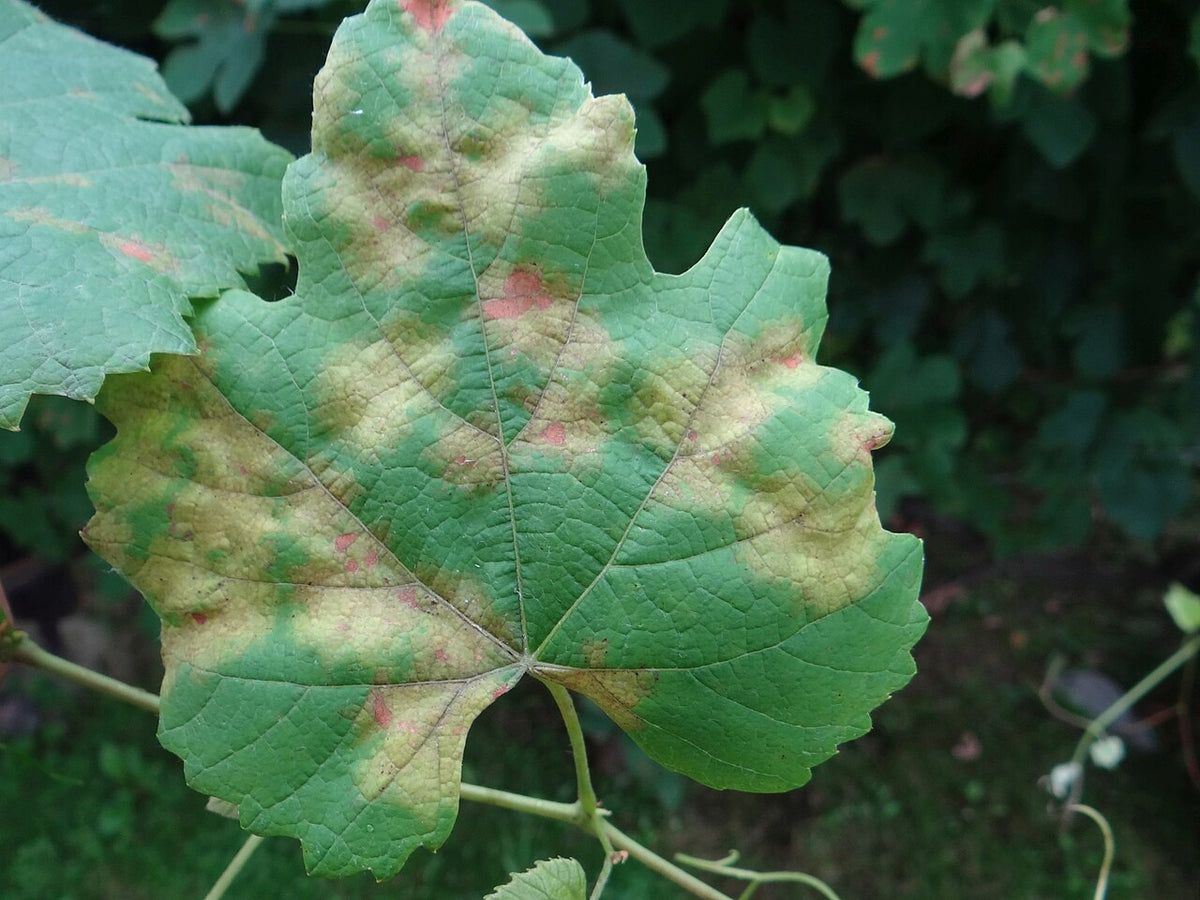
Photo at the top: Grape leaf, upper side: yellow patches of downy mildew. Photo: Jerzy Opioła, CC BY-SA 4.0
Quick answer
Downy mildew of grapes is a leaf and bunch disease caused by a fungus-like water mould, Plasmopara viticola. It makes yellow, oily patches on top of the leaf, with white, fluffy growth right under each patch. It spreads fast in cool, wet weather. Control it with an open canopy, clean pruning and label-approved fungicide sprays at the first sign.
Downy mildew also attacks maize, onion and cucurbits such as cucumber. Each crop has its own downy mildew organism. The grape one does not spread to maize or cucumber, and the other way round. But they look alike, need similar weather, and are managed in similar ways. This guide covers all four crops.
How to identify downy mildew of grapes and other crops
Check both sides of the leaf. The key sign is a yellow or pale patch on the upper side with white, grey or purplish fluffy growth on the underside, right below it. The growth is easiest to see early in the morning, after a humid night.
Downy mildew symptoms in grapes
Pale yellow, oily-looking patches appear on the upper side of young leaves. Farmers often call them "oil spots". Hold the leaf up to the light and the patch looks see-through. Under each patch, a white, downy growth forms. Later the patches turn brown and dry, and leaves fall early. Tender shoots stay short, and brown, sunken marks can form on the stem. Young shoots, flower bunches and young berries can be covered with white growth. Infected berries turn hard, leathery and shrivel. Berries infected later can turn soft, but their skin does not crack.

Downy mildew in cucumber and other cucurbits
Small yellow spots appear on the upper side of older leaves. The spots are angular, because the leaf veins limit them, so a leaf looks like a mosaic of yellow blocks. Grey to purplish growth forms underneath. Leaves turn brown and dry, and fruits get sunburnt or stay small.

Downy mildew in maize
Leaves show pale yellow or whitish stripes running along the leaf. A white, downy growth appears on the leaf, mostly in the early morning. Plants infected young stay short, look pale and may give small or no cobs. In some types of maize downy mildew, the tassel is deformed.

Downy mildew in onion
Pale, oval patches appear on the leaves, with violet-grey growth on them in humid weather. The leaf bends and dries from the patch upwards.
Look-alikes: how to tell downy mildew apart
- Powdery mildew: white, dusty powder mostly on the upper side of the leaf. It likes dry days and humid nights. Downy mildew growth is mostly underneath and needs wet leaves. See our guide to powdery mildew in chilli, grapes, mango and wheat.
- Nutrient deficiency in maize: zinc or magnesium shortage can also cause pale stripes, but there is no white growth on the leaf. Read more on zinc deficiency signs in crops.
- Virus diseases: yellow mosaic patterns in cucurbits, with no growth under the leaf.
- Anthracnose in grapes: small dark spots with a grey centre and a dark edge on leaves, shoots and berries, with no white growth underneath. See anthracnose of chilli, mango and grapes.
Life cycle: weather and season when downy mildew attacks
The disease spreads by spores carried by wind and rain splash. Spores need a film of water on the leaf to infect, so the disease grows fast in cool weather with rain, fog or heavy dew. For grapes, Tamil Nadu Agricultural University (TNAU) gives 20–22°C and 80–100% humidity as the conditions in which it grows most. The organism survives between seasons in infected leaves, shoots and twigs, and in the soil as tough resting spores.
In Telangana, Andhra Pradesh and the rest of South India, grapes are most at risk when new shoots grow during rain or heavy dew. Vines here are pruned twice a year. The weeks after the October (fruit) pruning are the riskiest, because new shoots and flower bunches come out while late rains are still falling. Maize is at risk in kharif, when the weather is humid and the crop is young. In maize, the disease can also come from infected seed and soil, and from wild grasses and sorghum nearby. Cucurbits are at risk in the rainy season and in cool, foggy winter months.
Crops downy mildew attacks
Grapes: attacks leaves, young shoots, flower bunches and young berries. Infection at flowering and fruit set does the most harm, because bunches can be lost.
Maize: young plants, up to about a month old, are the most at risk. Plants infected early stay stunted and give poor cobs.
Cucurbits (cucumber, melons, gourds): older leaves are hit first. Leaf loss cuts yield and fruit quality.
Onion: leaves collapse early, so bulbs stay small. Seed crops are also affected.
When to spray for downy mildew
There is no pest count for a disease, so spray timing depends on weather and first symptoms. Downy mildew fungicides do their job before infection or at the very first sign. Once the white growth is spread across the crop, control is much harder.
- Watch closely after rain, fog or heavy dew, and after new flushes of growth in grapes. In grapes, the weeks from new shoot growth to berry set after pruning need the closest watch.
- Check the underside of leaves in the morning, at least twice a week in wet spells.
- Spray at first symptoms, or before, if the weather is wet and the disease was in the field last season. The labels below give the timing for each product.
Control downy mildew without chemicals
- Open the canopy: in grapes, prune and train so that air moves through the vine and leaves dry quickly. Remove extra shoots and leaves around the bunches.
- Water the soil, not the leaves: use drip or furrow irrigation, and avoid overhead sprinklers. Irrigate in the morning so the field dries by night.
- Remove sources: cut and destroy infected shoots and leaves. After harvest, clear fallen leaves and crop waste.
- Spacing and drainage: wider spacing and good drainage keep leaves drier, mainly in cucurbits and onion.
- Maize: use resistant hybrids and seed from a healthy crop. Pull out and destroy plants with stripes early, before they spread spores. Remove wild grasses and infected sorghum plants near the field, and rotate with a crop that is not a cereal.
- Cucurbits: grow on a trellis where possible, so leaves dry faster. Use tolerant varieties where your seed dealer has them.
Chemical control of downy mildew, crop by crop
Use only a product whose label lists your crop and downy mildew. Doses below are per acre, from each product's official label. Where a label gives only a spray strength, it is shown as written.
Grapes
- Indofil M45 Fungicide (mancozeb 75% WP): label dose 0.6–0.8 kg per acre in 300 L water, as a foliar spray.
- Polyram - Fungicide (metiram 70% WG): label dose 809 g per acre in 200–300 L water.
- Companion Fungicide (carbendazim 12% + mancozeb 63% WP): a ready-mixed product with two actives, approved on the label. Dose as per label: 0.15% spray (formulation), water as required for the crop canopy.
- Saaf Fungicide (carbendazim 12% + mancozeb 63% WP): a ready-mixed product, approved on the label. Dose as per label: 0.15% spray (1.5 g per litre water), water as required for the crop canopy.
- Saafilizer Systemic and Contact Fungicide (carbendazim 12% + mancozeb 63% WP): a ready-mixed product, approved on the label. Dose as per label: 0.15% spray (formulation), water as required for the crop canopy.
Companion, Saaf and Saafilizer contain the same two actives at the same strength. Choose one of them.
Maize
- Indofil M45: label dose 0.6–0.8 kg per acre in 300 L water, as a foliar spray.
- Companion: label dose 405 g per acre in 200 L water.
- Saaf: label dose 405 g per acre in 200 L water, as soon as disease symptoms appear.
- Amistar Top Fungicide (azoxystrobin 18.2% + difenoconazole 11.4% SC): a ready-mixed product, approved on the label. Dose as per label: 0.1%, or 1 ml per litre water, with 1–2 sprays when the disease appears.
Onion
- Amistar Top: dose as per label, 0.1% or 1 ml per litre water, with 1–2 sprays when the disease appears.
Cucumber and other cucurbits
None of the products in our range has a label for downy mildew in cucurbits. Ask your local agriculture officer or Krishi Vigyan Kendra (KVK) for an approved fungicide, and use the field steps above.
Never mix two fungicides in one tank yourself. Use only the ready-mixed products above.
Rotate fungicides to avoid resistance
FRAC, the international body that groups fungicides by how they act, gives each active ingredient a code.
| FRAC group | Products | Resistance risk |
|---|---|---|
| M3 | Indofil M45 (mancozeb), Polyram (metiram) | Low. These act at many points in the fungus. |
| 1 + M3 | Companion, Saaf, Saafilizer (carbendazim + mancozeb) | Group 1 is high; the mancozeb part is low. |
| 11 + 3 | Amistar Top (azoxystrobin + difenoconazole) | Group 11 is high. |
Downy mildew can quickly stop responding to group 11 fungicides. Do not use Amistar Top more times than the label allows, and do not spray it twice in a row. Alternate it with a group M3 product. Group M3 products protect the leaf surface, so spray them before infection or at first signs, and repeat after heavy rain washes them off, within the label limits.
Safety and waiting period
| Product | Crop | Waiting period before harvest |
|---|---|---|
| Indofil M45 | Grapes, maize | 20 days |
| Polyram | Grapes | 7 days |
| Companion, Saaf, Saafilizer | Grapes | 7 days |
| Companion, Saaf | Maize | 37 days |
| Amistar Top | Maize | 26 days |
| Amistar Top | Onion | 7 days |
- Wear gloves, a mask, goggles and full-sleeve clothes while mixing and spraying.
- The Amistar Top and Saaf labels warn that they are toxic to fish. Do not use them near fish ponds or in rice-fish fields, and do not wash sprayers in ponds or canals.
- Keep products away from children, animals, food and water sources.
- Read the label and leaflet before use.
Frequently asked questions
What causes downy mildew of grapes?
A fungus-like water mould called Plasmopara viticola. Its spores spread by wind and rain splash, and infect only when the leaf stays wet. It survives between seasons in fallen leaves, shoots and twigs. So clearing crop waste after pruning cuts the risk.
How is downy mildew different from powdery mildew?
Downy mildew makes yellow patches on top of the leaf with fluffy growth underneath, and it needs wet weather. Powdery mildew is a dry, white powder mostly on the upper side, and it likes dry days. See our powdery mildew article.
Which fungicide can I use for downy mildew in cucumber?
None of the products in our current range has a label for downy mildew in cucumber or other cucurbits. Ask your agriculture officer for an approved product, and keep leaves dry with drip irrigation, spacing and a trellis.
Should I spray before I see the disease in grapes?
In wet weather, yes, if your vineyard had downy mildew before. Products like mancozeb and metiram protect the leaf but cannot cure an infection that is already inside. Follow the label for timing and number of sprays.
Can grape leaves recover after downy mildew?
No. Leaves and bunches already hit by the disease will not turn green again. Sprays protect the new growth. Remove badly infected shoots, and keep checking the new leaves after each rain.
Can downy mildew in maize come from the seed?
Yes, some maize downy mildews can spread through infected seed and also survive in the soil. Use seed from a healthy crop and resistant hybrids, and pull out striped plants early.
Related reading
- Powdery mildew: symptoms and fungicides for chilli, grapes, mango and wheat
- Anthracnose of chilli, mango and grapes: symptoms and control
- Late blight of potato and tomato, another water mould disease
- Early blight of tomato and potato: symptoms and control
- Fall armyworm in maize: how to identify and control it
- Shop all fungicides
Sources
- Tamil Nadu Agricultural University (TNAU) Agritech Portal, Grapes: downy mildew (symptoms, survival, temperature and humidity).
- Fungicide Resistance Action Committee (FRAC), FRAC Code List (fungicide groups).
- The official label and leaflet of each product named above (doses and waiting periods).
Products that control it, by crop
Maize
- Indofil M45 Fungicide0.6–0.8 kg per acreFoliar spray.
- Companion Fungicide405 g per acre
- Saaf Fungicide405 g per acreSpray as soon as disease symptoms appear.
- Amistar Top FungicideSpray 1 ml per litre of water (0.1%) when the disease appears; 1-2 sprays
Grapes
- Indofil M45 Fungicide0.6–0.8 kg per acreFoliar spray.
- Polyram - Fungicide809 g per acre
- Companion FungicideSpray 0.15% (1.5 g per litre of water). Use enough water to cover the whole crop canopy.
- Saaf FungicideSpray 0.15% (1.5 g per litre of water). Use enough water to cover the whole crop canopy.
- Saafilizer Systemic and Contact FungicideSpray at 0.15% (1.5 g per litre of water). Use enough water to cover the whole crop canopy.
Onion
- Amistar Top FungicideSpray 1 ml per litre of water (0.1%) when the disease appears; 1-2 sprays
Do not spray the same product again and again. Change to a product with a different mode of action (the group number on the label) so the pest or disease does not build resistance.
As printed on the brand's official label. Read the label before use.


Like these farming tips? Add AgriVruddhi as a preferred source on Google
Back to Crop Health Guide