
Anthracnose of chilli, mango and grapes: symptoms and control
· By AgriVruddhi
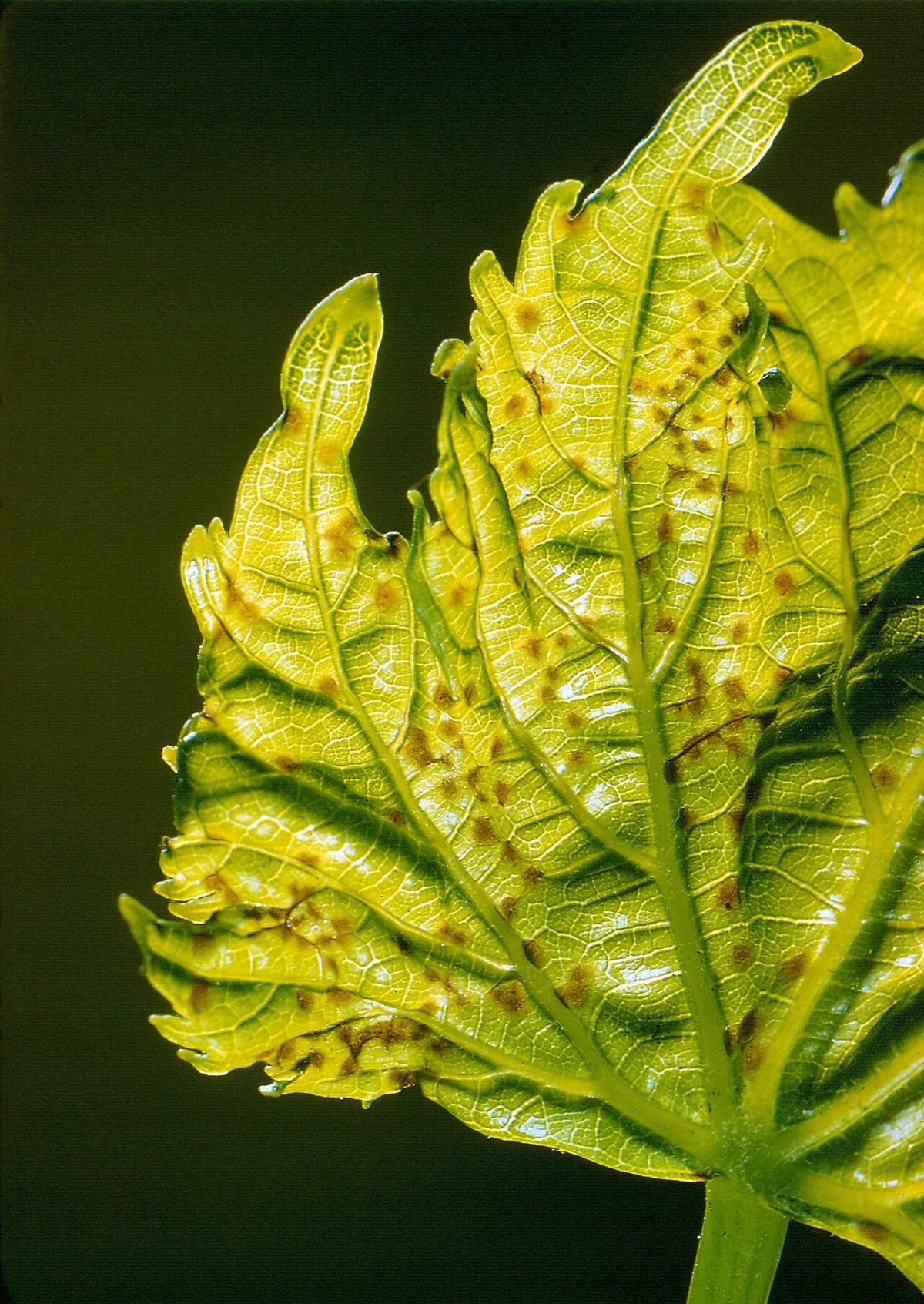
Photo at the top: Small brown anthracnose spots on young grape leaves, Photo: E.A. Lawton, CSIRO, CC BY 3.0
Quick answer
Anthracnose of chilli is a fungal disease that makes dark, sunken spots on fruits (fruit rot) and dries shoot tips from the top down (die-back). Spotted pods shrivel, lose colour and pungency, and fetch a poor price. Control it with clean seed, field hygiene and good air flow, and spray a label-approved fungicide when wet weather comes.
The same name is used for similar diseases of mango, grapes and watermelon, so this guide covers them too.
How to identify anthracnose of chilli
In chilli the disease has two main forms.
- Fruit rot: small, round, dark spots appear on the fruits, most often as they ripen. The spots sink in and grow larger. Tiny black dots, which are the fungus's spore bodies, form inside the spots, often in rings. In wet weather the spots may show a pink or orange, slimy layer of spores. Ripe red fruits are hit harder than green ones. Tamil Nadu Agricultural University (TNAU) notes that badly infected fruits turn straw-coloured or pale white and lose their pungency. The seeds inside can also be infected.
- Die-back: tender shoot tips dry from the tip backwards. The dead twigs turn grey or straw-coloured, with black dots on them. TNAU notes that infection usually begins when the crop is in flower: flowers drop, flower stalks dry, and the drying spreads down into the branch. Plants that are partly affected bear fewer fruits of low quality.
- Leaves: small, dark spots may also appear on leaves in wet weather.
The fungus that causes anthracnose in chilli belongs to the group called Colletotrichum. The main species in India has long been known as Colletotrichum capsici. It is one of the most damaging chilli diseases in India, because it spoils the fruit itself.
Look-alikes and how to tell them apart
- Sunscald: pale, papery patches on the side of the fruit facing the sun. There are no black dots or rings.
- Fruit borer damage: a clean, round hole made by a caterpillar, often with droppings. Anthracnose spots are sunken patches, not holes. See our guide to Helicoverpa fruit borer control.
- Cercospora leaf spot: round leaf spots with a pale grey centre and a dark edge, often called frog-eye spots. These stay on the leaves. Anthracnose does most of its harm on fruits and shoot tips.
- Virus problems (leaf curl): leaves curl and crinkle and the plant stays small. There are no sunken fruit spots. Leaf curl in chilli is linked to sucking pests, see our guide to thrips control in chilli.
Life cycle and when it attacks
The fungus survives on infected seed, on dead twigs and on fallen fruits left in the field. When it rains, water splashes the spores onto healthy fruits and shoots. Warm, wet and humid weather helps it spread fast, and fruits that stay wet for long hours get infected most.
In Telangana and Andhra Pradesh, chilli is planted in the kharif season and the fruits ripen in the cooler months. Rain, cloudy weather or heavy dew while fruits are turning red raises the risk of fruit rot. Die-back is more common earlier, in the rainy months.
Anthracnose of chilli does not stop at harvest. Fruits picked with hidden infection can keep rotting while they dry in the yard and in storage, especially if they get wet or dry slowly.
Crops it attacks
Chilli: fruit rot on green and ripening fruits, and die-back of shoot tips. Fruit rot hurts the most, because it lowers both the weight and the price of dry chilli.
Mango: caused by a related fungus, Colletotrichum gloeosporioides. It makes black spots on young leaves. At flowering it causes blossom blight: dark spots on the flower stalks, and the flowers dry and drop. On ripening fruits it makes black, sunken spots that rot the fruit, often after harvest. Rain, fog or dew at flowering time favours it.
Grapes: grape anthracnose is caused by a different fungus (Elsinoe ampelina), but labels and farmers use the same name. It makes small dark spots with grey centres on young leaves, which may fall out and leave holes. On shoots it makes sunken, dark cankers. On berries it makes round spots with a light centre and a dark edge, often called "bird's eye" spots. Rain on fresh growth, for example after pruning, favours it.
Watermelon: brown to black spots on leaves, and sunken, dark spots on stems and fruits in warm, wet weather.
Tomato and banana: anthracnose also causes sunken spots on ripe tomato fruits and black spots on ripening bananas. No product in our store has these crops on its anthracnose label, so ask the store or your agriculture officer for advice.
When to spray
We could not confirm a published economic threshold (a fixed level of disease at which spraying starts to pay) for anthracnose from TNAU or another public source. For a disease like this, the fungicide labels themselves say when to spray: as a protective spray before the disease shows, or at the first sign. In chilli, watch closely from flowering, and act quickly if rain or dew is expected while fruits are ripening.
Control without chemicals
- Clean seed: save seed only from healthy fruits of healthy plants, or buy good-quality seed. The fungus can travel inside seed. Ask your agriculture officer about seed treatment.
- Remove sources: pick and destroy spotted fruits. Cut dried twigs below the dead part and burn or bury them away from the field.
- Air and water: use proper spacing so leaves and fruits dry quickly. Avoid waterlogging and water that splashes onto the plants.
- Timely picking: pick ripe chilli on time. Ripe fruits left on the plant in wet weather get infected more.
- Clean drying: dry picked chilli quickly on a clean tarpaulin or cement floor, not on bare wet soil. Remove spotted pods before drying and before storage, and keep the produce dry.
- Variety: no chilli variety is fully resistant. Ask your local Krishi Vigyan Kendra (KVK) or agriculture officer which tolerant varieties do well in your area.
- Crop rotation: do not grow chilli in the same field year after year. Clear crop waste after harvest.
- Mango and grapes: prune out dead and diseased twigs and canes, and burn them. Remove fallen leaves and fruits. Keep the canopy open for air flow.
Fungicides for anthracnose, crop by crop
Only the products below list this crop and anthracnose (or its label names: die back, fruit rot, ripe rot) on their label or, where marked, the company leaflet. Where a label gives a dose per area, we show it per acre. Where the label gives only a strength per litre of water, we say "dose as per label" and quote it. Use one product per spray. Do not mix products in one tank. Most products below are ready-mixed products with two active ingredients, approved on the label as one product.
Chilli
- Kavach Flo Fungicide (chlorothalonil 40% + difenoconazole 4% SC), a ready-mixed product approved on the label. Label target: "Powdery Mildew, Anthracnose, Fruit rot". Label dose 405 ml per acre in 200 L water. First spray as a protective spray or at the first sign, one more after 10–15 days, and no more than two sprays per season. Waiting period before harvest: 7 days.
- Amistar Top Fungicide (azoxystrobin 18.2% + difenoconazole 11.4% SC), a ready-mixed product approved on the label. Label target: "Anthracnose & Powdery Mildew". Dose as per label: the label gives "0.1% or 1 ml per litre water", with 1–2 sprays when the disease appears. Waiting period: 5 days.
- Galileo Sensa Fungicide (picoxystrobin 6.78% + tricyclazole 20.33% SC), a ready-mixed product. Its chilli leaflet (in Hindi) lists anthracnose. Leaflet dose 400 ml per acre in 200 L water, as a protective spray; for red chilli, as soon as fruits start turning red. No more than 3 sprays per crop. The leaflet does not print a waiting period, so ask the store before use. It also warns that no residue limit is set for chilli, so take care if your chilli is meant for export.
- Score Fungicide (difenoconazole 25% EC). Label target: "Die Back" and "Fruit Rot", listed as two diseases. Dose as per label: "0.05% or 50 ml per 100 L water", sprayed when the disease appears, in 200–400 L water per acre. Waiting period: 15 days.
- Indofil M45 Fungicide (mancozeb 75% WP). Label target: "Fruit rot; Ripe rot". Label dose 0.6–0.8 kg per acre in 300 L water, as a foliar spray. Waiting period: 10 days.
- Custodia Fungicide (azoxystrobin 11% + tebuconazole 18.3% SC), a ready-mixed product. Per the company leaflet (not the official label), it is for chilli "Fruit rot, Powdery mildew & Dieback". Leaflet dose 240 ml per acre. The leaflet does not print the water volume, spray timing or waiting period, so ask the store before use.
Grapes
- Score Fungicide (difenoconazole 25% EC). Label target: "Anthracnose". Dose as per label: "0.03% or 30 ml per 100 L water", sprayed when the disease appears. Waiting period: 10 days.
- Indofil M45 Fungicide (mancozeb 75% WP). Label target: "Angular leaf spot; Downey mildew; Anthracnose" (spelling as printed). Label dose 0.6–0.8 kg per acre in 300 L water, as a foliar spray. Waiting period: 20 days.
- Companion Fungicide (carbendazim 12% + mancozeb 63% WP), a ready-mixed product approved on the label. Label target: "anthracnose". Dose as per label: "0.15% spray (formulation), water as required depending on crop canopy". Waiting period: 7 days.
- Saaf Fungicide (carbendazim 12% + mancozeb 63% WP), a ready-mixed product approved on the label. Label target: "Downy mildew, Powdery mildew & Anthracnose". Dose as per label: "0.15% spray (1.5 g per litre water)", water as required for the canopy. Waiting period: 7 days.
- Saafilizer Systemic and Contact Fungicide (carbendazim 12% + mancozeb 63% WP), a ready-mixed product approved on the label. Label target: "anthracnose". Dose as per label: "0.15% spray (formulation), water as required depending on crop canopy". Waiting period: 7 days.
Mango
- Companion. Label target: "anthracnose". Dose as per label: "0.15% spray (formulation)", water as required for the tree canopy. Waiting period: 7 days.
- Saaf. Label target: "Powdery mildew & Anthracnose". Dose as per label: "0.15% spray (1.5 g per litre water)". Waiting period: 7 days.
- Saafilizer. Label target: "anthracnose". Dose as per label: "0.15% spray (formulation)", water as required for the tree canopy. Waiting period: 7 days.
Watermelon
- Indofil M45. Label target: "Anthracnose". Label dose 0.6–0.8 kg per acre in 300 L water. Waiting period: 10 days.
Companion, Saaf and Saafilizer contain the same two active ingredients, so treat them as one product when you plan sprays.
Rotate to avoid resistance
Fungicides are grouped by how they act on the fungus. This is called the mode of action, and the international FRAC system gives each group a code. Fungi can become resistant when the same group is used again and again. FRAC rates groups 1 and 11 as high risk for resistance. Groups marked M act on many parts of the fungus at once, so the risk is low.
| FRAC group | Active ingredient | Products here |
|---|---|---|
| M05 + 3 | chlorothalonil + difenoconazole | Kavach Flo |
| 11 + 3 | azoxystrobin + difenoconazole | Amistar Top |
| 11 + 16.1 | picoxystrobin + tricyclazole | Galileo Sensa |
| 11 + 3 | azoxystrobin + tebuconazole | Custodia |
| 3 | difenoconazole | Score |
| M03 | mancozeb | Indofil M45 |
| 1 + M03 | carbendazim + mancozeb | Companion, Saaf, Saafilizer |
In chilli, Amistar Top and Galileo Sensa both carry a group 11 ingredient, and Amistar Top and Kavach Flo both carry difenoconazole (group 3). So do not spray Amistar Top straight after either of them. A simple order is Kavach Flo first, then Galileo Sensa, keeping within each label's limit on the number of sprays. Custodia also carries groups 11 and 3, so do not spray it straight after Amistar Top, Galileo Sensa, Kavach Flo or Score; put a product from a different group in between, such as Indofil M45 (mancozeb, group M03). In grapes and mango, switch between a product with group 1 and one without it, for example Companion, then Score or Indofil M45 in grapes.
Safety and waiting period
The waiting period (pre-harvest interval, or PHI) is the number of days between the last spray and harvest. It is given with each product above and changes by crop: for example, Indofil M45 needs 20 days on grapes but 10 days on watermelon.
- Wear gloves, a mask, full-sleeve clothes and boots while mixing and spraying. Wash well afterwards.
- Keep products locked away from children, animals and food.
- Do not spray just before rain, as it washes the fungicide off. Do not wash sprayers in ponds or streams.
- Mango and grape flowers are visited by bees and other insects. Spray in the late evening where possible, and follow any warning on the label.
Read the label and leaflet before use.
Anthracnose of chilli: farmer questions
What are the symptoms of anthracnose in chilli?
Dark, sunken, round spots on the fruits, often with black dots in rings, and shoot tips that dry from the top down. Badly hit pods turn pale or straw-coloured and lose pungency.
What causes anthracnose in chilli?
A fungus from the Colletotrichum group. It survives on seed and crop waste and spreads by rain splash in warm, wet weather.
Which fungicide is used for anthracnose in chilli?
In our store, six products are listed for anthracnose on chilli: Kavach Flo, Amistar Top, Galileo Sensa, Score, Indofil M45 and Custodia. Some labels name it die back, fruit rot or ripe rot, and Galileo Sensa and Custodia are listed on the company leaflet. Use them at the label or leaflet dose and rotate as shown above.
Can anthracnose spread through chilli seed?
Yes. The fungus can live inside seed from infected fruits. Use seed from healthy fruits only, and ask your agriculture officer about seed treatment.
Is grape anthracnose the same disease as chilli anthracnose?
No. They share a name and look somewhat alike, but a different fungus causes grape anthracnose. Use only products whose label names your crop.
Related reading
- Powdery mildew of chilli, grapes and mango: symptoms and fungicides
- Downy mildew of grapes: how to identify and control it
- Thrips control in chilli, cotton and onion
- Early blight of tomato and potato: symptoms and control
- Shop chilli crop care products and all fungicides
Sources
- Tamil Nadu Agricultural University, TNAU Agritech Portal: Chilli fruit rot and die-back
- Fungicide Resistance Action Committee (FRAC): FRAC Code List 2024
- Product labels and leaflets of the fungicides named above
Products that control it, by crop
Chilli
- Kavach Flo Fungicide405 ml per acreFoliar spray as prevention or at the first sign of disease; one more spray after 10-15 days; max 2 sprays per season
- Amistar Top FungicideSpray 1 ml per litre of water (0.1%) when the disease appears; 1-2 sprays
- Galileo Sensa Fungicide400 ml per acreProtective spray. For red chilli, spray as soon as fruits start turning red. Max 3 sprays per crop.
- Custodia Fungicide240 ml per acreSpray on the leaves.
- Score FungicideSpray 0.5 ml per litre of water (0.05%) when the disease first appears.
- Indofil M45 Fungicide0.6–0.8 kg per acreFoliar spray.
Grapes
- Score FungicideSpray 0.3 ml per litre of water (0.03%) when the disease first appears.
- Indofil M45 Fungicide0.6–0.8 kg per acreFoliar spray.
- Companion FungicideSpray 0.15% (1.5 g per litre of water). Use enough water to cover the whole crop canopy.
- Saaf FungicideSpray 0.15% (1.5 g per litre of water). Use enough water to cover the whole crop canopy.
- Saafilizer Systemic and Contact FungicideSpray at 0.15% (1.5 g per litre of water). Use enough water to cover the whole crop canopy.
Watermelon
- Indofil M45 Fungicide0.6–0.8 kg per acreFoliar spray.
Mango
- Companion FungicideSpray 0.15% (1.5 g per litre of water). Use enough water to cover the whole crop canopy.
- Saaf FungicideSpray 0.15% (1.5 g per litre of water). Use enough water to cover the whole crop canopy.
- Saafilizer Systemic and Contact FungicideSpray at 0.15% (1.5 g per litre of water). Use enough water to cover the whole tree.
Do not spray the same product again and again. Change to a product with a different mode of action (the group number on the label) so the pest or disease does not build resistance.
As printed on the brand's official label. Read the label before use.


Like these farming tips? Add AgriVruddhi as a preferred source on Google
Back to Crop Health Guide