
Powdery mildew fungicide guide for chilli, grapes, mango and wheat
· By AgriVruddhi
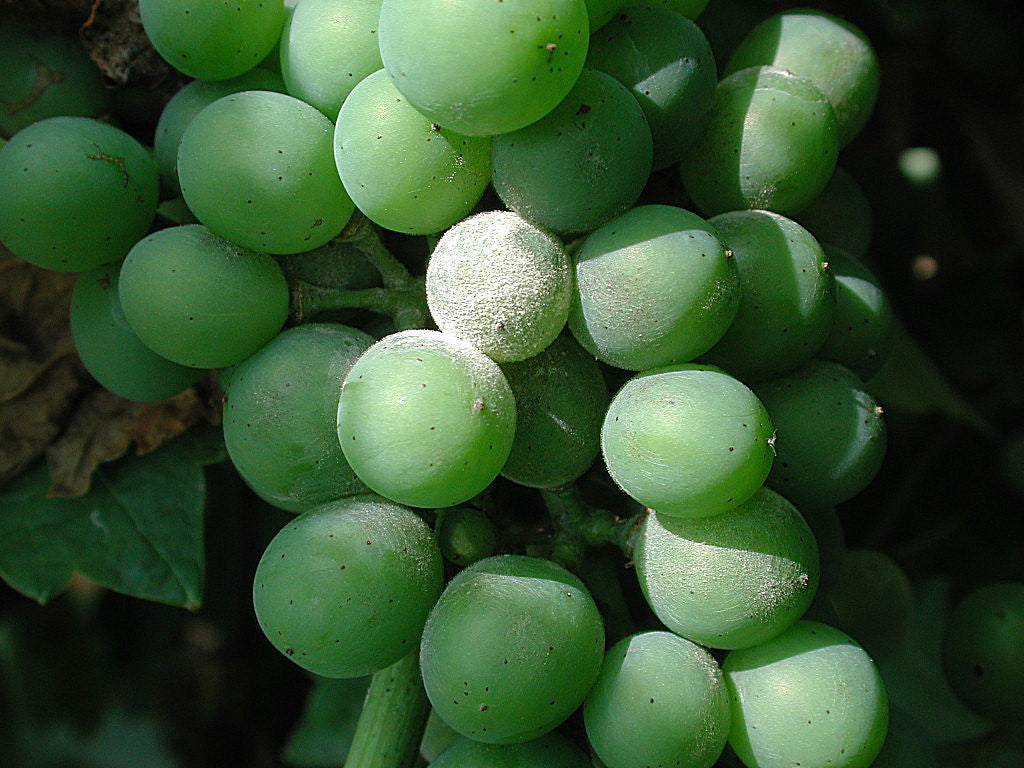
Photo at the top: Powdery mildew on grape berries, Photo: Bauer Karl, CC BY 3.0
Quick answer
Powdery mildew is a fungal disease that covers leaves, flowers and fruit with white or grey powder. It makes leaves fall and cuts fruit set in chilli, grapes, mango and wheat. To control it, open the crop to air and sun, remove infected parts, and spray a powdery mildew fungicide labelled for your crop at the first sign of powder.
This guide shows how to spot it on each crop, when to spray, and which fungicide labels list your crop, with the dose per acre and the waiting period before harvest.
Powdery mildew symptoms: how to identify it
In Telangana and Andhra Pradesh, farmers call it boodida tegulu (ash disease). In Hindi it is often called chhachhya. The disease is easy to spot once you know where to look. The powder is the fungus itself: its threads and spores sit on the plant surface. You can wipe it off with a finger, but a yellow or brown mark stays underneath.
- Chilli: white powdery growth, mostly on the lower side of the leaf. The upper side shows pale yellow patches. Badly hit leaves fall, and the plant is left with bare stems.
- Grapes: white powder mostly on the upper side of leaves, on young shoots and on bunches. Leaves become misshapen. Infected flowers drop, and older berries crack.
- Mango: white powder on flower panicles, young leaves and tiny fruits. Flowers and small fruits drop, so the fruit set is poor.
- Wheat and pea: grey-white fluffy pads on leaves and stems. Later the patches can show tiny black dots, which are the resting bodies of the fungus.
- Cucurbits (cucumber, bottle gourd, bitter gourd, melons, pumpkin): round white powdery spots on both sides of the leaf that join and cover it.
Look-alikes and how to tell them apart
- Downy mildew: shows yellow, angular spots on the upper side of the leaf, with grey or purple-grey fuzzy growth on the underside. It needs wet weather. Powdery mildew is a dry white powder and spreads in dry weather too. Grape and cucurbit growers often see both, so look closely.
- Whiteflies, mealybugs and their wax: these are insects. Look with a hand lens: they move, or they have a body and legs. Powdery mildew has no shape, only powder.
- Spray or dust residue: wipes off and leaves clean green tissue underneath. Powdery mildew leaves a yellow or brown patch.
Life cycle and when it attacks
Powdery mildew is caused by a different fungus on each crop. On chilli it is Leveillula taurica, on grapes Erysiphe necator, on mango Oidium mangiferae, on wheat Blumeria graminis and on pea Erysiphe pisi. They all behave in a similar way.
- The spores are very light and travel on the wind from field to field. In warm weather a new crop of spores can form in about a week, so the disease spreads fast once it starts.
- Unlike most leaf diseases, the spores do not need water drops on the leaf to start an infection. Warm days, cool nights, cloudy or misty weather and medium humidity suit them well. TNAU notes that sultry, warm, cloudy weather is very favourable on grapes.
- The fungus survives between seasons in infected shoots and buds (grapes, mango), in crop debris, and on volunteer plants and weeds.
- Heavy rain washes spores off the leaves. That is why the disease often grows fastest in dry spells with cloudy or misty weather, not in the middle of a wet spell.
- Dense, shaded crops and heavy nitrogen give soft leaves that the fungus attacks more easily.
In Telangana and Andhra Pradesh, chilli is often hit from the flowering stage in the cooler months of late kharif and rabi. Mango is at risk during flowering, roughly December to February, especially in misty or cloudy weather. Wheat and pea in north and central India see it in the winter crop.
Crops it attacks and the damage it does
Chilli: powdery mildew disease in chilli attacks from flowering onwards, often on older leaves first. Leaf fall exposes the fruit to sun scald, and yield drops.
Grapes: powdery mildew in grapes attacks young shoots, leaves and bunches. Infection at flowering cuts fruit set, and infected berries crack and rot.
Mango: the flowering stage is the danger point. Infected panicles dry, and flowers and pea-sized fruits drop.
Wheat: attacks leaves, sheaths and sometimes the ear from tillering onwards. Heavy attack shrivels the grain.
Pea and other pulses: attacks leaves, stems and pods, mostly in the second half of the crop.
Cucurbits: attacks leaves at any stage, often from fruiting onwards. Leaves dry early and fruits stay small.


When to spray a powdery mildew fungicide
We could not confirm an economic threshold (the disease level at which spraying pays) for powdery mildew from a recognised public source, so we do not give one here. The labels in this article say to spray when the disease first appears, and some allow a protective spray before it appears. In practice, check the crop twice a week in risky weather. In chilli, turn the leaves over and look at the underside. In mango, check the new panicles. Spray when you first see the powder, not when the leaves are already falling. A fungicide protects healthy leaves and stops new spread. It will not make white, dried leaves green again.
Control without chemicals
- Variety: ask your KVK or agriculture officer for tolerant varieties of your crop for your area.
- Air and sun: use the recommended spacing. In grapes and mango, prune so that light and air reach inside the canopy.
- Nitrogen: do not overdo urea. Soft, lush growth catches the disease faster.
- Clean up: pick off and destroy the first infected leaves, shoots or panicles. Remove crop debris after harvest and keep the field free of weeds and volunteer plants that carry the fungus.
- Do not grow susceptible crops back to back in the same field when you can avoid it.
- Biological products: some registered biological fungicides are sold for powdery mildew. Use only those whose label names your crop.
Powdery mildew fungicide for each crop
Only the products below have the crop and powdery mildew on their official label or leaflet. Doses are per acre, as printed on the label or converted from the label's per-hectare dose. Where the label gives only a strength per litre of water, we say "dose as per label" and quote it. Spray one product at a time. Do not mix products in one tank.
Chilli
| Product | Contains | Label dose per acre | Water per acre | Wait before harvest |
|---|---|---|---|---|
| Saaf Fungicide | Carbendazim 12% + Mancozeb 63% WP | 304 g | 200 L | 3 days |
| Companion Fungicide | Carbendazim 12% + Mancozeb 63% WP | 304 g | 200 L | 3 days |
| Amistar Top Fungicide | Azoxystrobin 18.2% + Difenoconazole 11.4% SC | Dose as per label: 0.1%, or 1 ml per litre of water | 200 L | 5 days |
| Kavach Flo Fungicide | Chlorothalonil 40% + Difenoconazole 4% SC | 405 ml | 200 L | 7 days |
| Galileo Sensa Fungicide | Picoxystrobin 6.78% + Tricyclazole 20.33% SC | 400 ml | 200 L | Not printed on the brand leaflet |
| Armatura Fungicide | Polyoxin D Zinc Salt 5% SC | 240 ml | Not given | The brand booklet says zero days |
- Saaf: spray as soon as symptoms appear. Amistar Top: one or two sprays when the disease appears.
- Kavach Flo: first spray as a protective spray or at the first sign of disease, one more after 10–15 days. No more than two sprays in a season.
- Galileo Sensa: a protective spray. For red chilli, spray as soon as the fruits start turning red. No more than three sprays per crop. The brand leaflet notes that no residue limit (MRL) is set for it on chilli, so take care if your chilli is for export.
- Armatura: our dose comes from the brand's product booklet, not the printed label. Check the pack label before use.
Grapes
| Product | Label dose | Water | Wait before harvest |
|---|---|---|---|
| Saaf | Dose as per label: 0.15% spray, or 1.5 g per litre of water | As needed to cover the canopy | 7 days |
| Companion | Dose as per label: 0.15% spray | As needed to cover the canopy | 7 days |
| Saafilizer Systemic and Contact Fungicide | Dose as per label: 0.15% spray | As needed to cover the canopy | 7 days |
| Score Fungicide (Difenoconazole 25% EC) | Dose as per label: 0.03%, or 30 ml per 100 L of water | 200 L per acre | 10 days |
| Insulf Gold Contact Fungicide (Sulphur 80% WDG) | 0.8–1.0 kg per acre | 300–400 L per acre | Not printed on the label |
| Armatura | 240 ml per acre | Not given | The brand booklet says zero days |
Mango
| Product | Label dose | Water | Wait before harvest |
|---|---|---|---|
| Saaf | Dose as per label: 0.15% spray, or 1.5 g per litre of water | As needed to cover the canopy | 7 days |
| Companion | Dose as per label: 0.15% spray | As needed to cover the canopy | 7 days |
| Saafilizer | Dose as per label: 0.15% spray | As needed to cover the tree canopy | 7 days |
| Insulf Gold | 0.8–1.0 kg per acre | 300–400 L per acre | Not printed on the label |
Wheat
Amistar Top: dose as per label, 0.1% or 1 ml per litre of water, in 200 L water per acre. One or two sprays when the disease appears. Wait 35 days before harvest.
Pea, cowpea, guar, cumin and apple
| Crop | Product | Label dose | Wait before harvest |
|---|---|---|---|
| Pea, cowpea, guar | Insulf Gold | 0.8–1.0 kg per acre in 300–400 L water | Not printed on the label |
| Cumin | Insulf Gold | 0.8–1.0 kg per acre in 300–400 L water | Not printed on the label |
| Cumin | Score | Dose as per label: 0.05%, or 50 ml per 100 L of water; 200 L water per acre | 15 days |
| Apple | Saaf | Dose as per label: 0.25% spray, or 2.5 g per litre of water | 20 days |
| Apple | Companion | Dose as per label: 0.25% spray | 20 days |
| Apple | Avtar Fungicide (Hexaconazole 4% + Zineb 68% WP) | Dose as per label: 0.25%, or 25 g per 10 L of water, 10 L per tree | 30 days |
| Apple | Insulf Gold | 0.8–1.0 kg per acre in 300–400 L water | Not printed on the label |
Sulphur warning (Insulf Gold): the label says not to use it on sulphur-sensitive crops such as cucurbits and some apple and pear varieties, or when the temperature is 30 °C or above. Sulphur can burn leaves in heat.
Cucurbits
None of the products we stock lists cucurbits (cucumber, gourds, melons, pumpkin) for powdery mildew on its label. Do not use sulphur on these crops. Ask your local agriculture officer for a product registered for your cucurbit crop.
Rose (flower crop only)
Terraguard Fungicide (Triflumizole 42.14% SC) is labelled for powdery mildew on rose only: 342 ml per acre in 810 L water, sprayed at the first symptoms, two or three sprays depending on severity. It is not approved for any food crop. The label says that treated roses must not be used for food or medicine.
Amistar Top, Kavach Flo, Galileo Sensa, Avtar, Saaf, Companion and Saafilizer each hold two active ingredients in one pack. These are ready-mixed products approved on the label. They are not tank mixes.
Rotate to avoid resistance
Powdery mildew fungi can quickly stop responding to a fungicide that is sprayed again and again. Fungicides are grouped by how they work, using the FRAC code (from the international Fungicide Resistance Action Committee). Change the group from one spray to the next.
| FRAC group | Active ingredient | Products in this article |
|---|---|---|
| 1 (benzimidazoles) | Carbendazim | One part of Saaf, Companion and Saafilizer |
| 3 (triazoles and other DMIs) | Difenoconazole, hexaconazole, triflumizole | Score; Terraguard; one part of Amistar Top, Kavach Flo and Avtar |
| 11 (strobilurins) | Azoxystrobin, picoxystrobin | One part of Amistar Top and Galileo Sensa |
| 16.1 | Tricyclazole | One part of Galileo Sensa |
| 19 | Polyoxin D | Armatura |
| M02 (multi-site contact) | Sulphur | Insulf Gold |
| M03 (multi-site contact) | Mancozeb, zineb | One part of Saaf, Companion, Saafilizer and Avtar |
| M05 (multi-site contact) | Chlorothalonil | One part of Kavach Flo |
Saaf, Companion and Saafilizer contain the same two active ingredients. Switching between them is not a rotation. In chilli, for example, after a Saaf spray (groups 1 and M03), the next spray could be Kavach Flo (groups M05 and 3) or Galileo Sensa (groups 11 and 16.1). Keep to the number of sprays each label allows.
Safety and waiting period
- The waiting period before harvest (PHI, pre-harvest interval) for each product and crop is in the tables above. Count the days from the last spray. Where the label does not print one, ask the brand or your agriculture officer before you harvest.
- Wear gloves, a mask, full-sleeve clothes and boots while mixing and spraying. Do not eat, drink or smoke while spraying. Wash well afterwards.
- Spray in the cool morning or evening. With sulphur, never spray in the heat of the day.
- Saaf and Kavach Flo labels warn that they are toxic to fish. Keep spray and washings away from ponds and canals.
- Mango and grape growers: avoid spraying when bees are busy on the flowers.
- Read the label and leaflet before use.
Frequently asked questions
What are the symptoms of powdery mildew?
A white or grey powder on leaves, shoots, flowers or fruit. When you wipe it off, a yellow or brown patch stays. Leaves later dry and fall, and flowers and small fruits drop.
Which fungicide is used for powdery mildew?
Choose a powdery mildew fungicide whose label lists your crop and the disease. The right product is different for chilli, grapes, mango and wheat, so check the crop tables above. Change the FRAC group between sprays.
How do I control powdery mildew in grapes?
Prune to open the canopy, remove infected shoots, and start spraying at the first sign of powder. Saaf, Companion, Saafilizer, Score, Insulf Gold and Armatura list grapes for powdery mildew on their labels. Rotate between FRAC groups.
Why is powdery mildew on the underside of chilli leaves?
The chilli powdery mildew fungus grows inside the leaf and pushes its spores out mainly through the underside. That is why you must turn the leaves over to find it early, and spray to cover the underside too.
Can I use sulphur for powdery mildew on cucumber or melon?
No. The Insulf Gold label says not to use it on cucurbits, as sulphur can burn these crops. Ask your agriculture officer for a product registered on your cucurbit crop.
Related reading
- Downy mildew of grapes, maize and cucurbits: identify and control
- Anthracnose of chilli, mango and grapes: symptoms and control
- Thrips insecticide guide: control thrips in chilli, cotton and onion
- Red spider mite: how to identify and control it
- Early blight of tomato and potato: symptoms and control
- Products for chilli and all fungicides
Sources
- TNAU Agritech Portal, Tamil Nadu Agricultural University: Chilli powdery mildew
- TNAU Agritech Portal, Tamil Nadu Agricultural University: Grapes powdery mildew
- Fungicide Resistance Action Committee (FRAC): FRAC Code List 2026
- Official product labels and leaflets of each product named above
Products that control it, by crop
Grapes
- Saaf FungicideSpray 0.15% (1.5 g per litre of water). Use enough water to cover the whole crop canopy.
- Companion FungicideSpray 0.15% (1.5 g per litre of water). Use enough water to cover the whole crop canopy.
- Saafilizer Systemic and Contact FungicideSpray at 0.15% (1.5 g per litre of water). Use enough water to cover the whole crop canopy.
- Score FungicideSpray 0.3 ml per litre of water (0.03%) when the disease first appears.
Mango
- Saaf FungicideSpray 0.15% (1.5 g per litre of water). Use enough water to cover the whole crop canopy.
- Companion FungicideSpray 0.15% (1.5 g per litre of water). Use enough water to cover the whole crop canopy.
- Saafilizer Systemic and Contact FungicideSpray at 0.15% (1.5 g per litre of water). Use enough water to cover the whole tree.
Chilli
- Saaf Fungicide304 g per acreSpray as soon as disease symptoms appear.
- Companion Fungicide304 g per acre
- Amistar Top FungicideSpray 1 ml per litre of water (0.1%) when the disease appears; 1-2 sprays
- Kavach Flo Fungicide405 ml per acreFoliar spray as prevention or at the first sign of disease; one more spray after 10-15 days; max 2 sprays per season
- Galileo Sensa Fungicide400 ml per acreProtective spray. For red chilli, spray as soon as fruits start turning red. Max 3 sprays per crop.
Apple
- Saaf FungicideSpray 0.25% (2.5 g per litre of water). Use enough water to cover the whole crop canopy.
- Companion FungicideSpray 0.25% (2.5 g per litre of water). Use enough water to cover the whole crop canopy.
- Avtar FungicideMix 25 g in 10 litres of water (0.25%). Use 10 litres per tree.
Wheat
- Amistar Top FungicideSpray 1 ml per litre of water (0.1%) when the disease appears; 1-2 sprays
Cumin
- Score FungicideSpray 0.5 ml per litre of water (0.05%) when the disease first appears.
Rose
- Terraguard Fungicide342 ml per acreFoliar spray at first symptoms, vegetative to flowering stage; 2-3 sprays as needed. Treated roses are not for food or medicinal use.
Do not spray the same product again and again. Change to a product with a different mode of action (the group number on the label) so the pest or disease does not build resistance.
As printed on the brand's official label. Read the label before use.


Like these farming tips? Add AgriVruddhi as a preferred source on Google
Back to Crop Health Guide