
Tungro disease of rice: symptoms, spread and control in paddy
· By AgriVruddhi
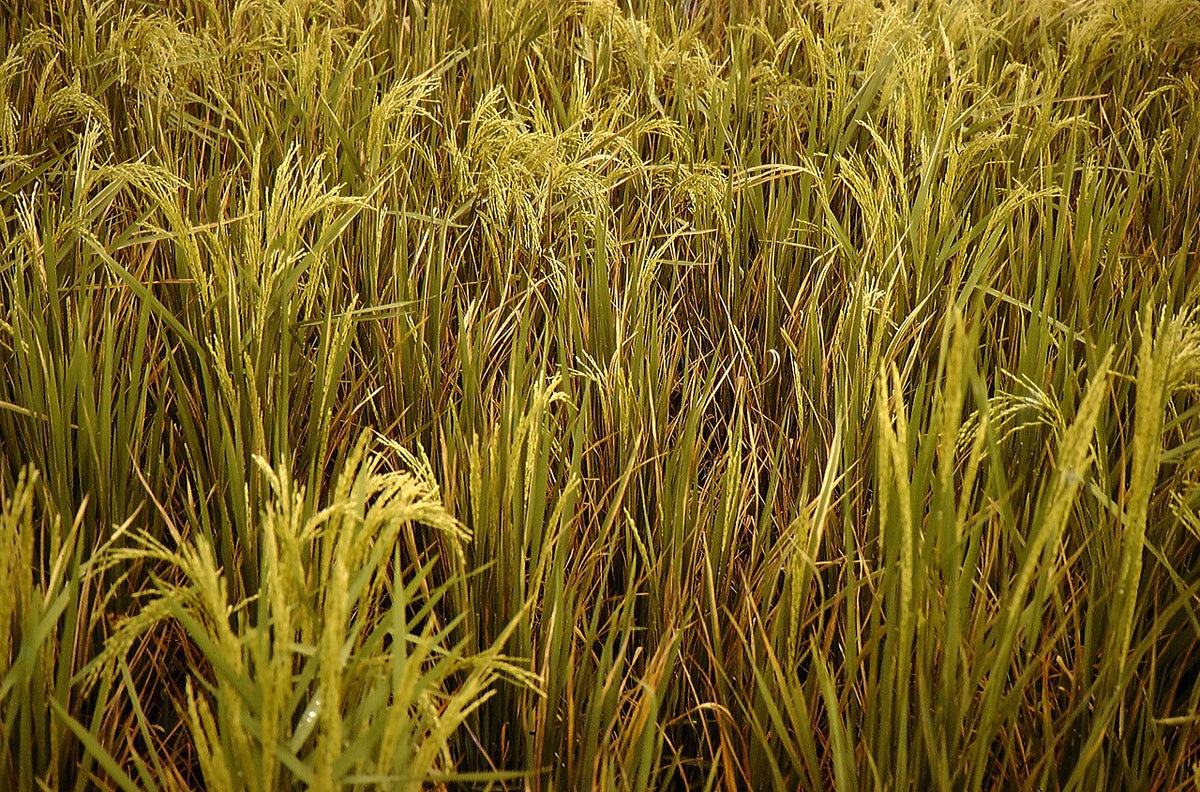
Photo at the top: Rice plants with tungro disease. Yellow to orange leaves among green ones are the usual field sign, Photo: Nozaki Michio (JIRCAS Photo Archive), CC BY 2.0
Quick answer
Tungro disease of rice is a virus disease spread by the green leafhopper. Leaves turn yellow to orange from the tip down, plants stay short with few tillers, and grains fill poorly. No spray cures an infected plant. Grow a tolerant variety, plant at the same time as your neighbours, plough in old stubble and watch for leafhoppers early.
Symptoms of tungro disease of rice
Tungro is caused by two viruses that work together: rice tungro bacilliform virus (RTBV) and rice tungro spherical virus (RTSV). In Hindi it is called dhan ka tungro rog (धान का टुंग्रो रोग), and in Telugu vari tungro tegulu (వరి టుంగ్రో తెగులు). The International Rice Research Institute (IRRI) calls it one of the most damaging diseases of rice in South and Southeast Asia.
Walk into the field, not just along the bund. Look for plants that are shorter and more yellow than the plants around them.
- Leaf colour: leaves turn yellow or orange-yellow. The colour starts at the leaf tip and moves down the blade.
- Young leaves: may look mottled, with pale green to whitish stripes between the veins.
- Older leaves: may show rust-coloured spots or streaks.
- Plant size: plants stay short (stunted) and make fewer tillers than healthy plants.
- Flowering: comes late. Panicles are small and do not come fully out of the sheath.
- Grain: many grains are empty or only half filled, often with dark brown blotches.
- In the field: sick plants show up in patches of yellow to orange among green plants.
Plants infected young can die. How strong the signs are depends on the variety, the strain of the virus, the age of the plant and the weather. IRRI notes that in varieties with some resistance, infected plants may show little or no yellowing, and it may fade as the plants grow.
Tungro disease of rice symptoms: how to confirm
Two checks help you be sure:
- Look for the insect. Tap a few yellow hills over your palm or a white sheet. Small, bright green, wedge-shaped insects that jump away are green leafhoppers. Finding them near yellow patches makes tungro much more likely.
- Ask for a test. TNAU describes a simple iodine test: leaf tips picked early in the morning are soaked in an iodine solution, and tungro leaves show dark blue streaks. IRRI lists lab tests such as ELISA. Your Krishi Vigyan Kendra (KVK) or agriculture officer can help with either.
Look-alikes and how to tell them apart
IRRI warns that tungro is often mistaken for nutrient shortage, water stress or insect damage. Here is how to tell them apart.
- Nitrogen shortage: the older, lower leaves turn evenly pale yellow, often across the whole field. There is no orange colour from the tip and no patches of short plants among tall ones. See nitrogen deficiency in plants and how to correct it.
- Zinc shortage (khaira): appears two to four weeks after transplanting. Young leaves turn pale at the base and older leaves get tiny rusty brown spots, in patches where the soil is poor. See khaira disease in rice and zinc deficiency.
- Brown plant hopper: round patches turn yellow, then brown and dry ("hopper burn"). You find many brown insects at the base of the plants, just above the water. See brown plant hopper in paddy.
- Stem borer: the central shoot dries and pulls out easily (dead heart). The rest of the plant stays green.
- Water stress: leaves roll and dry, and the whole dry part of the field is affected, not scattered patches.
How tungro spreads and when it attacks
The tungro viruses cannot move on their own. They need a carrier, and the most important one is the green leafhopper (GLH, Nephotettix virescens). TNAU notes that RTBV can only be carried by the insect when RTSV is also present.

This is how the disease moves through a field, as IRRI explains it:
- A leafhopper feeds on a sick plant, even for a short time, and picks up the virus.
- It can pass the virus on to healthy plants straight away, for about 5 to 7 days.
- The insect does not keep the virus for life. It must feed on a sick plant again to pick up more.
- Leafhoppers prefer young rice plants, and pick up the virus more easily from young sick plants. So once tungro is in a young crop, it spreads fast.
The virus survives between crops in several places. IRRI lists stubble from the last crop, new growth from stubble that was not ploughed in, self-sown rice plants, and sick plants in nearby fields. A nursery in a tungro area can also carry infection into the main field.
Tungro can attack at any stage, but it is seen most during the vegetative (leafy growth) stage. IRRI says plants are most at risk at tillering. TNAU lists the conditions that favour the disease: a source of virus, plenty of leafhoppers, and young plants of a susceptible variety, all at the same time.
In Telangana and Andhra Pradesh, paddy is grown in both kharif and rabi, and in many villages fields are planted weeks apart. That gives the leafhopper and the virus green rice to live on almost all year. IRRI warns that fields planted late compared with the rest of the area face more tungro, and also put the next season's early crop at risk.
Crops it attacks
Paddy (rice): rice is the main host. Infection can happen from the nursery to the later stages, but the early weeks after transplanting are the most dangerous. IRRI notes that a susceptible variety infected early can lose up to the whole crop in severe cases.
Wild rice and grassy weeds: some wild relatives of rice and grassy weeds in and around paddy fields also carry the virus. Keep bunds and channels clean.
When to act
There is no spray that cures tungro, so there is no threshold for a "tungro spray". The thresholds below tell you when to act against the leafhopper that spreads it.
- The Integrated Pest Management Package for Rice (NCIPM, DPPQS and NIPHM) gives the level for the tillering stage as 1 tungro plant per square metre together with 2 green leafhoppers per hill, in areas where tungro is common.
- TNAU advises starting leafhopper control when one affected hill per square metre is seen from the pre-tillering to mid-tillering stage.
Check the nursery and the main field once or twice a week from sowing. Look at several hills in different parts of the field. Our green leafhopper guide for paddy explains how to count the hoppers and gives the leafhopper thresholds for areas with and without tungro.
Tungro disease of rice: control without chemicals
IRRI says prevention works better against tungro than any treatment after it appears. These steps come from IRRI, TNAU and the rice IPM package. They work better when neighbouring farmers follow them together.
Grow a tolerant variety
IRRI calls this the cheapest way to manage tungro. The rice IPM package lists Vikramarya, Nidhi, Amulya, Dinesh, Lakshmi and Nalini as tolerant to tungro. Vikramarya was released in Andhra Pradesh and also tolerates the green leafhopper and gall midge. TNAU also names IR 36, IR 50, ADT 37, Ponmani, Co 45, Co 48, Surekha, Bharani and White Ponni. Not every variety suits every area or season, so ask your KVK or agriculture officer which ones grow well near you.
Plant at the right time, together
- Transplant at the same time as the farms around you. A late field becomes a target.
- Where you know the leafhopper's peak season, plant to avoid it.
- Grow no more than two rice crops a year (IPM package).
- Keep the field free of rice for at least a month between crops (TNAU). This breaks the chain of virus and insect.
- In areas with frequent tungro, rotate with pulses or oilseeds (TNAU).
Remove the sources of virus
- Plough and harrow the field soon after harvest to bury the stubble. This also destroys leafhopper eggs and breeding places.
- Pull out self-sown rice plants and new shoots from old stubble.
- Remove grassy weeds from bunds and channels.
- Pull out tungro plants early and bury them away from the field, so leafhoppers cannot pick up the virus from them.
A healthy nursery
- Raise the nursery away from tungro fields. TNAU also advises keeping it away from street lamps, which draw leafhoppers at night.
- Transplant seedlings older than 3 weeks. The IPM package says this makes plants less likely to get viruses spread by leafhoppers.
- TNAU advises neem cake as a basal dose in the nursery. Ask your KVK for the right amount for your nursery size.
Watch the leafhopper and protect its enemies
- Light traps: TNAU advises light traps to show when leafhoppers arrive and how many there are.
- Balanced nitrogen: give only the recommended amount of urea, in split doses. A soft, dark green crop draws more leafhoppers.
- Natural enemies: IRRI lists spiders, mirid bugs, dragonflies and tiny wasps that feed on leafhoppers or their eggs. Sprays that are not needed kill these helpers.
Can a spray cure tungro?
No. Once a rice plant has tungro, it cannot be cured. No fungicide, insecticide, nutrient spray or tonic will make it green and healthy again. Be careful of anyone who sells a "tungro cure".
Sprays can only control the leafhopper that carries the virus. That can protect healthy plants, not sick ones. Even this often fails. IRRI explains that leafhoppers keep flying in from nearby fields and spread the virus in very short feeding times, before a spray can act.
None of the products in our store lists tungro on its label, so we do not suggest one here. For green leafhopper on paddy, our green leafhopper insecticide guide lists the label-approved products with doses per acre and waiting periods. Or ask your local agriculture officer or KVK for a product labelled for your crop.
If you do spray for leafhoppers, keep these points in mind:
- Spray only when the counts reach the threshold, and early in the crop, when tungro does the most harm.
- Change the insecticide group from one spray to the next, so the leafhopper does not build resistance. The green leafhopper guide shows the groups.
- Use one product at a time. Do not mix products in one tank.
Safety and waiting period
- Before any spray, check the waiting period before harvest (PHI, pre-harvest interval) on the label.
- Wear gloves, a mask, full-sleeve clothes and boots while mixing and spraying. Do not eat, drink or smoke while you work. Wash well afterwards.
- Spray in the morning or evening, not in strong wind.
- Keep sprays and washings out of ponds, canals and fish tanks. Paddy water flows into them easily.
- Read the label and leaflet before use.
Frequently asked questions
Can tungro disease be cured?
No. A plant with tungro stays infected. Pull out sick plants early and protect the rest of the crop with tolerant varieties, timely planting, clean bunds and leafhopper control.
Which insect spreads tungro in paddy?
The green leafhopper. It picks up the virus from a sick plant and passes it to healthy plants within a few days. Other leafhoppers can carry it too, but the green leafhopper is the most important one.
Why are my paddy leaves turning orange-yellow from the tip?
Orange-yellow leaves starting at the tip, with short plants in patches, point to tungro. Check for green leafhoppers on those plants. If the older leaves are evenly pale across the whole field and there are no hoppers, nitrogen shortage is more likely.
Which rice varieties are resistant to tungro?
No variety is fully immune. The rice IPM package lists Vikramarya, Nidhi, Amulya, Dinesh, Lakshmi and Nalini as tolerant, and TNAU names others such as IR 36, IR 50 and Surekha. Ask your KVK which ones suit your area and season.
Should I remove tungro-affected plants?
Yes, especially early in the crop. Sick plants give little grain and act as a source of virus for the leafhoppers. Pull them out and bury them away from the field.
Related reading
- Green leafhopper in rice: symptoms, tungro risk and control in paddy
- Jassids in cotton, okra and brinjal: how leafhoppers feed and how to control them
- Brown plant hopper in paddy: symptoms, treatment and control
- Khaira disease in rice: zinc deficiency signs and correction
- Products for paddy
- All insecticides
Sources
- International Rice Research Institute (IRRI), Rice Knowledge Bank: Tungro
- Tamil Nadu Agricultural University, TNAU Agritech Portal: Rice tungro virus: symptoms
- Tamil Nadu Agricultural University, TNAU Agritech Portal: Rice tungro virus: management
- Tamil Nadu Agricultural University, TNAU Agritech Portal: Green leafhopper of rice
- International Rice Research Institute (IRRI), Rice Knowledge Bank: Green leafhopper
- NCIPM (ICAR), DPPQS and NIPHM: Integrated Pest Management Package for Rice
Like these farming tips? Add AgriVruddhi as a preferred source on Google
Back to Crop Health Guide