
Brown plant hopper in paddy: symptoms, treatment and control
· By AgriVruddhi
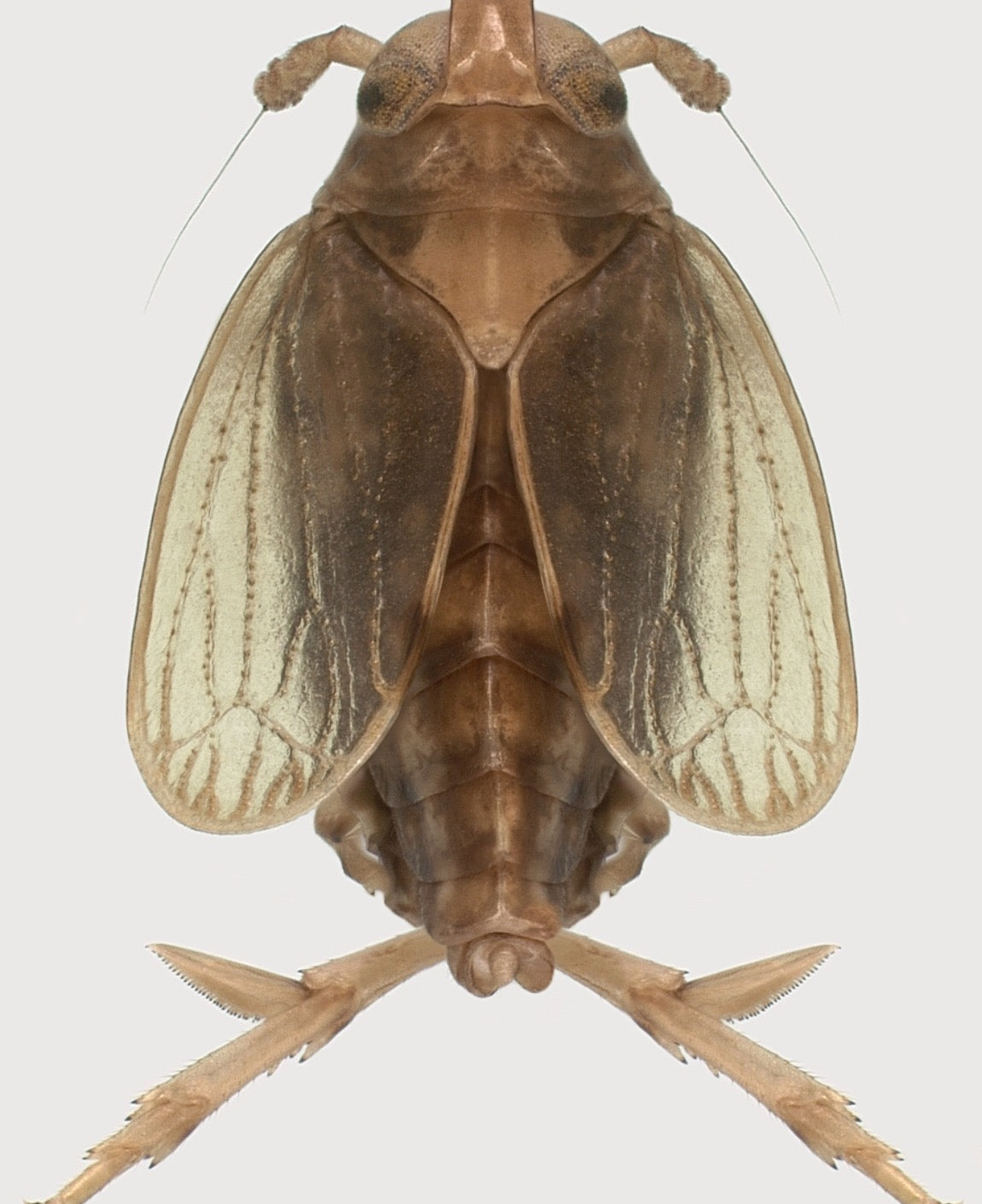
Photo at the top: A short-winged adult brown plant hopper under a lens. In the field it is only about 5 mm long, Photo: Natasha Wright, Florida Department of Agriculture and Consumer Services, Bugwood.org, CC BY 3.0 US (cropped)
Quick answer
Brown plant hopper (BPH, Nilaparvata lugens) is a small brown insect that sucks sap from the base of paddy plants, just above the water. A heavy attack turns the plants yellow, then brown and dry, in round patches called "hopper burn". To control brown plant hopper, avoid extra nitrogen and close planting, drain the field for a few days when numbers rise, check the base of the hills every week, and spray a label-approved insecticide at the plant base only when the count crosses the economic threshold.
How to identify brown plant hopper
In Telugu, farmers call this pest sudi doma (సుడిదోమ). In Hindi it is bhura phudka (भूरा फुदका). You will not find BPH on the top leaves. Part the plants and look at the lower stems, close to the water. The hoppers sit there in groups. When you disturb them, they hop away or slip round to the other side of the stem.
- Eggs: white, thin and slightly curved. The female pushes them into the leaf sheath in neat rows, so you rarely see them.
- Nymphs (young hoppers): cottony white when they hatch, then purple-brown as they grow. A grown nymph is about 3 mm long and has no wings.
- Adults: 4.5–5 mm long, yellowish brown to dark brown. Some adults have long wings and fly to new fields. Others have short wings and stay to breed on the same plants.
Tamil Nadu Agricultural University (TNAU) describes these stages.
Brown plant hopper symptoms in the field (hopper burn)
In the field, you will usually notice the damage before the insect:
- Sticky honeydew (a sugary liquid the hoppers pass out) on the lower stems, with black sooty mould growing on it.
- Round yellow patches that soon turn brown as the plants dry up. TNAU calls this scorched look "hopper burn". The Government of India plant protection office (DPPQS) notes that these patches can spread until they cover the whole field.
- In a heavy attack, the dried plants may lean and fall over.
- Poor grain filling in attacked plants, with more chaffy (empty) grains.

Look-alikes and how to tell them apart
- White-backed plant hopper: similar size and often on the same hills, but the adult has a clear white band on its back. Its threshold is counted together with BPH.
- Green leafhopper: bright green and found higher up on the leaves, not at the base.
- Sheath blight: oval grey-green spots with a brown border on the leaf sheath, near the water line. There are no hoppers. See sheath blight of rice: symptoms and control.
- Water stress or nutrient shortage: yellowing follows the shape of the field or a low spot, and you find no hoppers or honeydew at the base.
Life cycle and when it attacks
BPH goes from egg to adult in about three to four weeks in warm weather. It breeds again and again on the same crop, so the number of hoppers can jump quickly in the second half of the season. Short-winged adults stay and multiply. Long-winged adults appear when the plants are crowded or drying, and fly to new fields.
The DPPQS advisory on BPH (2022) lists the conditions that favour it: rice grown season after season, fields kept under water all the time, heavy shade, high humidity and heavy use of chemical fertilisers and pesticides. The rice IPM package from NCIPM and NIPHM adds high doses of nitrogen and close spacing. Repeated sprays of the wrong insecticides also kill spiders and other natural enemies. BPH can then come back stronger than before. This is called resurgence.
In Telangana and Andhra Pradesh, BPH usually builds up from the tillering stage and is most harmful from panicle initiation to grain filling. Attacks are most common in the later part of kharif, but rabi paddy can also be hit. Hot, humid weather with standing water in the field helps it multiply.
Crops it attacks
Paddy: BPH is a pest of rice. The nursery is seldom badly hit. In the main field, numbers rise from active tillering and peak around flowering and grain filling. That is when hopper burn appears and yield losses are highest. In some Asian countries BPH also spreads two virus diseases of rice, grassy stunt and ragged stunt.
When to spray for brown plant hopper (economic threshold)
The economic threshold (ETL) is the number of pests at which spraying starts to pay for itself. Below it, natural enemies and good field care usually keep BPH in check.
- The Integrated Pest Management Package for Rice (NCIPM, DPPQS and NIPHM) gives 10–15 hoppers per hill from early to late tillering, and 15–20 hoppers per hill from panicle initiation to booting. These counts are for brown and white-backed plant hoppers together.
- TNAU gives 1 hopper per tiller where there are no spiders, and 2 hoppers per tiller when there is at least 1 spider per hill.
Check the field every week from tillering onwards. Walk across the field, not only along the bund. Tilt a few hills in different places and count the hoppers at the base. Count spiders too, because they eat many hoppers.
Control without chemicals
- Spacing: do not plant too close. In areas where BPH comes back every year, leave a 30 cm walking gap (alley) every 2.5–3 m. This lets light and air reach the base of the plants and makes spraying easier. Both TNAU and the rice IPM package advise this.
- Nitrogen: do not use more urea than recommended. Give nitrogen in split doses, and give potash as recommended. DPPQS advises split nitrogen with split potash to lower the risk of hopper outbreaks.
- Water: follow alternate wetting and drying instead of keeping water standing all the time. When the attack is heavy, drain the field for 3–4 days.
- Plant together: neighbours who transplant within about 3 weeks of each other, and keep a rice-free gap between seasons, give BPH less time to build up.
- Clean bunds: remove grassy weeds from bunds and channels, as they shelter the pest.
- Tolerant varieties: the rice IPM package lists BPH-tolerant varieties such as Vijetha, Chaitanya, Krishnaveni, Pratibha, Vajram and Nagarjuna. Ask your nearest Krishi Vigyan Kendra (KVK) which ones suit your area and season.
- Natural enemies: spiders (wolf, lynx and orb spiders), the mirid bug that eats hopper eggs, ladybird beetles, ground beetles, rove beetles and tiny egg parasites all feed on BPH. Avoid early sprays that are not needed, so these friends survive.
- Light traps: help you see when winged adults arrive in your area.
- Neem while numbers are low: DPPQS suggests a neem product (azadirachtin 1500 ppm at 2.5 ml per litre of water), or 5% neem seed kernel extract, sprayed at the plant base when BPH is still below the threshold.
Brown plant hopper insecticides: chemical control in paddy
Only the products below have paddy and brown plant hopper on their official label or leaflet. Doses are per acre, as printed on the label or worked out from the label's per-hectare dose. Spray one product at a time. Do not mix products in one tank.
Paddy
| Product | Contains | Label dose per acre | Water per acre | Wait before harvest |
|---|---|---|---|---|
| Chess Insecticide | Pymetrozine 50% WG | 121 g | 200 L | 19 days |
| Pymate - Insecticide | Pymetrozine 50% WG | 121 g | 200 L | 19 days |
| Skystar Insecticide | Dinotefuran 15% + Pymetrozine 45% WG | 135 g | 200 L | 24 days |
| Pexalon Insecticide | Triflumezopyrim 10% SC | 94 ml | 150–200 L | Not printed on the brand leaflet; check the pack label |
| Ulala Insecticide | Flonicamid 50% WG | 61 g | 200 L | 36 days |
| Hogger Insecticide | Dinotefuran 70% WG | 36 g | 200 L | 32 days (check the pack) |
| Imidagold Plus | Imidacloprid 30.5% SC | 24–30 ml | 200–300 L | 37 days |
| Hokori Insecticide | Dinotefuran 5% + Ethion 50% EC | 405 ml | 200 L | 33 days |
| Sapper Insecticide | Dinotefuran 4% + Acephate 50% SG | 356 g | 200 L | 21 days |
| Mahaveer Insecticide | Fipronil 5% SC | 405–607 ml | 200 L | 32 days |
| Virtako Insecticide | Thiamethoxam 1% + Chlorantraniliprole 0.5% GR | 2.4 kg granules | No water: broadcast by hand | 60 days |
Notes from the labels:
- Skystar, Hokori, Sapper and Virtako each hold two active ingredients in one pack. These are ready-mixed products approved on the label. They are not tank mixes.
- Chess and Pymate: first spray when the pest first reaches the ETL. Repeat only if needed, with no more than two sprays.
- Skystar, Hokori, Hogger and Sapper: spray when the pest reaches the ETL. Hogger and Sapper allow no more than two sprays, in the morning or evening.
- Pexalon: apply when you see 5–10 hoppers per hill, from active tillering to panicle initiation. Use it only once per crop season. If another spray is needed 21–25 days later, use a product from a different group.
- Ulala: spray after the pest appears, from the vegetative to the reproductive stage, 2–3 sprays depending on pest numbers.
- Imidagold Plus: spray when the pest attacks. The label gives no crop stage.
- Mahaveer: first spray 25–30 days after transplanting.
- Virtako: granules, not a spray. Broadcast them evenly by hand, once only, 20 days after transplanting.
How to spray for BPH
Drain the standing water first, as TNAU advises. Point the nozzle at the base of the hills, where the hoppers live. A spray that only wets the top leaves will miss most of them.
Rotate to avoid resistance
BPH can stop responding to an insecticide that is used again and again. Insecticides are grouped by how they work, using the IRAC code (IRAC is the international Insecticide Resistance Action Committee). Change the group from one spray to the next.
| IRAC group | Active ingredient | Products in this article |
|---|---|---|
| 9B | Pymetrozine | Chess, Pymate, and one part of Skystar |
| 4A (neonicotinoids) | Dinotefuran, imidacloprid, thiamethoxam | Hogger, Imidagold Plus, and one part of Skystar, Hokori, Sapper and Virtako |
| 4E | Triflumezopyrim | Pexalon |
| 29 | Flonicamid | Ulala |
| 2B | Fipronil | Mahaveer |
| 1B (organophosphates) | Ethion, acephate | One part of Hokori and Sapper |
| 28 | Chlorantraniliprole | One part of Virtako |
Group 4A is in six of the eleven products. If you have used Virtako granules or a 4A spray, choose the next spray from a group that is not 4A, such as Chess or Pymate (9B), Pexalon (4E) or Ulala (29). Keep to the number of sprays each label allows.
Safety and waiting period
- The waiting period before harvest (PHI, pre-harvest interval) for each product is in the table above. Count the days from the last spray or granule application.
- Wear gloves, a mask, full-sleeve clothes and boots while mixing and spraying. Do not eat, drink or smoke while spraying. Wash well afterwards.
- Bees: the Hogger, Sapper and Imidagold Plus labels warn against use when honey bees are active. Spray in the morning or evening.
- Virtako's label warns that it is highly toxic to bees and to water creatures. Do not use it in paddy fields where fish or prawns are raised.
- Sapper contains acephate. Some states have placed limits on acephate in basmati paddy. If you grow basmati or rice for export, check your state's current rules and the buyer's residue limits before you spray.
- Read the label and leaflet before use.
Frequently asked questions
What are the symptoms of brown plant hopper in paddy?
Round patches of plants that turn yellow, then brown and dry, called hopper burn. At the base of the plants you will see brown hoppers, sticky honeydew and black sooty mould.
Which insecticide controls brown plant hopper?
Use one whose label lists paddy and brown plant hopper. In our store these are Chess, Pymate, Skystar, Pexalon, Ulala, Hogger, Imidagold Plus, Hokori, Sapper, Mahaveer and Virtako. The doses are in the table above. Change the IRAC group between sprays.
Should I drain the field before spraying for BPH?
Yes. TNAU advises draining the water and aiming the spray at the plant base, where the hoppers sit. Draining for 3–4 days also slows BPH down.
Why does BPH come back after I spray?
Common reasons are spraying the top of the plant instead of the base, using the same group of insecticide again and again, and sprays that kill spiders and other natural enemies. Heavy nitrogen also helps BPH recover.
Does too much urea increase brown plant hopper?
Yes. Heavy nitrogen makes the plants soft and lush, which BPH prefers. Use the recommended dose in splits.
Related reading
- Stem borer in paddy: dead heart, white ear and control
- Leaf folder in paddy: identification and action level
- Rice blast: leaf blast and neck blast control
- Nitrogen deficiency in plants: signs and how to correct it
- Paddy crop protection products
- All insecticides
Sources
- Directorate of Plant Protection, Quarantine and Storage (DPPQS), Government of India: Advisory on brown plant hopper in rice
- NCIPM (ICAR), DPPQS and NIPHM: Integrated Pest Management Package for Rice
- Tamil Nadu Agricultural University, TNAU Agritech Portal: Brown plant hopper of rice
- Insecticide Resistance Action Committee (IRAC): Mode of action classification
- Product labels and leaflets of the insecticides listed above.
Products that control it, by crop
Paddy (rice)
- Chess Insecticide121 g per acreSpray with a knapsack sprayer when the pest first reaches the action level (ETL). Repeat only if needed, no more than 2 sprays.
- Pymate - Insecticide121 g per acreFrom leafy growth to the flowering stage. First spray when the pest reaches the action level (ETL). Do not spray more than twice.
- Pexalon Insecticide94 ml per acreSpray at 5-10 hoppers per hill, active tillering to panicle initiation. Once per season; then rotate to another insecticide group.
- Ulala Insecticide61 g per acreFoliar spray from the growing stage to the flowering stage, once the pest appears. Give 2-3 sprays as needed.
- Hogger Insecticide36 g per acreFoliar spray when the pest reaches the action level (ETL). Spray in the morning or evening. Maximum 2 sprays.
- Hokori Insecticide405 ml per acreSpray when the pest reaches the action level (ETL).
- Virtako Insecticide2.4 kg per acreBroadcast the granules evenly by hand, 20 days after transplanting. One application only.
Do not spray the same product again and again. Change to a product with a different mode of action (the group number on the label) so the pest or disease does not build resistance.
As printed on the brand's official label. Read the label before use.


Like these farming tips? Add AgriVruddhi as a preferred source on Google
Back to Crop Health Guide