
Leaf folder in paddy: symptoms, when to spray and control
· By AgriVruddhi
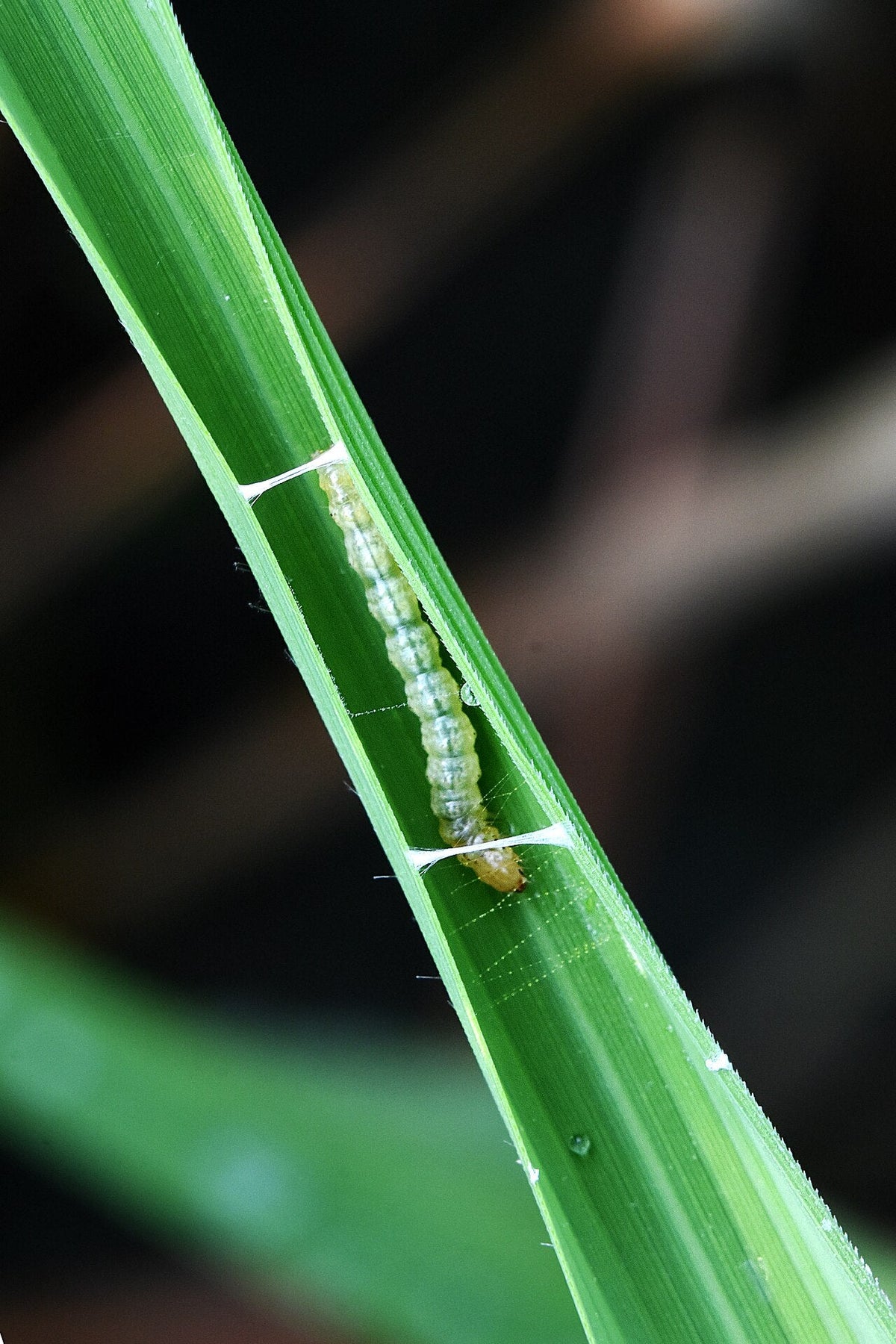
Photo at the top: A leaf folder caterpillar inside a rice leaf, held shut with silk threads, Photo: Badal Chandra Sarker, CC BY-SA 4.0
Quick answer
Leaf folder in paddy is a small green caterpillar (Cnaphalocrocis medinalis) that folds rice leaves lengthwise with silk and scrapes the green part inside, leaving white streaks. In a heavy attack the field looks white and scorched. Use balanced nitrogen and clean bunds, and spray a label-approved insecticide only when damage crosses the TNAU action level.
How to identify leaf folder in paddy
Leaf folder is also called the rice leaf roller. In Telugu farmers call it aaku mudata purugu, and in Hindi patti lapetak keet. TNAU lists two closely related species, Cnaphalocrocis medinalis and Marasmia patnalis. They look alike, do the same damage and are controlled the same way.
- Folded leaves: the leaf is rolled or folded along its length into a tube, held with fine silk threads. Usually one caterpillar lives in one fold.
- White streaks: the caterpillar scrapes the green tissue from inside the fold. The leaf shows long, white, see-through stripes. Fresh damage is white. Older damage turns dry and brown. Tamil Nadu Agricultural University (TNAU) says the whole field can look scorched in a severe attack.
- Caterpillar: open a fold. TNAU describes the caterpillar as greenish and see-through. A grown one is about 1.5–2 cm long.
- Eggs: flat, oval and yellowish white, laid on the leaves.
- Pupa: brown, inside a folded leaf.
- Moth: small and yellowish brown, with dark wavy lines across the wings and a dark band along the wing edge (TNAU). When you walk through the field, the moths fly up and settle again a short distance away.

Look-alikes and how to tell them apart
- Rice hispa: also makes white streaks, but the leaf is not folded. You will see small spiny dark beetles on the leaves.
- Rice caseworm: cuts off leaf tips and rolls them into small tubes that float on the water, with the caterpillar inside.
- Stem borer: causes a dried central shoot (dead heart) or a white empty earhead, not white streaks on leaves. Many products below cover both. See our stem borer article.
Life cycle and when it attacks
The moth lays eggs on young leaves. The eggs hatch in a few days. The caterpillar feeds inside folded leaves for about 2–3 weeks and folds several leaves as it grows. It then turns into a pupa inside a fold, and the moth comes out about a week later. A full cycle takes about a month, so two or three generations can build up in one crop.
Leaf folder is most active from tillering to flowering. It likes humid weather, shade, thick planting and fields given too much nitrogen fertiliser, which keeps the leaves soft and dark green. In Telangana and Andhra Pradesh it is common in the kharif crop, usually from August to October, and it also appears in rabi paddy. Grassy weeds on bunds help it survive between crops.
Crops it attacks
Paddy (rice): its main crop. Damage in the tillering stage reduces leaf area, but the plant can often recover. Damage to the flag leaf (the top leaf, which feeds the grain) at booting and flowering hurts most, because it lowers grain filling.
It can also feed on some grasses, including weeds on bunds, which is why clean bunds matter.
When to spray (economic threshold)
The economic threshold level (ETL) is the pest level at which spraying starts to pay for itself. TNAU gives this ETL for rice leaf folder:
- Vegetative stage: 10% of leaves damaged.
- Flowering stage: 5% of flag leaves damaged.
To check, pick a few spots across the field. At each spot, count the leaves on a few hills and how many are folded or streaked. Below these levels, natural enemies usually keep the pest in check.
Control without chemicals
- Balanced nitrogen: TNAU advises against too much nitrogen fertiliser. Give urea in split doses, as your soil test or local advice suggests. If your crop is pale, read how to spot and correct nitrogen deficiency before adding more urea.
- Clean bunds: keep bunds trimmed and free of grassy weeds (TNAU).
- Light trap: the moths fly to light at night. A light trap at the field edge shows you when moths arrive, so you know when to start checking leaves.
- Spacing: avoid very thick planting, so the crop stays airy and less humid.
- Egg parasites: Trichogramma chilonis is a tiny wasp that kills leaf folder eggs. TNAU advises releasing it at 2 cc (about 40,000 wasps) per acre, three times, at 30, 37 and 44 days after planting.
- Protect natural enemies: spiders, small wasps and other predators eat leaf folder eggs and caterpillars. Avoid early sprays that are not needed, as they kill these helpers. Too many sprays can also lead to a build-up of brown plant hopper in paddy.
- Neem: TNAU lists neem seed kernel extract (NSKE) 5% or azadirachtin 0.03% at 400 ml per acre.
Insecticides for leaf folder in paddy
Only the products below have paddy (rice) and leaf folder on their official label. Doses are per acre, worked out from the label. We show the label's own words for the pest. Use one product per spray. Do not mix products in one tank.
Paddy: sprays
- Incipio Insecticide (isocycloseram 18.1% SC). Label target: "Leaf folder". Label dose 40 ml per acre in 200 L water. First spray at ETL, one more after 10–15 days if needed. Waiting period before harvest: 29 days.
- Minecto Xtra (cyantraniliprole 16.9% + lufenuron 16.9% SC). This is a ready-mixed product with two active ingredients, approved on the label as one product. Label target: "Stem borer, Leaf folder". Label dose 20 ml per acre in 200 L water. First spray at ETL, one more after 10–15 days if needed. Waiting period: 39 days.
- Aston Insecticide (chlorantraniliprole 18.5% SC). Label target: "Stem borer (Schirphophaga incertuals) and Leaf Floder (Cnaphalocrocis medinalis)" (spelling as printed). Label dose 61 ml per acre in 200 L water. Spray at ETL. Waiting period: 47 days.
- OMG Insecticide (chlorantraniliprole 18.5% SC, the same active ingredient as Aston). Label target: "Leaf Folder (Cnaphalocrocis medinalis)". Label dose 61 ml per acre in 200 L water. Waiting period: 47 days.
- Quartz Insecticide (fipronil 80% WG). Label target: "Stem borer, Leaf folder". Label dose 20–25 g per acre in 150–200 L water. The label says to give the first spray as soon as leaf folder white stripes (or stem borer dead hearts) appear. Waiting period: 15 days.
- Hokori Insecticide (dinotefuran 5% + ethion 50% EC), a ready-mixed product approved on the label. Label target: "Leaf folder". Label dose 405 ml per acre in 200 L water, at ETL. Waiting period: 33 days.
- Hamla 550 Insecticide (chlorpyrifos 50% + cypermethrin 5% EC), a ready-mixed product approved on the label. Label target: "Stem borer & Leaf folder". Label dose 253–304 ml per acre in 200–280 L water, when the pest is seen to cause economic loss. Waiting period: 15 days.
- Mahaveer Insecticide (fipronil 5% SC). Label target: "Rice leaf folder". Label dose 405–607 ml per acre in 200 L water. The label suggests the first spray 25–30 days after transplanting. Waiting period: 32 days.
Paddy: granules
- Virtako Insecticide (thiamethoxam 1% + chlorantraniliprole 0.5% GR), a ready-mixed granule approved on the label. Label target: "Stem borer, Leaf folder, Green Leaf Hopper, Brown Plant hopper". Label dose 2.4 kg per acre, spread by hand as evenly as possible, one application only, at 20 days after transplanting. Waiting period: 60 days.
Rotate to avoid resistance
Insecticides are grouped by how they kill the insect. This is called the mode of action, and the international IRAC system gives each group a number. If you use the same group again and again, the surviving insects breed and the next generation is harder to kill. So use a different group for the next application, counting the granules too.
| IRAC group | How it works (simple words) | Products here |
|---|---|---|
| 28 | Makes the caterpillar's muscles stop working, so it stops eating | Aston, OMG (same active ingredient) |
| 28 + 15 | Two groups in one pack; group 15 stops moulting | Minecto Xtra |
| 4A + 28 | Two groups in one pack (granule) | Virtako |
| 30 | Acts on the insect's nerves in a new way | Incipio |
| 2B | Blocks nerve signals | Quartz, Mahaveer (same active ingredient, fipronil) |
| 4A + 1B | Two groups in one pack | Hokori |
| 1B + 3A | Two groups in one pack | Hamla 550 |
For example, if you spread Virtako granules at 20 days, it already carries a group 28 ingredient. For a later leaf folder spray, pick a product from group 30 or 2B instead of Aston, OMG or Minecto Xtra. Quartz and Mahaveer both contain fipronil, so do not use one after the other.
Safety and waiting period
The waiting period (pre-harvest interval, or PHI) is the number of days between the last application and harvest. For paddy it is 15 days for Quartz and Hamla 550, 29 days for Incipio, 32 days for Mahaveer, 33 days for Hokori, 39 days for Minecto Xtra, 47 days for Aston and OMG, and 60 days for Virtako, as printed on the labels.
- Wear gloves, a mask, full-sleeve clothes and boots while mixing, spraying or spreading granules. Wash well afterwards.
- Keep products locked away from children, animals and food.
- Do not let spray water or granules reach ponds, canals or fish. Do not wash sprayers in water sources.
- Many insecticides harm bees. Avoid spraying when bees are active near flowering weeds or nearby crops.
Read the label and leaflet before use.
Farmer questions
Which insecticide controls both stem borer and leaf folder in paddy?
Among the products above, the labels of Aston, Minecto Xtra, Quartz, Hamla 550 and Virtako name both stem borer and leaf folder in rice. Check your field first: spray only if leaf folder damage crosses the action level.
When should I spray for leaf folder in paddy?
When about 10% of leaves are damaged in the growing stage, or 5% of flag leaves at flowering, as TNAU advises. Below that, natural enemies usually manage it.
Why does my paddy field look white?
White streaks on folded leaves point to leaf folder. White streaks on flat leaves with small dark beetles point to rice hispa. A white, empty earhead points to stem borer. Open a few leaves and stems to check.
Does too much urea increase leaf folder?
Yes. Too much nitrogen keeps leaves soft and dark green, and the moths prefer such fields. TNAU advises avoiding excess nitrogen. Give urea in split doses, as your soil test or local advice suggests.
Can paddy recover from leaf folder damage?
Early damage at tillering often does little harm, because the plant makes new leaves. Damage to the flag leaf at booting and flowering hurts more, as it lowers grain filling. That is why the action level is lower at flowering.
Can I use granules instead of a spray?
Yes. Virtako granules are approved for leaf folder in paddy. Spread 2.4 kg per acre once, at 20 days after transplanting, as the label says.
Related reading
- Stem borer in paddy: dead heart, white ear and how to control it
- Brown plant hopper in paddy: symptoms, treatment and control
- Rice blast: leaf blast and neck blast control in paddy
- Sheath blight of rice: symptoms, causes and control
- Khaira disease in rice and zinc deficiency
- Paddy crop care products and all insecticides
Sources
- Tamil Nadu Agricultural University (TNAU) Agritech Portal: Pest of paddy, leaf folder (or) leaf roller
- Insecticide Resistance Action Committee (IRAC): Mode of action classification
- The official label and leaflet of each product named above, for the label target, dose and waiting period
Products that control it, by crop
Paddy (rice)
- Incipio Insecticide40 ml per acreFirst spray when pests reach the action level (ETL). One more spray after 10-15 days if pest attack is still high.
- Minecto Xtra Insecticde20 ml per acreFirst spray when pests reach the action level (ETL). One more spray after 10-15 days if pest attack is still high.
- Aston Insecticide61 ml per acreSpray on the leaves with a knapsack sprayer when the pest reaches the action level (ETL).
- OMG Insecticide61 ml per acreFoliar spray when the pest reaches the action level (ETL), ideally at early growth or when flowering starts.
- Quartz Insecticide20–25 g per acreFoliar spray. First spray as soon as white stripes appear on leaves. More sprays depending on severity.
- Hokori Insecticide405 ml per acreSpray when the pest reaches the action level (ETL).
- Virtako Insecticide2.4 kg per acreBroadcast the granules evenly by hand, 20 days after transplanting. One application only.
- Hamla 550 Insecticide253–304 ml per acreSpray at any crop stage when the pest starts to cause crop loss. Keep people out of the field for 48 hours after spraying.
Do not spray the same product again and again. Change to a product with a different mode of action (the group number on the label) so the pest or disease does not build resistance.
As printed on the brand's official label. Read the label before use.


Like these farming tips? Add AgriVruddhi as a preferred source on Google
Back to Crop Health Guide