
Sheath blight of rice: symptoms, causes and control in paddy
· By AgriVruddhi
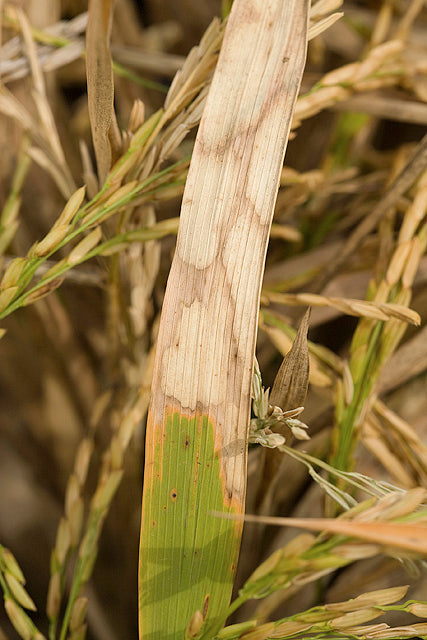
Photo at the top: Sheath blight patches on a rice leaf: grey-white centres with brown borders, Photo: Peggy Greb, USDA Agricultural Research Service, Public domain
What is sheath blight of rice?
Sheath blight of rice (poda tegulu in Telugu) is a fungal disease of paddy caused by Rhizoctonia solani. It makes grey-white patches with brown borders on the sheath near the water line. Then it climbs up the plant and leaves grain poorly filled. Control it with wider spacing, split nitrogen and a label-approved fungicide at the first signs.
Research reviews rank sheath blight as the second most important fungal disease of rice, after rice blast (leaf blast and neck blast). This guide shows you how to spot it early, what makes it spread and how to control it in paddy.
Rice sheath blight symptoms: how to identify it
Walk into the field and part the plants. Look low down, on the leaf sheath (the part of the leaf that wraps around the stem) just above the water. This is where the disease starts.
- Early spots: oval or uneven greenish-grey spots, about 1–3 cm long, on the sheath near the water level.
- Older spots: the centre turns greyish white and the border turns blackish brown or purple brown. Many spots join, so the sheath shows a banded pattern, a bit like snake skin.
- Spread upwards: in humid weather the patches climb to the upper sheaths and leaf blades, and in bad cases up to the flag leaf. The infection can move to the inner sheaths and kill the whole tiller.
- Fungus bodies: small round brown balls, called sclerotia, form on the patches. They look like mustard seeds and fall off easily. These are how the fungus survives.
- Dead leaves: several large patches on one sheath can kill the whole leaf. In severe cases all the leaves of a plant dry up.
- In the field: the disease shows up first in patches, often where the crop is thick and dark green.
Look-alikes and how to tell them apart
- Sheath rot: attacks the top sheath that covers the young panicle (the flag leaf sheath). The sheath turns reddish brown and the panicle does not come out fully. Sheath blight starts at the water line, not at the top.
- Stem rot: causes black patches near the water line, and the stem breaks. If you split the stem you see tiny black sclerotia inside. Sheath blight sclerotia are brown and sit on the outside.
- Brown spot: makes small oval brown spots on the leaf blade, not large banded patches on the sheath.
What causes sheath blight of rice: life cycle and weather
The fungus lives in the soil as sclerotia and as threads in old stubble and grass weeds. Tamil Nadu Agricultural University (TNAU) reports that it can survive about 20 months in dry soil and 5–8 months in moist soil. When the field is flooded, sclerotia float on the water and stick to the sheaths at the water line. From there the fungus grows into the plant.
The disease is worst when these conditions come together:
- very humid air (TNAU gives 96–100% relative humidity) and temperatures of 28–32 °C
- frequent rain and cloudy days
- heavy nitrogen (urea) doses
- close spacing or a high seed rate, so the canopy closes early and air cannot move
Paddy can be attacked from tillering to heading, and older plants are more at risk. In Telangana and Andhra Pradesh it is a problem in both kharif (vanakalam) and rabi (yasangi) paddy, mostly from the time the rows close until grain filling. Across India it is common in high-input, irrigated rice.
Crops it attacks
This article covers paddy, the crop where sheath blight causes the most loss in India. Rhizoctonia solani also attacks many other crops, such as maize, but the disease and the products differ there.
Paddy: the most damaging stage is from maximum tillering to grain filling. When the flag leaf and the sheaths below it are hit at early heading or grain filling, the grain fills poorly, mostly in the lower part of the panicle. Badly hit tillers dry up and can lodge (fall over).
When to spray for sheath blight
We could not confirm an economic threshold (the pest level at which spraying pays) for sheath blight from a recognised public source, so we do not give one here. The product labels in this article say to spray when the disease first appears. So check the lower sheaths every week from tillering. If you see fresh greenish-grey spots at the water line in several places, that is the time to act. Do not wait until the patches reach the flag leaf.
The disease starts low in the plant. So when you spray, aim the nozzle at the lower part of the plants, so that the spray reaches the sheaths near the water and not only the top leaves.
Control sheath blight without chemicals
- Variety: ask your local Krishi Vigyan Kendra (KVK) or agriculture officer which moderately resistant varieties suit your area. No common variety is fully resistant.
- Spacing: do not crowd the crop. Use the recommended seed rate and spacing so that air moves and the canopy dries.
- Nitrogen: split urea into two or three doses as per the soil test. Heavy single doses make the crop lush and the disease worse.
- Water: do not let water from an infected field flow into a healthy one. The sclerotia float and travel with it.
- Field hygiene: keep bunds free of grass weeds, which can carry the fungus. Remove crop stubble after harvest. TNAU also advises deep ploughing in summer to bury and dry out the sclerotia.
- Organic matter: TNAU advises neem cake (60 kg per acre) or farmyard manure (5 tonnes per hectare) as soil amendments.
- Biological control: TNAU advises the friendly bacterium Bacillus subtilis: 1 kg per acre to the soil 30 days after transplanting, and a 0.2% spray at boot leaf stage and again 10 days later. Use a registered product and follow its label.
Sheath blight fungicides for paddy: chemical control
Only the products below have paddy and sheath blight on their official label or leaflet. Doses are per acre, as printed on the label or converted from the label's per-hectare dose. Where the label gives only a strength per litre, we say "dose as per label" and quote that strength. Spray one product at a time. Do not mix products in one tank.
Paddy
| Product | Contains | Label dose per acre | Water per acre | Wait before harvest |
|---|---|---|---|---|
| Motive Fungicide | Mancozeb 68% + Hexaconazole 4% WG | 506 g | 200 L | 30 days |
| Yamakazi Fungicide | Pyraclostrobin 10% + Thifluzamide 10% SC | 324–364 ml | 200 L | 18 days |
| Amistar Top Fungicide | Azoxystrobin 18.2% + Difenoconazole 11.4% SC | Dose as per label: 0.1%, or 1 ml per litre of water | 200 L | 31 days |
| Avtar Fungicide | Hexaconazole 4% + Zineb 68% WP | 405–506 g | 200 L | 34 days |
| Score Fungicide | Difenoconazole 25% EC | Dose as per label: 0.05%, or 50 ml per 100 L of water | 200 L | 25 days |
| GLOIT Fungicide | Propiconazole 13.9% + Difenoconazole 13.9% EC | Dose as per label: 0.07–0.1%, or 0.7–1.0 ml per litre of water | 200 L (label: 500 L per hectare) | 46 days |
| Reflect Top Fungicide | Isopyrazam 11.5% + Difenoconazole 11.5% SC | 162 ml | 200 L | 30 days |
| Armatura Fungicide | Polyoxin D Zinc Salt 5% SC | 240 ml | Not given | The brand booklet says zero days |
Notes from the labels:
- Motive, Yamakazi, Amistar Top, Avtar, GLOIT and Reflect Top each hold two active ingredients in one pack. These are ready-mixed products approved on the label. They are not tank mixes.
- Motive: spray when symptoms appear, at the vegetative or reproductive stage, in the morning or evening. One to three sprays, depending on how bad the disease is.
- Yamakazi: spray when the disease is seen. One or two sprays, 10–15 days apart.
- Amistar Top: one or two sprays when the disease appears.
- GLOIT: spray when the disease is active but still early.
- Reflect Top: first spray when the disease starts, a second spray 10–15 days later if needed. No more than two sprays in a season.
- Armatura: our dose comes from the brand's product booklet, not the printed label, and it gives no water volume or timing. Check the pack label before use.
Rotate to avoid resistance
If you spray the same type of fungicide again and again, the fungus can stop responding to it. Fungicides are grouped by how they work, using the FRAC code (FRAC is the international Fungicide Resistance Action Committee). Change the group from one spray to the next.
| FRAC group | Active ingredient | Products in this article |
|---|---|---|
| 3 (triazoles) | Hexaconazole, difenoconazole, propiconazole | Score; GLOIT; and one part of Motive, Avtar, Amistar Top and Reflect Top |
| 11 (strobilurins) | Azoxystrobin, pyraclostrobin | One part of Amistar Top and Yamakazi |
| 7 (SDHI) | Isopyrazam, thifluzamide | One part of Reflect Top and Yamakazi |
| 19 | Polyoxin D | Armatura |
| M03 (multi-site contact) | Mancozeb, zineb | One part of Motive and Avtar |
Group 3 is in six of the eight products. So if your first spray was Score or GLOIT, which are group 3 only, make the next spray a product that brings a different group, such as Yamakazi (groups 11 and 7). Keep to the number of sprays each label allows.
Safety and waiting period
- The waiting period before harvest (PHI, pre-harvest interval) for each product is in the table above. Count the days from the last spray.
- Wear gloves, a mask, full-sleeve clothes and boots while mixing and spraying. Do not eat, drink or smoke while spraying. Wash well afterwards.
- Spray in the morning or evening, not in strong wind.
- Amistar Top's label warns that it is toxic to fish and should not be used where rice and fish are grown together. Motive's label says it is toxic to water life, so keep it away from ponds and fish culture.
- If you grow basmati or other rice for export, check your state's current rules and the buyer's residue limits before you spray.
- Read the label and leaflet before use.
Frequently asked questions
What are the first symptoms of sheath blight in rice?
Oval greenish-grey spots on the leaf sheath, just above the water line. The centre soon turns greyish white with a brown or purple-brown border. Look low in the plant, not at the top leaves.
What causes sheath blight of rice?
A soil fungus called Rhizoctonia solani. It survives in the soil and old stubble as small brown balls (sclerotia). These float on field water and stick to the sheaths. Humid weather, heavy urea and a crowded crop help it spread.
Which fungicide controls sheath blight in paddy?
Use one whose label lists paddy and sheath blight. On our store these are Motive, Yamakazi, Amistar Top, Avtar, Score, GLOIT, Reflect Top and Armatura. The doses are in the table above. Change the FRAC group between sprays.
Can sheath blight spread through irrigation water?
Yes. The brown sclerotia float on water and travel with it. Do not let water from an infected field run into healthy fields.
Does too much urea make sheath blight worse?
Yes. Heavy nitrogen makes a thick, soft, dark green crop that stays humid inside, and the fungus spreads fast. Split the urea into smaller doses as per your soil test.
Is sheath blight the same as sheath rot?
No. Sheath blight starts at the water line and climbs up. Sheath rot attacks the top sheath around the young panicle and stops the panicle from coming out fully.
Related reading
- Rice blast: leaf blast and neck blast control in paddy
- Brown plant hopper in paddy: symptoms, treatment and control
- Stem borer in paddy: dead heart, white ear and how to control it
- Leaf folder in paddy: identification, action level and control
- Khaira disease in rice and zinc deficiency: signs and correction
- Shop products for paddy and all fungicides
Sources
- Tamil Nadu Agricultural University, TNAU Agritech Portal: Rice sheath blight
- Fungicide Resistance Action Committee (FRAC): fungicides by FRAC mode of action group
- Frontiers in Plant Science (2022): Rhizoctonia solani Kühn pathophysiology: status and prospects of sheath blight disease management in rice
- The official label and leaflet of each product named in this article
Products that control it, by crop
Paddy (rice)
- Motive Fungicide506 g per acreSpray when disease signs appear, in the morning or evening; 1-3 sprays based on how bad the disease is
- Yamakazi Fungicide324–364 ml per acreSpray when the disease is first seen. 1-2 sprays, 10-15 days apart.
- Amistar Top FungicideSpray 1 ml per litre of water (0.1%) when the disease appears; 1-2 sprays
- Avtar Fungicide405–506 g per acre
- Score FungicideSpray 0.5 ml per litre of water (0.05%) when the disease first appears.
- GLOIT FungicideSpray 0.7 to 1 ml per litre of water (0.07 to 0.1%) when the disease is active but still early.
Do not spray the same product again and again. Change to a product with a different mode of action (the group number on the label) so the pest or disease does not build resistance.
As printed on the brand's official label. Read the label before use.


Like these farming tips? Add AgriVruddhi as a preferred source on Google
Back to Crop Health Guide