
Rice blast in paddy: symptoms and control of leaf and neck blast
· By AgriVruddhi
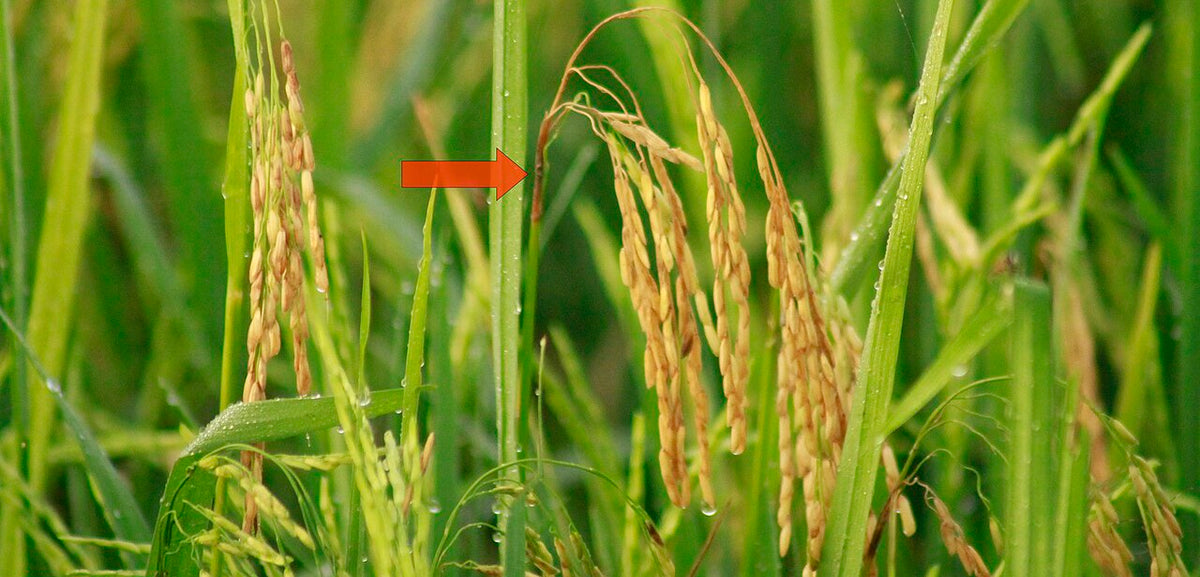
Photo at the top: Neck blast in a paddy field. The arrow points to the rotted neck below the panicle, Photo: Namanegara, CC BY-SA 3.0 (cropped)
Quick answer
Rice blast (aggi tegulu in Telugu, jhonka rog in Hindi) is a fungal disease of paddy. It makes eye-shaped spots on leaves, blackens the nodes and rots the panicle neck, so grains stay empty. Control it with clean seed, seed treatment, tolerant varieties and balanced nitrogen, plus a label-approved fungicide at the first leaf spots and before panicles come out.
The fungus is Magnaporthe oryzae (also called Pyricularia oryzae). Farmers call the three main forms leaf blast, node blast and neck blast. Neck blast does the most damage to yield.
How to identify rice blast disease
Blast can attack the crop at any stage, from the nursery to grain filling, and on every part above the ground. The Government of India plant protection office (DPPQS) notes that leaf and neck infections do the most harm.
- Leaf blast: starts as small bluish-green flecks. In moist weather they grow into spindle-shaped spots, wide in the middle and pointed at both ends, like an eye. The centre turns grey and the border dark brown. Spots join up and whole leaves dry. A badly hit nursery or young crop looks burnt from a distance.
- Collar blast: TNAU lists the leaf collar among the parts blast attacks. The collar is the joint where the leaf blade meets the sheath. It turns brown, and the leaf above it can dry and die. On the flag leaf (the top leaf) this hurts grain filling.
- Node blast: black patches circle the nodes (the joints on the stem). The stem can break at the node, and everything above it dies.
- Neck blast (medavirupu in Telugu): a grey-brown to black patch circles the neck, just below the panicle. The panicle turns white or grey and falls over. Tamil Nadu Agricultural University (TNAU) notes that if the neck is hit before the milky stage, no grain forms. If it is hit later, the grains are light and poor.

Look-alikes and how to tell them apart
- Brown spot: spots are oval or round and brown, often with a yellow halo, and do not have the pointed ends of blast spots. It is common on poor or nutrient-short soils.
- Sheath blight: large grey-green patches on the leaf sheath near the water line, not eye-shaped spots on the leaf blade. See our sheath blight article.
- Bacterial leaf blight: yellow to straw-coloured stripes that start at the leaf tip or edge and run down the leaf with a wavy border.
- White ear from stem borer: the panicle also turns white, but it pulls out easily, and the stem has a bore hole or a caterpillar inside. The neck is not black. See our stem borer article.
Rice blast life cycle and the weather that favours it
The blast fungus lives through the gap between crops in infected straw, seed and grassy weeds on the bunds, such as Panicum repens. From there, its spores (tiny seeds of the fungus) travel by wind and in irrigation water. TNAU notes that spores are in the air through the year. A spore lands on a wet leaf, gets in, and within about a week the new spot is producing spores of its own. This is why blast can spread through a field very fast.
TNAU and the DPPQS blast advisory (2022) list the conditions that favour it:
- Cloudy weather with on-and-off drizzle, and dew in the morning.
- Very humid air (above about 93% relative humidity) and leaves that stay wet for more than about 10 hours.
- Mild, cool weather. TNAU gives night temperatures of 15–20 °C, and DPPQS gives 22–28 °C as the range that favours blast.
- Too much nitrogen fertiliser.
- A very thick crop, where the leaves stay wet for longer.
- Dry, aerobic soil, or water in the field falling below the recommended level.
In Telangana and Andhra Pradesh these conditions are common in rabi paddy, with its cool nights and heavy dew, and in late kharif when cloudy, drizzly spells meet the crop at tillering or panicle emergence. Watch closely during such spells.
Crops it attacks
Paddy: the nursery and young crop suffer leaf blast, which can kill seedlings outright. During tillering, leaf blast cuts the green leaf area. From booting to grain filling, neck and node blast do the most damage, because they stop the grain from filling. Neck blast causes the biggest yield losses. A related blast fungus attacks wheat and some millets, but this article covers paddy only.
When to spray for rice blast (economic threshold)
The economic threshold (ETL) is the level of disease at which a spray starts to pay for itself. The Integrated Pest Management Package for Rice (NCIPM, DPPQS and NIPHM) gives:
- Leaf blast: 3–5 spots per leaf, from early to late tillering.
- Neck blast: 2–5 plants with infected necks per square metre, from panicle initiation to booting.
Fungicides protect healthy leaves and necks; they cannot bring back a leaf or panicle that is already dead. So do not wait for the disease to spread. Check the field twice a week during cloudy, humid or dewy spells. Walk across the field, not just along the bund, and look at the upper leaves and the flag leaf. Act on the first spots. For neck blast, the protective spray must go on before or as the panicles come out.
How to control rice blast without chemicals
- Clean seed: use certified, disease-free seed. Infected seed carries the fungus into the new crop.
- Seed and seedling treatment: DPPQS advises treating seed with Pseudomonas fluorescens 0.5% WP at 10 g per kg of seed, and dipping seedlings in Pseudomonas fluorescens at 5 g per litre of water for 20 minutes before transplanting.
- Tolerant varieties: the rice IPM package lists blast-tolerant varieties such as Rasi, Vikas, Krishna Hamsa, Tulasi, IR 64 and Swarnadhan. Ask your nearest Krishi Vigyan Kendra (KVK) which ones suit your area and season.
- Balanced nitrogen: do not overdose urea. Give it in split doses. In a blast-prone season, hold back the top dressing until the disease is under control.
- Spacing: plant at the normal spacing for your variety. A crop that is too thick stays wet for longer and suits blast. Too much nitrogen also makes a thick, soft crop. To tell real nitrogen shortage from normal leaf colour, see our guide on nitrogen deficiency symptoms in plants.
- Water: keep the recommended water level. DPPQS notes that blast is worse where the water falls below that level.
- Clean bunds: remove grassy weeds from bunds and channels, as TNAU advises.
- Field hygiene: remove and destroy infected plant parts. After harvest, clear away infected straw and stubble. Rotating with a non-rice crop also helps.
Fungicides for rice blast: chemical control in paddy
Only the products below have paddy and blast on their official label or leaflet. Doses are per acre, as printed on the label or worked out from the label's per-hectare dose. Where the label gives only a strength per litre, we say "dose as per label" and quote that strength. Spray one product at a time. Do not mix products in one tank.
Paddy
| Product | Contains | Label dose per acre | Water per acre | Wait before harvest |
|---|---|---|---|---|
| Baan Fungicide | Tricyclazole 75% WP | 121–162 g | 200 L | 30 days |
| Galileo Sensa Fungicide | Picoxystrobin 6.78% + Tricyclazole 20.33% SC | 400 ml | 200 L | Not printed on the brand leaflet; check the pack label |
| Merger Fungicide | Tricyclazole 18% + Mancozeb 62% WP | 405–506 g | 200 L | 25 days |
| Yamakazi Fungicide | Pyraclostrobin 10% + Thifluzamide 10% SC | 324–364 ml | 200 L | 18 days |
| Amistar Top Fungicide | Azoxystrobin 18.2% + Difenoconazole 11.4% SC | Dose as per label: 0.1%, or 1 ml per litre of water | 200 L | 31 days |
| Motive Fungicide | Mancozeb 68% + Hexaconazole 4% WG | 506 g | 200 L | 30 days |
| Avtar Fungicide | Hexaconazole 4% + Zineb 68% WP | 405–506 g | 200 L | 34 days |
| Indofil M45 Fungicide | Mancozeb 75% WP | 0.6–0.8 kg | 300 L | 20 days |
| Polyram - Fungicide | Metiram 70% WG | 607–809 g | 200 L | 51 days |
| Companion Fungicide | Carbendazim 12% + Mancozeb 63% WP | 304 g | 300 L | 57 days |
| Saaf Fungicide | Carbendazim 12% + Mancozeb 63% WP | 304 g | 300 L | 57 days |
| Saafilizer Systemic and Contact Fungicide | Carbendazim 12% + Mancozeb 63% WP | 304 g | 300 L | 57 days |
Notes from the labels:
- Galileo Sensa, Merger, Yamakazi, Amistar Top, Motive, Avtar, Companion, Saaf and Saafilizer each hold two active ingredients in one pack. These are ready-mixed products approved on the label. They are not tank mixes.
- Baan: spray for leaf blast when the first symptoms appear. For neck (panicle) blast, spray at late booting, before the panicles come out. Use a knapsack sprayer with a hollow cone nozzle.
- Baan seed treatment: 30 g of product per 10 kg of seed, with 1 litre of water per 10 kg of seed, mixed in a seed drum.
- Galileo Sensa: for leaf blast, a protective spray when fewer than 3 in 100 leaves show blast. For neck blast, spray before the panicles come out, and a second spray 10–14 days later at the milk stage if needed. No more than 2 sprays per crop.
- Merger and Motive: spray when symptoms appear, in the morning or evening, 1–3 sprays depending on how bad the disease is.
- Yamakazi: spray when leaf blast is seen, 1–2 sprays 10–15 days apart.
- Amistar Top: 1–2 sprays when the disease appears.
- Saaf and Saafilizer: spray as soon as symptoms appear.
Mind the waiting period when you choose. Companion, Saaf and Saafilizer need 57 days between the last spray and harvest, and Polyram 51 days. Count the days left to your expected harvest before you pick a product, especially for a late neck blast spray.
Rotate to avoid resistance
If you spray the same type of fungicide again and again, the fungus can stop responding to it. Fungicides are grouped by how they work, using the FRAC code (FRAC is the international Fungicide Resistance Action Committee). Change the group from one spray to the next.
| FRAC group | Active ingredient | Products in this article |
|---|---|---|
| 16.1 | Tricyclazole | Baan, and one part of Galileo Sensa and Merger |
| 11 (strobilurins) | Picoxystrobin, pyraclostrobin, azoxystrobin | One part of Galileo Sensa, Yamakazi and Amistar Top |
| 3 (triazoles) | Hexaconazole, difenoconazole | One part of Motive, Avtar and Amistar Top |
| 7 (SDHI) | Thifluzamide | One part of Yamakazi |
| 1 | Carbendazim | One part of Companion, Saaf and Saafilizer |
| M03 (multi-site contact) | Mancozeb, zineb, metiram | Indofil M45, Polyram, and one part of Merger, Motive, Avtar, Companion, Saaf and Saafilizer |
Group 11 carries a high risk of resistance, so do not use Galileo Sensa, Yamakazi and Amistar Top in back-to-back sprays. A simple plan: if the first spray was a tricyclazole product (group 16.1), make the second one a product from a different group, such as Yamakazi (groups 11 and 7) or Motive (groups M03 and 3). Contact fungicides in group M03 carry a low risk of resistance, but they only protect the surface they cover. Keep to the number of sprays each label allows.
Safety and waiting period
- The waiting period before harvest (PHI, pre-harvest interval) for each product is in the table above. Count the days from the last spray.
- Wear gloves, a mask, full-sleeve clothes and boots while mixing and spraying. Do not eat, drink or smoke while spraying. Wash well afterwards.
- Spray in the morning or evening, not in strong wind or just before rain.
- Fish: the Amistar Top and Galileo Sensa labels say not to use them where rice and fish are grown together. The Merger, Motive and Saaf labels warn that they are toxic to fish or water life, so keep them away from ponds and fish culture.
- Basmati and export rice: Punjab has in some years stopped the sale of tricyclazole and hexaconazole for basmati, because of residue limits in buyer countries. If you grow basmati or rice for export, check your state's current rules and the buyer's residue limits before you spray.
- Read the label and leaflet before use.
Frequently asked questions
What causes rice blast disease?
A fungus, Magnaporthe oryzae. Its spores spread by wind and water from infected straw, seed and grassy weeds. Cool nights, dew, drizzle and too much nitrogen help it spread.
Can neck blast in paddy be cured once the panicles turn white?
No. A panicle with a rotted neck will not fill. A spray can only protect the necks that are still healthy. That is why the neck blast spray goes on before or as the panicles come out.
How do I tell leaf blast in rice from brown spot?
Leaf blast spots are eye-shaped, pointed at both ends, with a grey centre and a brown border. Brown spot spots are smaller, round or oval, and brown throughout, often with a yellow halo.
Which fungicide is used for rice blast?
Use one whose label lists paddy and blast. In our store these are Baan, Galileo Sensa, Merger, Yamakazi, Amistar Top, Motive, Avtar, Indofil M45, Polyram, Companion, Saaf and Saafilizer. The doses are in the table above. Change the FRAC group between sprays.
When should I spray for neck blast in paddy?
Before or as the panicles come out. The Baan label says late booting. Do not wait until the panicles turn white. If needed, the Galileo Sensa label allows a second spray 10–14 days later, at the milk stage. Check each product's waiting period before harvest first.
Does seed treatment help against blast?
Yes. It lowers the fungus carried on the seed and protects the nursery. Baan's label gives a seed treatment rate, and DPPQS advises Pseudomonas fluorescens as a biological seed treatment.
Related reading
- Sheath blight of rice: symptoms, causes and control in paddy
- Brown plant hopper in paddy: symptoms, treatment and control
- Stem borer in paddy: dead heart, white ear and how to control it
- Leaf folder in paddy: identification, action level and control
- Khaira disease in rice and zinc deficiency: signs and correction
- All paddy products
- All fungicides
Sources
- National Centre for Integrated Pest Management (NCIPM, ICAR), DPPQS and NIPHM, Integrated Pest Management Package for Rice (2014).
- Tamil Nadu Agricultural University, TNAU Agritech Portal: rice blast.
- Directorate of Plant Protection, Quarantine and Storage (DPPQS), advisory on rice blast (2022).
- Fungicide Resistance Action Committee, FRAC Code List 2026.
- Official labels and leaflets of the products named in this guide.
Products that control it, by crop
Paddy (rice)
- Baan Fungicide121–162 g per acreFoliar spray. Leaf blast: at first signs. Panicle blast: at late booting, before panicles come out. Use a hollow cone nozzle.
- Baan FungicideSeed treatment: mix 30 g with 1 litre of water for every 10 kg of seed, in a seed drum.
- Galileo Sensa Fungicide400 ml per acreLeaf blast: protective spray when under 3 in 100 leaves show it. Neck blast: before panicles emerge, again 10-14 days later if needed. Max 2 sprays.
- Merger Fungicide405–506 g per acreSpray when disease signs first appear, in the morning or evening. 1 to 3 sprays, based on how bad the disease is.
- Yamakazi Fungicide324–364 ml per acreSpray when the disease is first seen. 1-2 sprays, 10-15 days apart.
- Amistar Top FungicideSpray 1 ml per litre of water (0.1%) when the disease appears; 1-2 sprays
- Motive Fungicide506 g per acreSpray when disease signs appear, in the morning or evening; 1-3 sprays based on how bad the disease is
- Avtar Fungicide405–506 g per acre
- Indofil M45 Fungicide0.6–0.8 kg per acreFoliar spray.
- Polyram - Fungicide607–809 g per acre
- Companion Fungicide304 g per acre
- Saaf Fungicide304 g per acreSpray as soon as disease symptoms appear.
- Saafilizer Systemic and Contact Fungicide304 g per acre
Do not spray the same product again and again. Change to a product with a different mode of action (the group number on the label) so the pest or disease does not build resistance.
As printed on the brand's official label. Read the label before use.


Like these farming tips? Add AgriVruddhi as a preferred source on Google
Back to Crop Health Guide