
Narrow brown leaf spot of rice: symptoms and control in paddy
· By AgriVruddhi
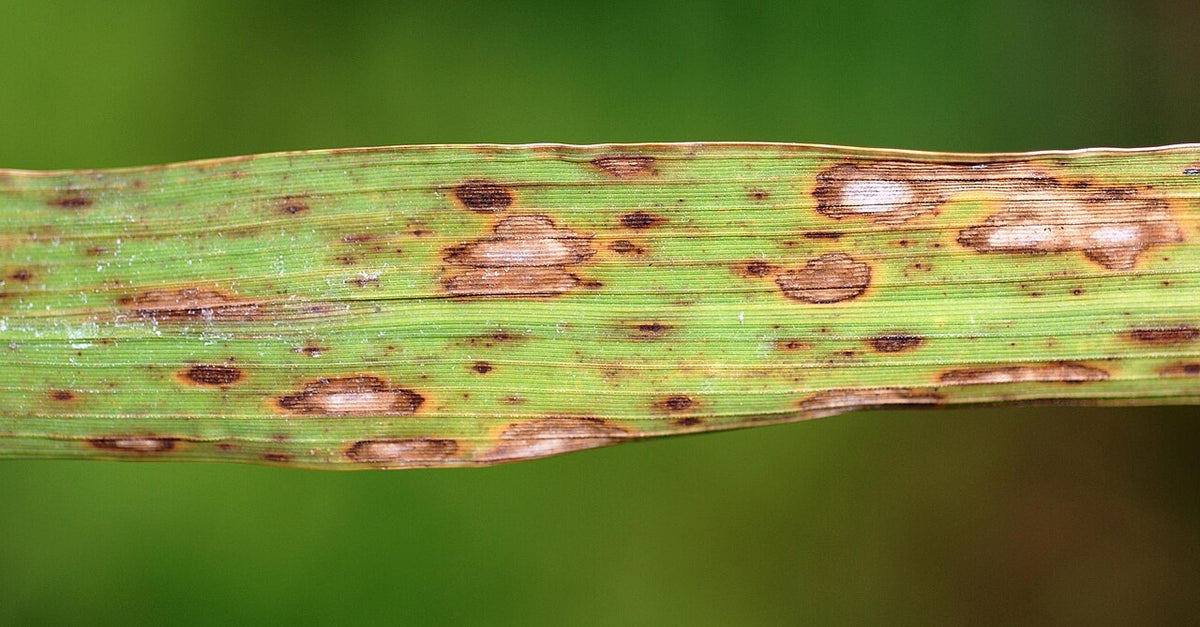
Photo at the top: Look-alike, not this disease: brown spot makes oval spots with a light centre. Narrow brown spot makes thin brown lines along the veins, Photo: Donald Groth, Louisiana State University AgCenter, CC BY 3.0 US
Quick answer
Narrow brown leaf spot is a fungal disease of paddy. It makes short, thin, brown streaks that run along the leaf veins, mostly from panicle initiation to harvest. Bad attacks dry leaves early, ripen grain too soon and lower milling quality. Control it with clean seed, tolerant varieties, enough potash, weed-free fields and advice from your KVK.
The disease is also called narrow brown spot or Cercospora leaf spot of rice. The fungus is Cercospora janseana. IRRI lists it as Sphaerulina oryzina, and older books call it Cercospora oryzae. It is usually a minor disease, but it can get serious in some seasons and on some varieties.
How to identify narrow brown leaf spot of rice
In Hindi it is called sankara bhura patti dhabba (संकरा भूरा पत्ती धब्बा), and in Telugu sannani godhuma aakumachcha tegulu (సన్నని గోధుమ ఆకుమచ్చ తెగులు). The fungus can attack the leaves, the leaf sheath and the panicle (the ear). Look at the upper leaves and the flag leaf (the top leaf) first.
Narrow brown leaf spot symptoms on the leaf
- Thin brown streaks: the spots are light brown to dark brown and long and narrow, like short lines. IRRI (International Rice Research Institute) gives their size as about 2–10 mm long and only 1–1.5 mm wide.
- They run along the veins: each streak grows in the same direction as the leaf veins, not across them.
- Many spots on one leaf: Kerala Agricultural University notes many short, narrow brown spots on each leaf.
- Streaks join on weak varieties: on varieties that catch the disease easily, the streaks grow and join. Long brown strips of dead leaf form, and the leaf can dry early.
Symptoms on the sheath and the panicle
- Net blotch on the sheath: the leaf sheath shows a net-like pattern of brown patches with light brown to yellow areas between them. IRRI calls this "net blotch".
- Spots on the grain husk: spots on the husk (glume) are shorter than on the leaf but can be wider. The small stalks that hold each grain can also show brown spots.
- Panicle blight: the University of Arkansas extension service reports that the same fungus can darken the base of the panicle and its branches, so that grains fill poorly.
Look-alikes and how to tell them apart
- Brown spot: spots are oval or round, often with a grey or light centre and a dark brown edge. They are wider and not line-shaped. See our guide to brown spot of rice and its oval leaf spots.
- Leaf blast: spots are shaped like an eye, wide in the middle and pointed at both ends, with a grey centre. They are much bigger than narrow brown streaks. Read about rice blast in paddy: leaf blast and neck blast.
- Neck blast: the neck just below the panicle turns grey-brown to black, and the panicle can break over. The University of Arkansas notes that Cercospora panicle blight can look very similar. If you see panicle damage, ask your KVK or agriculture officer to check the sample before you choose a spray.
- Bacterial leaf blight: yellow to straw-coloured stripes start at the leaf tip or edge and spread down the leaf with a wavy border. See bacterial blight of rice: symptoms and spread.
- Potassium shortage: the tips and edges of older leaves turn yellowish brown and dry, without separate thin streaks. The two often come together, as the next section explains.
Life cycle and when it attacks
Kerala Agricultural University notes that the disease spreads through seed and through the air. Spores (tiny seed-like cells of the fungus) blow from sick plants to healthy leaves. IRRI adds that the fungus can live on weeds and weedy rice in and around the field, and spread from them to the new crop.
The disease can appear at any stage, but it is far more common late in the season. IRRI says plants are most at risk from panicle initiation (when the young ear starts to form inside the stem) onwards. It usually shows up around heading, and the damage grows worse as the crop nears maturity.
IRRI links the disease to two conditions:
- Soil that is short of potassium (potash).
- Temperatures of about 25–28 °C.
In Telangana and Andhra Pradesh, watch for it in the last weeks of both the kharif and the rabi crop, from heading to harvest. Fields with low potash, and varieties known to catch it easily, need the closest watch.
Crops it attacks
Paddy (rice): this guide covers paddy only. IRRI reports that a bad attack kills leaves and leaf sheaths early, makes the grain ripen too soon and, in severe cases, makes plants lodge (fall over). It also lowers the market value of the grain and the amount of rice you get after milling. IRRI notes that big yield losses are rare and happen only in occasional severe outbreaks. So in most seasons it is a quality problem more than a yield problem.
When to act
We could not find an economic threshold (the disease level at which a spray starts to pay) for this disease from a recognised public source, so we do not give one.
Instead, judge the risk of your own field:
- From panicle initiation onwards, walk across the field once a week and look at the flag leaf and the leaf below it.
- Count how many leaves have thin brown streaks, and check whether the streaks are joining into long dead strips.
- Treat it as high risk if your variety caught it badly before, your soil is short of potash, or streaks appear on the flag leaf before or at booting (when the ear swells inside the sheath).
- A few streaks on lower leaves close to harvest usually need no spray.
Narrow brown leaf spot control without chemicals
- Clean seed: the disease can travel with seed. Use certified seed, or seed from a healthy crop. Do not keep seed from a field that was badly hit.
- Tolerant varieties: IRRI's first advice is to grow a resistant variety. Varieties differ by region, so ask your KVK (Krishi Vigyan Kendra) or state agricultural university which local varieties show less narrow brown spot.
- Enough potash: IRRI advises balanced nutrients with enough potassium. Test your soil and give the potash it needs. Our guide to potassium deficiency symptoms in plants explains how to spot a shortage and correct it.
- Balanced fertiliser: give nitrogen, phosphorus and potash as your soil test suggests, not urea alone.
- Remove weeds and weedy rice: clear grassy weeds and weedy rice from the field, the bunds and the channels, so the fungus has fewer places to survive.
- Keep the field clean: after harvest, clear away infected straw and stubble instead of leaving it on the field or bunds.
- Spacing: plant at the normal spacing for your variety, so air moves through the crop and leaves dry faster.
Chemical control: ask before you spray
No product in our store has this disease on paddy in its label record, so we do not name one here. A spray cannot heal leaves that already have streaks. It only protects the new and healthy leaves.
IRRI advises a fungicide spray from booting to heading only where the disease poses a real risk to the field. Ask your local agriculture officer or KVK for a product labelled for narrow brown spot on paddy, and use the dose printed on its label. You can browse our fungicides and products for paddy, but use only a product whose label names this disease on paddy.
If you do spray:
- Use one product at a time. Do not mix products in one tank.
- Cover the flag leaf and the upper leaves well. These leaves fill the grain.
- If you spray more than once in a season, ask your KVK for a fungicide from a different group (mode of action) for the next spray. This slows down resistance.
Safety
- Wear gloves, a mask, full-sleeve clothes and boots while mixing and spraying. Do not eat, drink or smoke while you work. Wash well afterwards.
- Spray in the morning or evening, not in strong wind or hot afternoon sun.
- Keep the waiting period before harvest that is printed on the label of the product you use.
- Keep sprays and washings away from ponds, canals and wells.
- Read the label and leaflet before use.
Frequently asked questions
What causes narrow brown leaf spot in rice?
A fungus called Cercospora janseana, also listed as Sphaerulina oryzina or Cercospora oryzae. It spreads through the air and with seed, and it can survive on weeds and weedy rice near the field. It is more common on soil short of potash.
How is narrow brown spot different from brown spot of rice?
Narrow brown spot makes thin, line-shaped streaks that run along the veins, about 1–1.5 mm wide. Brown spot makes oval or round spots, often with a light centre and a dark edge. If you are not sure, take a few leaves to your KVK.
Is narrow brown leaf spot a serious disease?
Usually it is a minor disease, and big yield losses are rare. But a bad attack late in the season can dry the leaves early, make the grain ripen too soon, lower milling quality and make plants fall over. It is worth watching on varieties that catch it easily.
Does potash help prevent narrow brown spot?
IRRI notes that the disease usually occurs on potassium-deficient soil, and it advises balanced nutrients with enough potassium. Potash does not cure spots that are already there, but a well-fed crop is less at risk. Test your soil to know how much to give.
Can I keep seed from a field that had this disease?
It is better not to. The disease can travel with seed into the next crop. Use certified seed, or seed from a healthy field, and ask your KVK about seed treatment.
Related reading
- Brown spot of rice: symptoms, causes and control in paddy
- Rice blast in paddy: symptoms and control of leaf and neck blast
- Dirty panicle (grain discolouration) in paddy
- Potassium deficiency in plants: symptoms, causes and how to correct it
- Products for paddy and all fungicides
Sources
- International Rice Research Institute (IRRI), Rice Knowledge Bank: Narrow brown spot
- Kerala Agricultural University, KAU Agri Infotech Portal: Narrow brown spot of rice
- University of Arkansas Division of Agriculture, Research and Extension, FSA2213: Cercospora Diseases in Rice: Disease Symptomology
Like these farming tips? Add AgriVruddhi as a preferred source on Google
Back to Crop Health Guide