
Purple mite in tea: symptoms, treatment and control
· By AgriVruddhi
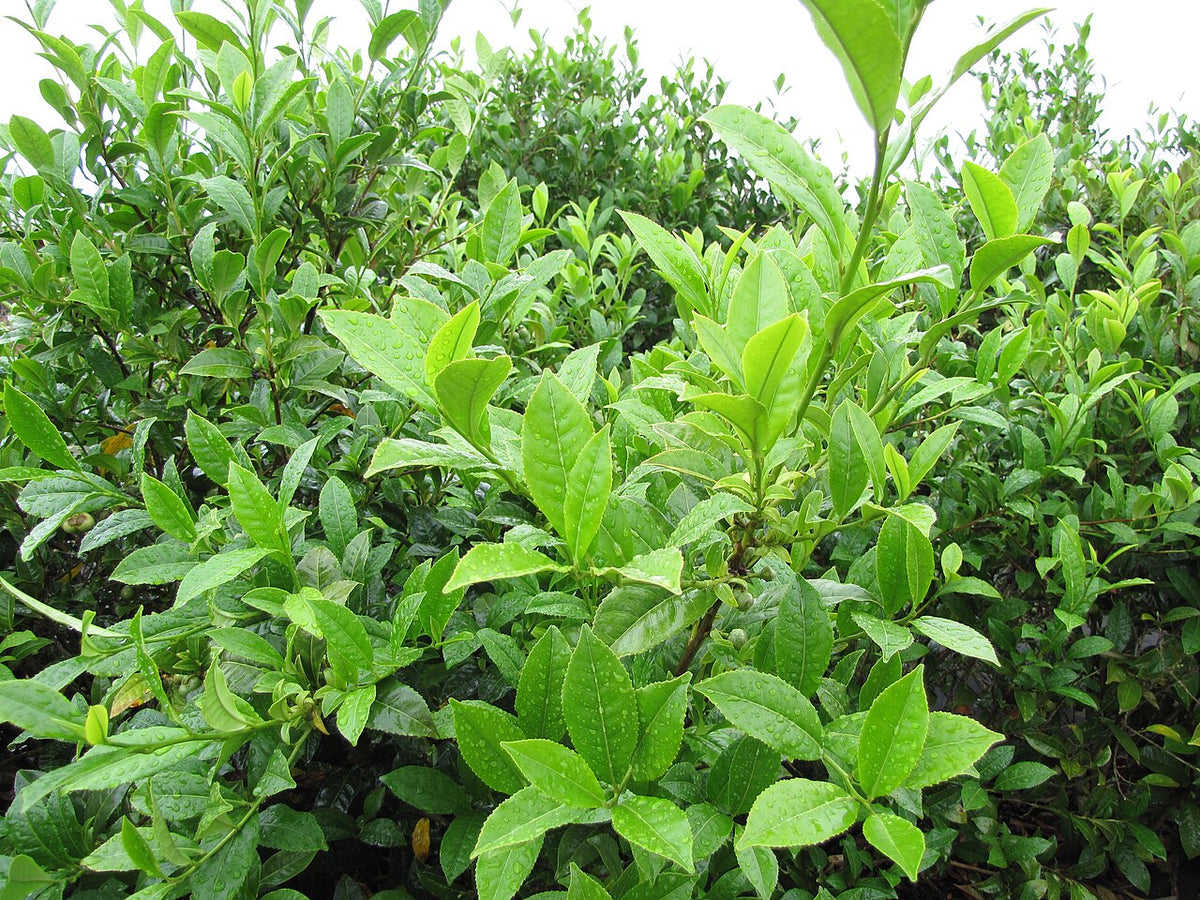
Photo at the top: A tea bush: light green young shoots on top, older mature leaves below. Look for the mites on the mature leaves. Photo: Forest and Kim Starr, CC BY 3.0 US
Quick answer
Purple mite (Calacarus carinatus) is a very small mite that sucks sap from mature tea leaves. The leaves lose their shine, turn a dull coppery brown and look dusty with white cast skins. Check the older leaves with a hand lens. Keep natural enemies alive, and if the attack spreads, spray a miticide labelled for purple mite on tea.
How to identify purple mite in tea
Purple mite is called baingani mite (बैंगनी माइट) in Hindi and ooda nalli (ఊదా నల్లి) in Telugu. Some books also call it the purple tea mite or the ribbed mite. It is not an insect. It is a mite, a small relative of spiders. It belongs to a family of very small mites called eriophyid mites, which have only four legs instead of eight.
You will not see this mite clearly with the naked eye. Use a hand lens (a small magnifying glass) and look at the mature leaves of the bush, not the tender shoots you pluck.
The mite
- Shape: long and spindle shaped, wide at the head end and narrow at the tail, like a tiny carrot.
- Colour: dark purple.
- Marks: five white, waxy lines (ridges) run along its back, from head to tail. TNAU and UPASI both use these white ridges to identify it.
- Where: mostly on the underside of mature leaves, as TNAU and UPASI note. In a heavy attack the mites spread to both sides of the leaf.
- Young stages: the eggs are laid mostly along the leaf veins. The young mites moult (shed their skin) as they grow, and these empty white skins stay on the leaf.
Damage signs
- Mature leaves lose their gloss and turn a dull coppery brown. TNAU names this coppery brown colour as the main sign.
- Leaves look dusty or powdery. This "dust" is the many white cast skins the mites leave behind as they grow, mixed with live mites.
- Some leaves first turn purplish between the veins, then bronze and brown.
- In a heavy attack the damaged leaves fall early. The bush has less healthy foliage to feed new shoots, so the crop of new leaves (the flush) can drop.
Look-alikes and how to tell them apart
Tea has several mites. Use a hand lens and check where on the bush the damage is.
- Red spider mite: bigger, crimson red in front and darker behind, with eight legs. It spins fine silk webs on the leaf, and the damage starts along the midrib and veins. The bush turns a reddish bronze that you can see from far away. The purple one makes no webs. See our guide on how to identify and control red spider mite.
- Pink mite: also a tiny four-legged mite, but pale pink, and it attacks the tender shoots. Young leaves turn pale and curl upward. The purple one stays on the older leaves. Read more in our pink mite guide for tea.
- Scarlet mite: bright red, flat and oval, with eight legs. Brown patches start on both sides of the midrib and then spread over the leaf.
- Yellow mite: yellowish, and found on the top two or three leaves and the bud. The leaves turn rough and brittle with corky patches. See yellow mite symptoms and control.
Life cycle and when it attacks
The female lays eggs on the leaf, mostly along the veins. UPASI (the tea research institute of South India) records that the eggs hatch in 3 to 5 days. There are two young stages, and the whole cycle from egg to adult takes 6 to 11 days. The NC State Extension fact sheet gives a similar picture: about 7 days in hot weather and 13 to 14 days in cool weather. Because one generation is so short, numbers can rise very fast.
Mites on tea build up in dry weather, when the bush is under stress. Hot and humid weather works against it. The NC State Extension sheet notes that in humid weather many of these mites die from a natural fungus disease (Hirsutella thompsonii).
TNAU calls purple mite a major pest of tea in South India. Tea is not a common crop in Telangana or Andhra Pradesh. This guide is for growers in the tea districts of Tamil Nadu, Kerala, Karnataka, Assam and West Bengal, and for anyone who grows tea bushes.
Crops it attacks
Tea: this is the main crop. The mite feeds on the mature "maintenance" leaves, the layer of older leaves that feeds the bush and the new shoots. TNAU notes that the Assam type of tea is more prone to this mite. Watch for it most in dry spells, when the bushes are under water stress.
The same mite also lives on ornamental camellias, which are close relatives of tea. It is not a pest of field crops such as cotton, chilli or paddy.
When to spray for purple mite
We could not find an economic threshold (the pest level at which spraying starts to pay) for this mite in a recognised public source such as ICAR, TNAU or UPASI. So we do not give one here.
Check the mature leaves of a few bushes in each section once a week in dry weather. Use a hand lens. Note when coppery leaves and live mites first appear, and whether the damaged patches are growing. If the damage spreads from bush to bush, it is time to act. For a local threshold, ask your Tea Board office, the tea research institute in your region (UPASI in the south, Tocklai in the north east) or your local agriculture officer.
Purple mite control without chemicals
UPASI advises regular field checks, managing shade, and building up natural enemies as the first line of control for tea mites.
- Check often: walk the field each week in dry spells and look at the older leaves with a hand lens. Early patches are easier to manage.
- Manage shade trees: keep shade trees and prune them as advised for your area. UPASI includes shade regulation in its mite control advice.
- Reduce drought stress: where you can irrigate, do not let the bushes suffer in long dry spells. Mulch helps the soil hold water.
- Protect natural enemies: UPASI names predatory mites (phytoseiid mites), predatory thrips and small predatory fly larvae (cecidomyiids) as natural enemies of tea mites. Avoid sprays that are not needed, so these friends survive.
- Biological sprays: UPASI also lists neem-based sprays and a fungus-based biopesticide against tea mites. If you use one, choose a product whose label names tea, and follow that label.
Purple mite treatment: chemical control in tea
Use a miticide (also called an acaricide), a product that acts on mites. Many common insecticides do not control mites. The two products below list purple mite on tea. TNAU also names their active ingredients, ethion and fenpyroximate, among the options for this pest. Use one product at a time. Never mix two products in one tank. Wet the mature leaves well, on both sides.
Tea
| Product | Contains | Dose per acre | Water per acre | When |
|---|---|---|---|---|
| Mit 505 Insecticide | Ethion 50% EC | 202 ml (label dose) | 200–400 L | Foliar spray right after plucking |
| Mitigate Insecticide | Fenpyroximate 5% EC | 120–240 ml (company product sheet) | Not given: follow the pack leaflet | Not given in the product sheet |
Mit 505: the leaflet gives the dose per hectare (500 ml in 500–1000 L water). We have converted it to per acre. Spray it right after a plucking round, as the label says.
Mitigate: the dose comes from the company's product sheet, not the printed pack label. Check the pack label before use, and follow it if it differs.
Rotate to avoid resistance
Mites have many generations in one season, so they can build resistance quickly. If you spray the same group again and again, it stops working. IRAC, the international body that groups pesticides by how they act, gives each active ingredient a group number. Do not spray the same group twice in a row.
| IRAC group | Active ingredient | Product in this article |
|---|---|---|
| 1B (organophosphates) | Ethion | Mit 505 |
| 21A (METI: blocks the energy supply inside mite cells) | Fenpyroximate | Mitigate |
The two products are in different groups. If a second spray is needed after Mit 505, the next one can be Mitigate, and the other way round. Keep to the number of sprays and the gap between sprays that each label allows.
Safety and waiting period
| Product | Crop | Waiting period before plucking |
|---|---|---|
| Mit 505 | Tea | Not given on the leaflet: check the pack label |
| Mitigate | Tea | Not given in the product sheet: check the pack label |
- The waiting period (PHI, pre-harvest interval) is the number of days to wait after a spray before you pluck. Tea leaves go straight into the made tea, so do not pluck before the waiting period on the pack label is over.
- Wear gloves, a mask, goggles and full-sleeve clothes while mixing and spraying. Do not eat, drink or smoke while you work. Wash well afterwards.
- Spray in the morning or evening, not in strong wind or hot afternoon sun.
- Keep sprays and washings away from streams, ponds and wells. Many miticides are harmful to fish.
- Keep products away from children, animals and food.
- Read the label and leaflet before use.
Frequently asked questions
What is purple mite in tea?
It is a very small, dark purple mite (Calacarus carinatus) with five white waxy lines on its back. It sucks sap from mature tea leaves and turns them a dull coppery brown.
Why are my tea leaves turning coppery brown?
Purple mite is a common cause, especially in dry weather. Look at the older leaves with a hand lens. If you see small purple mites and white dust (cast skins), it is purple mite. If you see silk webs and red mites, it is more likely red spider mite.
Can I see purple mite without a lens?
Not clearly. A heavy attack shows as a dusty, coppery look on the leaves, but you need a hand lens to see the mites and their white ridges.
Is purple mite the same as red spider mite?
No. Red spider mite is bigger, red, has eight legs and spins webs. Purple mite is smaller, purple, has four legs and spins no webs. They need different checks, though some miticides are labelled for both.
Does rain stop purple mite?
Rain and humid weather help. A natural fungus kills many mites in humid weather, and the bush is under less stress. Numbers usually build up again in the next dry spell, so keep checking.
Related reading
- Red spider mite: symptoms, treatment and control in crops
- Pink mite in tea: symptoms and control
- Yellow mite (broad mite): symptoms and control
- Tea mosquito bug: identify and control it in tea
- All insecticides and miticides
Sources
- Tamil Nadu Agricultural University, TNAU Agritech Portal: Purple mite of tea
- UPASI Tea Research Foundation: Pests of tea and their management
- NC State Extension: Purple mite fact sheet
- IRAC (Insecticide Resistance Action Committee): Mode of action classification
- Product leaflet of Mit 505 Insecticide and company product sheet of Mitigate Insecticide
Products that control it, by crop
Tea
- Mit 505 Insecticide202 ml per acreFoliar spray right after plucking.
- Mitigate Insecticide120–240 ml per acre
Do not spray the same product again and again. Change to a product with a different mode of action (the group number on the label) so the pest or disease does not build resistance.
As printed on the brand's official label. Read the label before use.


Like these farming tips? Add AgriVruddhi as a preferred source on Google
Back to Crop Health Guide