
Mites in chilli: yellow mite (broad mite) symptoms and control
· By AgriVruddhi
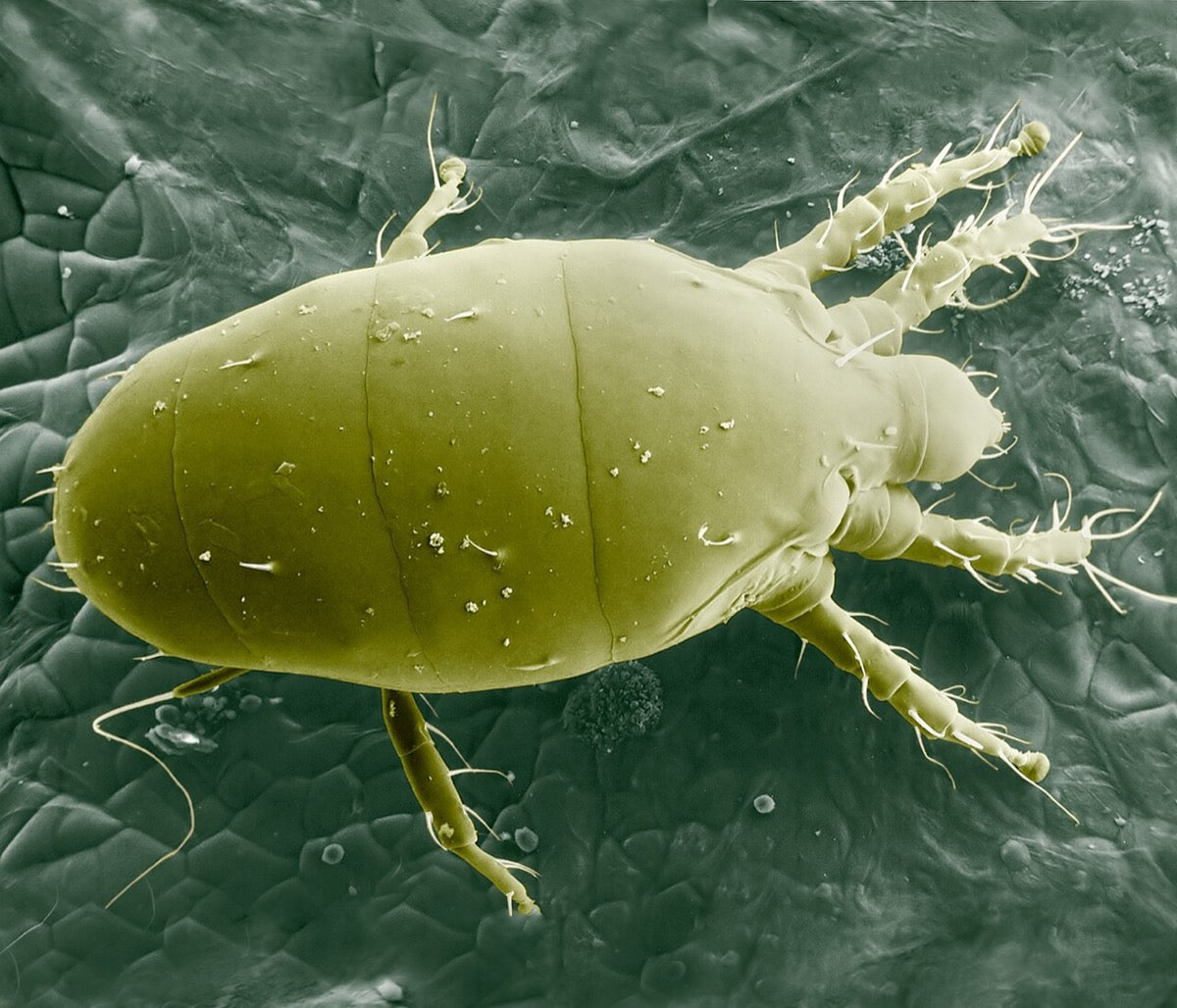
Photo at the top: An adult yellow (broad) mite seen under an electron microscope, coloured. In the field it cannot be seen without a lens. Photo: USDA Agricultural Research Service, public domain
Quick answer
Yellow mite (broad mite, Polyphagotarsonemus latus) is one of the main mites in chilli. It is too small to see without a lens. It sucks sap from the youngest leaves, which curl downward and turn narrow and leathery. Check shoot tips weekly, protect natural enemies, and spray a miticide labelled for chilli early.
How to identify yellow mites in chilli
In Hindi it is called peeli mite (पीली माइट), and in Telugu pasupu nalli (పసుపు నల్లి). Farmers often call the damage it causes in chilli murda, the leaf curl complex. Mites are not insects. They are relatives of spiders, and the adults have eight legs.
The mite
- Adult: about 0.2 mm long, oval and broad, pale yellow and shiny. You need a strong hand lens (20x) or a microscope to see it.
- Egg: oval and white, glued firmly to the leaf, as TNAU and the NIPHM chilli package note.
- Young stages: white and smaller than the adult.
- Where: on the underside of the youngest leaves at the shoot tip, in flower buds and on small fruits. Older leaves have few mites.
Damage signs in chilli
Because you cannot see the mite, you will notice the damage first. The NIPHM chilli package and TNAU (Tamil Nadu Agricultural University) describe the first four signs below:
- Leaves curl downward at the edges, like an upside-down boat.
- Leaf stalks grow long and thin.
- Some curled leaves turn dark green.
- Young leaves at the tip bunch together, and the plant looks stunted.
- Leaves become narrow, thick and leathery.
- Flowers drop, few fruits set, and fruits can get corky, brown scars on the skin.


Look-alikes and how to tell them apart
- Thrips: chilli leaves curl upward, with silvery streaks and black dots of droppings. You can see thrips when you tap a shoot over white paper. See our thrips guide for chilli, cotton and onion. Thrips and mites often attack together, which is why murda can show both kinds of curl.
- Leaf curl virus: spread by whitefly. Leaves pucker, curl and turn pale or yellow, and the plant stays small for good. If the curl is from mites, new leaves that grow after good control usually come out normal. With the virus, new leaves keep coming out curled. See leaf curl virus in chilli and tomato.
- Red spider mite: you can see moving red dots under the leaf, with speckles and fine webbing. Yellow mite leaves no webbing. See how to spot and control red spider mite.
Life cycle and when it attacks
A female lays eggs on the underside of young leaves and in flower buds. The NIPHM chilli package shows that the egg, young and adult stages each last only a few days. So one generation can finish in about a week in warm weather, and numbers rise fast.
Yellow mite likes warm weather with good humidity. That is different from red spider mite, which likes hot, dry spells. The mites walk only short distances. They spread to new plants on wind, on infested seedlings, and on hands, clothes and tools. They can also ride on the legs of whiteflies.
NIPHM lists yellow mite as a chilli pest in Andhra Pradesh, Karnataka, Kerala and Tamil Nadu. The same package lists mites as a chilli pest at the vegetative stage and again at flowering and fruiting.
Crops it attacks
Chilli: the main host. Damage can start soon after transplanting. Attacks at flowering cut fruit set the most, because the mites feed in the buds and on young fruits.
Brinjal: young leaves curl downward, look shiny or bronze on the underside, and the plant grows slowly.
Potato: top leaves become stiff, curl downward and may turn bronze underneath. The plant looks stunted.
When to spray (economic threshold)
We could not confirm a published economic threshold for yellow mite in chilli from a recognised Indian public source, so we do not give a number here. Ask your local agriculture officer or Krishi Vigyan Kendra (KVK) for the level used in your area.
The NIPHM chilli package advises a field check every week, starting soon after transplanting. For mites, it counts the young and adult mites on five leaves picked at random on each plant. In practice, watch the shoot tips. When the first plants show downward curl, look under the top leaves with a hand lens. Act early, because a badly curled plant takes a long time to recover.
Control without chemicals
These steps follow the NIPHM chilli package unless noted.
- Maize border: grow two rows of maize around the chilli, for every half acre of crop.
- Protect natural enemies: predatory mites (such as Amblyseius ovalis), small predatory bugs (Orius) and spiders feed on mites. Avoid sprays that are not needed, so these friends survive.
- Neem: when mite numbers are low, spray neem seed powder extract at 4%, every 10 days.
- Tolerant varieties: NIPHM lists Pusa Jwala and Phule Jyoti as tolerant to mites. Ask your KVK if they suit your area.
- Clean seedlings: raise the nursery away from old chilli fields. Do not transplant seedlings with curled tips.
- Remove early patches: pull out the first badly curled plants and destroy them away from the field.
- Visit infested fields last: mites ride on clothes and hands, so walk through clean fields first.
- Control whitefly: fewer whiteflies means fewer rides for the mites, and less leaf curl virus too. See our whitefly guide.
Chemical control: miticides for mites in chilli
Mites are not insects, so many insecticides do not control them. Only the products below have chilli and mites on their official label or product sheet. Doses are per acre, as printed or converted from the label's per-hectare dose. Use one product at a time. Do not mix products in one tank. Spray so the mix reaches the tender top leaves and the underside of the leaves, where the mites live.
Chilli
| Product | Contains | Label dose per acre | Water per acre | Wait before harvest |
|---|---|---|---|---|
| Ceasemite Insecticide | Propargite 42% + Hexythiazox 2% EC | 506 ml | 200 L | 7 days |
| Hanabi - Insecticide | Pyridaben 20% WP | 152–202 g | 200 L | 5 days |
| Rashinban Insecticide | Fluxametamide 3.8% + Pyridaben 9.5% SC | 405 ml | 200 L | 5 days |
| Simodis Insecticide | Isocycloseram 9.2% DC | 81 ml | 200 L | 7 days |
| Evicent Insecticide | Emamectin benzoate 5% + Lufenuron 40% WG | 24 g | 200 L | 3 days |
| Intrepid - Insecticide | Chlorfenapyr 10% SC | 304–405 ml | 200 L | 5 days |
| Pirate - Insecticide | Chlorfenapyr 240 g/L SC | 126–172 ml | 200 L | 7 days |
| Plesiva Insecticide | Cyantraniliprole 7.3% + Diafenthiuron 36.4% SC | 253 ml | 200 L | 5 days |
| Elpida Insecticide | Emamectin benzoate 5% SG | 81 g | 200 L | 3 days |
| Mitigate Insecticide | Fenpyroximate 5% EC | 120–240 ml (product sheet) | Not given in the product sheet | Not given in the product sheet |
Notes from the labels:
- Ceasemite: at the vegetative and fruiting stage, when the pest reaches ETL (economic threshold level). High volume spray with a low drift nozzle. One to three sprays, depending on mite numbers.
- Hanabi: when the pest reaches ETL. Two or three sprays, 7 to 14 days apart.
- Rashinban: when the pest reaches ETL, at any crop stage. Three or four sprays, 7 to 14 days apart, depending on the attack.
- Simodis: first spray when pests reach ETL, one more after 10 to 15 days if needed. No more than two sprays in a season.
- Evicent: first spray at ETL, then one or two more, 10 to 15 days apart.
- Intrepid: foliar spray with a knapsack or power sprayer.
- Pirate: spray as soon as the pest reaches ETL. Up to two sprays.
- Plesiva: spray when pests reach ETL, with a knapsack sprayer and hollow cone nozzle. Repeat 10 to 15 days apart if needed, with no more than two sprays in all.
- Elpida: repeat as needed, and use enough water to cover the leaves well.
- Mitigate: the dose is from the company's product sheet. Follow the pack leaflet for water and waiting period.
- Ceasemite, Rashinban, Evicent and Plesiva each have two active ingredients. They are ready-mixed products approved on the label, not tank mixes.
Brinjal and potato
None of the products in our range has yellow mite on brinjal or potato on its label, so we do not suggest one here. Use the steps above, and ask your local agriculture officer or KVK for a product labelled for your crop.
Rotate to avoid resistance
Mites have many generations in one season, so they build resistance fast. IRAC (the international Insecticide Resistance Action Committee) gives each active ingredient a group number based on how it works. Do not spray the same group twice in a row.
| IRAC group | Active ingredient | Products in this article |
|---|---|---|
| 21A | Pyridaben, fenpyroximate | Hanabi, Mitigate; one part of Rashinban |
| 13 | Chlorfenapyr | Intrepid, Pirate |
| 30 | Isocycloseram, fluxametamide | Simodis; one part of Rashinban |
| 12C and 10A | Propargite, hexythiazox | Ceasemite |
| 6 | Emamectin benzoate | Elpida; one part of Evicent |
| 15 | Lufenuron | One part of Evicent |
| 28 and 12A | Cyantraniliprole, diafenthiuron | Plesiva |
Intrepid and Pirate have the same active ingredient, so never follow one with the other. Hanabi, Mitigate and Rashinban share group 21A. Simodis and Rashinban share group 30, and Elpida and Evicent share group 6. After Hanabi, for example, choose Ceasemite, Simodis or Intrepid for the next spray, not Rashinban or Mitigate. Keep the gap and number of sprays within each label.
Safety and waiting period
- The waiting period before harvest (PHI, pre-harvest interval) for each product is in the table above. Count the days from the last spray. Chilli is picked many times, so check the waiting period before each picking. For Mitigate our record gives no waiting period, so check the pack label.
- Wear gloves, a mask, goggles and full-sleeve clothes while mixing and spraying. Spraying under the leaves brings the mist close to your face. Do not eat, drink or smoke while you work, and wash well afterwards.
- Bees: many of these products harm bees, for example emamectin benzoate (Elpida, Evicent), chlorfenapyr (Intrepid, Pirate) and Plesiva. Do not spray on open flowers while bees are working. Spray in the morning or evening.
- Fish: keep sprays and washings away from ponds, canals and wells.
- Read the label and leaflet before use.
Frequently asked questions
Why are my chilli leaves curling downward?
Downward curl with narrow, thick leaves and long leaf stalks is the classic sign of yellow mite. Upward curl with silvery streaks points to thrips. Puckered, pale leaves that never recover point to leaf curl virus. Check the top leaves with a hand lens to be sure.
How do I control yellow mites in chilli?
Start early. Grow a maize border, protect predatory mites, and use a 4% neem seed extract when numbers are low. If the attack grows, spray a miticide whose label lists chilli and mites, cover the top leaves and the underside well, and change the IRAC group for the next spray.
Which insecticide is used for mites in chilli?
Use a product whose label names chilli and mites. In our range these are Ceasemite, Hanabi, Rashinban, Simodis, Evicent, Intrepid, Pirate, Plesiva, Elpida and Mitigate. The doses are in the chilli table above.
Can I see yellow mites with my eyes?
No. An adult is about 0.2 mm long. You need a strong hand lens or a microscope. Most farmers find it from the leaf curl first.
Will curled chilli leaves become normal after spraying?
Leaves that are already curled stay curled. If mites caused the damage, new leaves that grow after good control usually come out normal. If new leaves keep curling, check for thrips or leaf curl virus.
Related reading
- Thrips insecticide guide: control thrips in chilli, cotton and onion
- Leaf curl virus: signs, spread and prevention
- Red spider mite: symptoms, treatment and control in crops
- Whitefly insecticide guide: control whitefly in cotton, brinjal and okra
- Products for chilli
- All insecticides and miticides
Sources
- National Institute of Plant Health Management (NIPHM): AESA based IPM package for chilli
- Tamil Nadu Agricultural University, TNAU Agritech Portal: Pests of chillies
- Insecticide Resistance Action Committee (IRAC): Mode of action classification
- Product labels, leaflets and company product sheets of the products named above
Products that control it, by crop
Chilli
- Ceasemite Insecticide506 ml per acreSpray at the action level (ETL), at growing or cropping stage. Use a low-drift nozzle. 1-3 sprays as needed.
- Hanabi - Insecticide152–202 g per acreSpray on the leaves when the pest reaches the action level. Give 2-3 sprays, 7 to 14 days apart.
- Rashinban Insecticide405 ml per acreSpray on the leaves when the pest reaches the action level (ETL), at any crop stage. 3-4 sprays, 7-14 days apart.
- Simodis Insecticide81 ml per acreFirst spray when the pest reaches the action level (ETL). One more spray 10-15 days later if needed. Max 2 sprays per season.
- Evicent Insecticide24 g per acreFoliar spray when the pest reaches the action level (ETL). Repeat 1-2 sprays at 10-15 day intervals.
- Intrepid - Insecticide304–405 ml per acreFoliar spray with a knapsack or power sprayer.
- Plesiva Insecticide253 ml per acreSpray on the leaves at the action level (ETL). Repeat once after 10-15 days if needed. Do not give more than 2 sprays.
- Elpida Insecticide81 g per acreSpray when the pest is first seen and repeat if needed. Use enough water to cover the leaves well. Do not spray when bees are active.
- Mitigate Insecticide120–240 ml per acre
Do not spray the same product again and again. Change to a product with a different mode of action (the group number on the label) so the pest or disease does not build resistance.
As printed on the brand's official label. Read the label before use.


Like these farming tips? Add AgriVruddhi as a preferred source on Google
Back to Crop Health Guide