
Tomato leaf curl virus and chilli leaf curl: signs, spread and control
· By AgriVruddhi
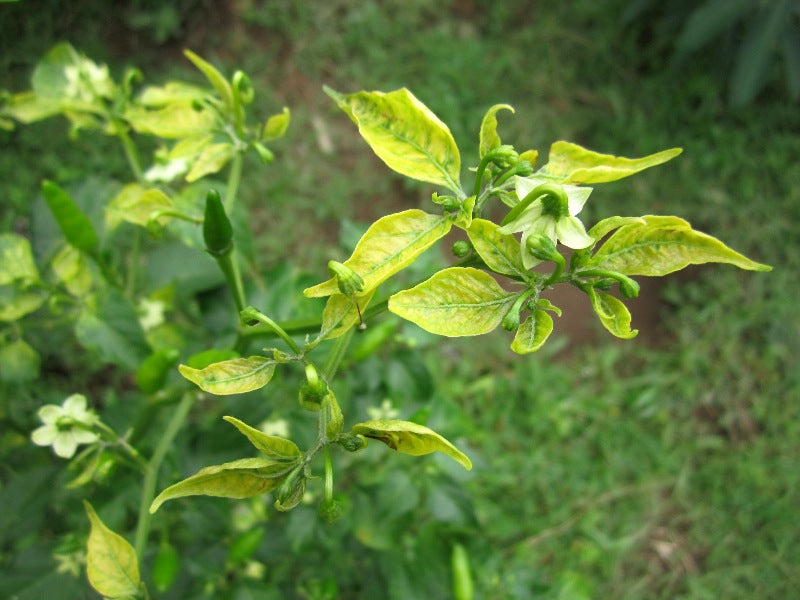
Photo at the top: A chilli shoot with leaf curl virus. Young leaves are pale yellow and curled at the edges, Photo: Kembangraps, CC BY-SA 3.0
Quick answer
Tomato leaf curl virus and chilli leaf curl virus are spread by whitefly. Leaves curl, crinkle and turn pale, the plant stays short and bushy, and flowers drop. No spray cures an infected plant. Raise seedlings under net, pull out sick plants early, grow a tolerant variety and keep whitefly down from the nursery stage.
How to identify tomato leaf curl virus and chilli leaf curl
Leaf curl in chilli and tomato is caused by a group of related viruses called begomoviruses. The tomato form is often shortened to ToLCV. In chilli it is chilli leaf curl virus. In Hindi the disease is called patti marod rog (पत्ती मरोड़ रोग), and in Telugu aaku mudata tegulu (ఆకుముడత తెగులు). Many farmers use the word murda or churda-murda for any leaf curl in chilli, whether it comes from the virus, thrips or mites. That is why it helps to look closely before you act.
Check the young leaves at the top of the plant first. The signs show up there.
Chilli leaf curl signs
TNAU (Tamil Nadu Agricultural University) describes these signs in chilli:
- Leaves curl towards the midrib (the central vein) and become twisted and out of shape.
- New leaves come out much smaller than normal.
- The gaps between leaves on the stem become short. The plant looks stunted and crowded at the top.
- Flower buds drop before they open fully, so fruit set falls.
In the field, the curled top leaves often also look pale or yellow, and the leaf surface may look puckered, with small bumps between the veins.

Tomato leaf curl signs
TNAU and the National Institute of Plant Health Management (NIPHM) describe these signs in tomato:
- The plant is badly stunted.
- Leaves roll downward and crinkle. New leaves show a light yellow colour at first, then curl too.
- Older leaves turn leathery and brittle.
- The gaps between leaves on the stem become short, and the plant makes many side branches. It looks pale and bushy.
- An infected plant stays stunted.
Look-alikes and how to tell them apart
- Thrips: chilli leaves curl upward, like a boat, with silvery streaks and tiny black dots of droppings. Tap a shoot over white paper and you see thin, moving insects. See our thrips guide for chilli, cotton and onion.
- Yellow mite: chilli leaves curl downward, become narrow and leathery, and the leaf stalks grow long. You need a hand lens to see the mites under the top leaves. See yellow mite symptoms and control in chilli.
- Red spider mite: tomato leaves get fine yellow or white speckles, then turn bronze, and you may see fine webbing under the leaf. The leaves do not pucker the way they do with the virus. See our red spider mite guide.
- Mosaic viruses: TNAU describes light green and dark green patches on chilli leaves, sometimes with yellow rings on leaves and fruits. These are other viruses. Many are spread by aphids, not whitefly.
A simple test helps. If the curl came from thrips or mites, new leaves that grow after good control usually come out normal. With leaf curl virus, new leaves keep coming out curled, and the plant never catches up.
How it spreads and when it attacks
Tomato leaf curl virus is transmitted by whitefly
The virus cannot move on its own. It needs a carrier. TNAU names the whitefly as the carrier for both tomato and chilli leaf curl. For tomato it names the species, Bemisia tabaci. This is a tiny insect with white wings that lives on the underside of leaves.
When a whitefly sucks sap from a sick plant or weed, it picks up the virus. It then flies to a healthy plant, feeds, and passes the virus on. A small number of whiteflies moving through a field can infect many plants. TNAU calls this the main way the disease spreads. The second way is people: moving infected seedlings from a nursery into a new field.

The virus also lives in some weeds near the field. TNAU names Abutilon indicum (Indian mallow, called atibala or kanghi) as a weed host for tomato leaf curl.
When it attacks
The disease follows the whitefly. Whitefly builds up in warm, dry weather and in long dry spells between rains. Heavy rain knocks its numbers down for a while.
The earlier a plant gets the virus, the worse the loss. Seedlings in the nursery and young plants in the first weeks after transplanting are most at risk. A plant infected late, after fruit set, still gives part of its crop.
In Telangana and Andhra Pradesh, chilli is a major crop, and tomato is grown through most of the year. Watch closely in dry spells during kharif, in the rabi crop, and in summer plantings, when whitefly is active.
Crops it attacks
Chilli: attacked from the nursery to the flowering stage. Infected plants stay short, leaves stay small and curled, and flowers drop. Plants infected early give few fruits.
Tomato: NIPHM lists leaf curl as a problem of tomato in many states, including Andhra Pradesh, Karnataka and Tamil Nadu. Plants infected in the nursery or soon after transplanting become stunted and bushy and give very little fruit.
Weeds and nearby crops: whitefly moves between crops and weeds. A field of sick tomato or chilli next to a new planting is a ready source of virus. Cotton gets its own leaf curl virus, also spread by whitefly. See cotton leaf curl virus.
When to act
There is no spray threshold for a virus. Once a plant shows the signs, it stays infected. So act early, before the disease spreads.
- Check the crop twice a week from the nursery stage. Look at the top leaves for curling, puckering and pale colour.
- Pull out the first sick plants as soon as you see them. Each sick plant is a source of virus for whitefly.
- Watch the whitefly: the NIPHM chilli package advises yellow sticky traps at 4 to 5 per acre, placed 15 cm above the crop, for monitoring whitefly. Rising catches tell you whitefly is building up.
We could not confirm a whitefly threshold for chilli or tomato from a recognised public source, so we do not give one here. Our whitefly guide explains how to check for whitefly under the leaves.
Leaf curl virus treatment without chemicals
These steps come from TNAU and the NIPHM pest management packages for chilli and tomato. They work better together than alone.
Start with a clean nursery
- Raise seedlings under net. NIPHM advises raising the tomato nursery under a net with a mesh fine enough to keep whitefly out. TNAU advises covering the chilli nursery with nylon net or straw.
- Use seed from healthy plants, as both TNAU and NIPHM advise.
- Remove sick seedlings in the nursery. Do not transplant any seedling with curled or puckered leaves.
Grow a tolerant variety
Tolerant means the plant gets less disease, not that it never gets it. NIPHM lists these tolerant varieties:
- Tomato, for leaf curl: Arka Ananya, Kashi Vishesh, Kashi Amrit, COTH 2 and TNAU Tomato Hybrid Co3.
- Chilli viral diseases and leaf curl complex: Pusa Sadabahar, Arka Harita, Arka Meghana, Arka Sweta, Hisar Shakti, Hisar Vijay and Pant C-1.
Not all of these are sold or suited everywhere. Ask your Krishi Vigyan Kendra (KVK) or state agricultural university which varieties or hybrids hold up in your area.
Remove sick plants and weeds
- Pull out plants with leaf curl early. Put them in a bag and bury or burn them away from the field, as TNAU advises.
- Remove weed hosts such as Abutilon indicum from the field and bunds.
- After the last picking, pull out the old plants. Do not leave an old, sick crop standing next to a new one.
- TNAU advises against growing chilli after chilli on the same land. Rotate with other crops.
Block and trap the whitefly
- Border crop: TNAU advises a barrier of sorghum, maize or bajra (pearl millet) around the tomato field. For chilli virus diseases, TNAU advises 2 to 3 rows of maize or sorghum around the field, and NIPHM advises 4 rows. A tall border slows insects coming in from outside.
- Yellow sticky traps: whitefly is drawn to yellow. For tomato, TNAU advises 5 traps per acre, and NIPHM notes that 10 traps per acre may reduce whitefly numbers.
- Use nitrogen in balance. NIPHM notes that too much nitrogen fertilizer makes the crop soft and juicy, so insects and diseases attack it more.
Protect natural enemies
Small wasps such as Encarsia and Eretmocerus live inside whitefly young and kill them. Ladybird beetles, lacewings and spiders eat whitefly too. NIPHM advises conserving them. Avoid sprays that are not needed, so these friends survive. NIPHM also lists neem seed kernel extract as a biological option against whitefly. Ask your KVK how to prepare and use it.
Can a spray cure chilli or tomato leaf curl virus?
No. No fungicide, insecticide or tonic cures a plant that already has the virus. Be careful of anyone who sells a "virus cure" for chilli or tomato.
Sprays can only control the whitefly that carries the virus. That protects the healthy plants, not the sick ones. None of the products in our store lists leaf curl virus on its label, so we do not suggest one here. For whitefly on chilli or tomato, ask your local agriculture officer or KVK for a product labelled for whitefly on your crop.
If you do spray for whitefly, keep these points in mind:
- Start early, in the nursery and the first weeks after transplanting. That is when infection does the most harm.
- Spray the underside of the leaves, where whitefly lives.
- Do not use the same insecticide group again and again. Whitefly builds resistance fast. Change the group from one spray to the next. Our whitefly insecticide guide explains the groups.
- Use one product at a time.
Safety and waiting period
- Chilli and tomato are picked often. Before any spray, check the waiting period before harvest (PHI, pre-harvest interval) on the label. Choose a product whose waiting period fits your picking days.
- Wear gloves, a mask, full-sleeve clothes and boots while mixing and spraying. Do not eat, drink or smoke while you work. Wash well afterwards.
- Spray in the morning or evening, not in strong wind or hot sun. Do not spray open flowers when bees are working.
- Keep sprays and washings away from ponds, canals and wells.
- Read the label and leaflet before use.
Frequently asked questions
Can tomato leaf curl virus be cured?
No. Once a plant has the virus, it stays infected for life. Pull it out early so whitefly cannot carry the virus from it to healthy plants. Protect the rest of the crop with a clean nursery, a tolerant variety and early whitefly control.
Which insect spreads leaf curl in tomato and chilli?
The whitefly, Bemisia tabaci. The whitefly picks up the virus while feeding on a sick plant or weed, then passes it to healthy plants. Infected seedlings carried to a new field also bring the disease in.
What is the treatment for chilli leaf curl virus?
There is no cure for an infected plant. Treatment means stopping the spread: raise seedlings under net, remove sick plants and weeds, grow a tolerant variety, use a maize or sorghum border and yellow sticky traps, and control whitefly early with a product labelled for chilli.
Why are my chilli leaves curling?
Look at the shape. Upward curl with silvery streaks points to thrips. Downward curl with narrow, thick leaves points to yellow mite. Small, pale, puckered leaves on a stunted plant that never recovers point to leaf curl virus. Check under the top leaves with a hand lens to be sure.
Should I pull out plants with leaf curl?
Yes, and the earlier the better. A sick plant gives little fruit and acts as a source of virus for the healthy plants. Bag it and destroy it away from the field.
Related reading
- Whitefly insecticide guide: control whitefly in cotton, brinjal and okra
- Thrips insecticide guide: control thrips in chilli, cotton and onion
- Mites in chilli: yellow mite symptoms and control
- Yellow vein mosaic of okra, another virus spread by whitefly
- Products for chilli
- Products for tomato
Sources
- Tamil Nadu Agricultural University, TNAU Agritech Portal: Leaf curl of tomato
- Tamil Nadu Agricultural University, TNAU Agritech Portal: Viral diseases of chilli
- National Institute of Plant Health Management (NIPHM), Government of India: AESA based IPM package for tomato
- National Institute of Plant Health Management (NIPHM), Government of India: AESA based IPM package for chilli
Like these farming tips? Add AgriVruddhi as a preferred source on Google
Back to Crop Health Guide