
Yellow rust of wheat and other rusts: symptoms and control in wheat, groundnut, soybean and sugarcane
· By AgriVruddhi
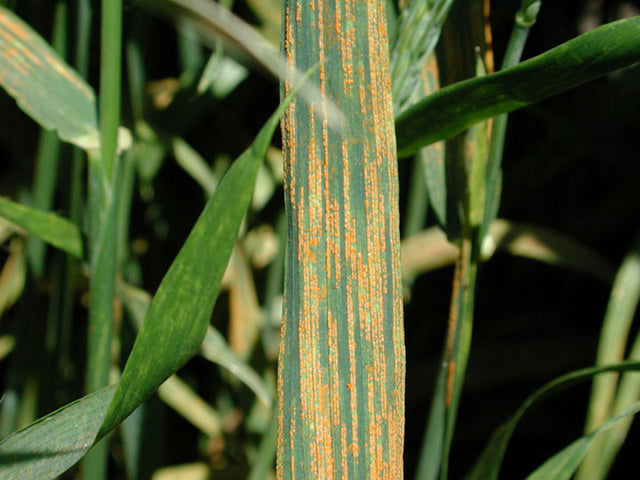
Photo at the top: Yellow rust (stripe rust) on a wheat leaf: yellow pustules in lines along the veins, Photo: Yue Jin, USDA Agricultural Research Service, public domain
Quick answer
Yellow rust of wheat is a fungal disease that forms bright yellow powdery stripes on the leaves in cool, damp weather. Wheat also gets brown and black rust, and groundnut, soybean and sugarcane get their own rusts. Grow a resistant variety, keep nitrogen balanced, and spray a fungicide labelled for your crop when the first pustules appear.
How to identify yellow rust of wheat and other rusts
Rust is called ratua or gerua (रतुआ, गेरुआ) in Hindi and tuppu tegulu (తుప్పు తెగులు) in Telugu. Yellow rust is peela ratua (पीला रतुआ) in Hindi. All rusts make small raised pustules (blisters) on the leaf. Each pustule bursts and lets out a fine powder of spores. Rub a leaf between your fingers: a yellow, orange or brown powder that comes off is almost always rust.
Yellow rust (stripe rust)
Bright yellow to orange-yellow pustules appear on the leaves early in the crop. They sit in long, narrow lines between the leaf veins, so the leaf looks striped. That is why it is also called stripe rust. Pustules can also form on the leaf sheath, the neck and the glumes (the husks around the grain). Later in the season the stripes turn dull black.
Brown rust of wheat (leaf rust)
Brown rust makes round or slightly oval pustules filled with orange to orange-brown powder. They are smaller than black rust pustules and are scattered over the leaf, not in lines. They usually do not join together. They are found mostly on the upper side of the leaf blade, and sometimes on the sheath, glumes and awns.

Black rust of wheat (stem rust)
Black rust pustules are dark reddish brown. They are found most on the stem and leaf sheath, and also on both sides of the leaf and on the ear. Before the pustules open, the spot feels rough to the touch. When they burst, the outer skin of the stem looks torn and ragged. Late in the season the pustules turn black.
Groundnut rust
Small, raised, reddish-brown pustules form on the lower side of the leaflets. Turn the leaf over to see them. In a heavy attack the leaves dry up and fall early.

Soybean rust and sugarcane rust
Soybean: small tan to reddish-brown spots appear, mostly on the lower side of the leaves, starting with the lower leaves of the plant. Many spots make the leaf turn yellow and drop early.
Sugarcane: the first signs are small, long, yellowish spots on both sides of the leaf. They grow longer and turn red-brown to brown, with a narrow pale yellow-green ring around each one. In a bad attack the spots join, the whole leaf looks rusty, and older leaves die early.
Look-alikes and how to tell them apart
- Powdery mildew on wheat: white or grey fluffy pads, not yellow or brown pustules. See our powdery mildew guide for wheat, chilli and other crops.
- Tikka leaf spot of groundnut: flat brown or black spots that leave no powder on your finger. Tikka and rust often come together. See tikka disease of groundnut: early and late leaf spot.
- Nitrogen shortage: older leaves turn pale yellow all over, with no pustules and no powder. Read about nitrogen deficiency symptoms and how to correct them.
- Red rust of tea: caused by an alga, not a rust fungus, so it is not covered here.
Life cycle and when rust attacks
Rust fungi live only on living plants. Wind carries their spores over long distances, and rain splash and farm tools spread them within a field. A spore needs a film of water on the leaf (rain or dew) to infect it. New pustules then release fresh spores, so the disease can cycle many times in one season.
Each rust likes different weather. These figures come from the Government of India IPM (integrated pest management) packages of NIPHM, the national plant health institute, and from TNAU (Tamil Nadu Agricultural University):
- Yellow rust of wheat: the NIPHM wheat package gives 10 to 20°C with high humidity. The fungus survives the off-season in the northern hills on self-sown wheat and other host plants. Spores then blow down to the plains, so it is a problem mostly in the hills and the north-western plains in the cool part of the season.
- Brown rust of wheat: NIPHM gives 20 to 25°C with rain or dew. The fungus survives the summer in the Himalayas and the Nilgiris. It reaches the eastern Indo-Gangetic plains around mid-January and moves west by March. NIPHM says a severe attack can cause up to 30% yield loss.
- Black rust of wheat: NIPHM gives warm weather above 20°C with moisture. The first spores come mainly from the southern hills, so it shows up more in central and southern India.
- Groundnut rust: TNAU gives relative humidity above 85%, heavy rain and temperatures of 20 to 25°C. It survives on volunteer groundnut plants (plants that come up on their own from the last crop).
- Soybean rust: the NIPHM package lists flowering to pod filling as the stage to scout for it.
- Sugarcane rust: NIPHM names high humidity and warm temperatures. Spores spread by wind and water splash.
Crops it attacks
Wheat: the rabi crop in north and central India is at risk from all three rusts. Yellow rust can strike early, even before the ears come out, and early attacks do the most harm. Rusts take food from the leaves, so the grain fills poorly and stays shrivelled.
Groundnut: heavy rust makes the leaves dry and fall early. The plant is then short of food for its pods, and fodder quality drops. In Telangana and Andhra Pradesh, watch kharif groundnut closely in long wet spells.
Soybean: the NIPHM package lists yield losses of 30% and more, and names Maharashtra, Karnataka, Madhya Pradesh, Andhra Pradesh, Tamil Nadu, Kerala, Rajasthan and the north-eastern states among the areas where it occurs.
Sugarcane: brown rust (Puccinia melanocephala) kills leaves early, so the cane has fewer green leaves to grow on.
When to spray
We could not find a fixed economic threshold (a disease level at which spraying starts to pay) for rust in the public IPM packages from NIPHM or in the TNAU pages. Instead, they advise spraying when the disease first appears. For groundnut, the NIPHM groundnut IPM package advises two sprays, 15 days apart, after the disease appears. TNAU also advises repeating after 15 days if needed. For soybean, the NIPHM package advises two to three sprays at 10 to 15 day intervals.
For wheat, walk the field once or twice a week from tillering onwards, more often in cool, foggy or rainy spells. Do the finger test on any yellow stripes. Once you see the first pustules, do not wait.
Control without chemicals
- Resistant varieties: the cheapest way to manage rust. The NIPHM wheat package lists rust-resistant varieties for each wheat zone, and the soybean package lists rust-tolerant ones such as JS 80-21 and Indira Soybean 9. Ask your KVK or state agricultural university which variety suits your area and season.
- Do not overuse nitrogen: TNAU and NIPHM both advise against excess nitrogen. Soft, lush leaves get more rust.
- Crop rotation and mixed cropping: TNAU and NIPHM advise mixed cropping and rotation for wheat rusts. For groundnut, NIPHM says rotating with sorghum, pearl millet, rice or maize after the kharif crop can reduce rust and leaf spots.
- Remove volunteer plants: pull out self-sown groundnut and wheat plants. They carry the fungus from one season to the next.
- Sugarcane: NIPHM advises resistant or moderately resistant varieties, and removing badly affected clumps early.
Fungicide for rust, crop by crop
Only the products below have that crop and rust on their official label. Doses are per acre, converted from the label's per-hectare dose. Where the label gives only a strength in water, we write "dose as per label" and quote that strength. Use one product at a time. Do not mix products in one tank. Cover both sides of the leaves well.
Wheat
| Product | Contains | Label dose per acre | Water per acre | Wait before harvest |
|---|---|---|---|---|
| Amistar Top Fungicide | Azoxystrobin 18.2% + Difenoconazole 11.4% SC | Dose as per label: 0.1%, or 1 ml per litre of water | 200 L | 35 days |
| Indofil M45 Fungicide | Mancozeb 75% WP | 0.6–0.8 kg | 300 L | 20 days |
| Indofil Z78 Fungicide | Zineb 75% WP | 0.6–0.8 kg | 300–400 L | Not given on the label |
- Amistar Top: one or two sprays when the disease appears. The label lists "rust" on wheat but does not name the type.
- Indofil M45: foliar spray. The label lists brown rust and black rust on wheat. It does not name yellow rust.
- Indofil Z78: foliar spray. The label lists "rust" on wheat without naming the type. Mix the powder into a thick paste with a little water, let it soak for 5 to 10 minutes, then add the rest of the water while stirring.
- Amistar Top holds two active ingredients in one pack. It is a ready-mixed product approved on the label, not a tank mix.
Groundnut
| Product | Contains | Label dose per acre | Water per acre | Wait before harvest |
|---|---|---|---|---|
| Score Fungicide | Difenoconazole 25% EC | Dose as per label: 0.1%, or 100 ml per 100 L of water | Not fixed on the label | 34 days |
| Indofil M45 Fungicide | Mancozeb 75% WP | 0.6–0.8 kg | 300 L | 20 days |
| Saaf Fungicide | Carbendazim 12% + Mancozeb 63% WP | 202 g | 200 L | 72 days |
| Saafilizer Systemic and Contact Fungicide | Carbendazim 12% + Mancozeb 63% WP | 202 g | 200 L | 72 days |
- Score: spray when the disease appears. 100 ml per 100 L is the same as 1 ml per litre of water.
- Indofil M45: foliar spray. The label lists tikka, leaf spot and rust on groundnut.
- Saaf and Saafilizer: spray as soon as the first symptoms appear. Both have the same two active ingredients in one pack. They are ready-mixed products approved on the label, not tank mixes. Treat them as one choice, not two.
- Saaf and Saafilizer need 72 days between the last spray and harvest. Count back 72 days from your expected digging date before you use them.
Soybean
| Product | Contains | Label dose per acre | Water per acre | Wait before harvest |
|---|---|---|---|---|
| Indofil M45 Fungicide | Mancozeb 75% WP | 0.6–0.8 kg | 300 L | 10 days |
Indofil M45: foliar spray. The label lists rust on soybean.
Sugarcane
| Product | Contains | Label dose per acre | Water per acre | Wait before harvest |
|---|---|---|---|---|
| Amistar Top Fungicide | Azoxystrobin 18.2% + Difenoconazole 11.4% SC | Dose as per label: 0.1%, or 1 ml per litre of water | 160 L | 265 days |
Amistar Top: one or two sprays when the disease appears. The label lists red rot, smut and rust on sugarcane. The 265-day waiting period is long, so plan any spray early in the crop.
Rotate to avoid resistance
If you spray the same type of fungicide again and again, the fungus can stop responding to it. Fungicides are grouped by how they work, using the FRAC code (FRAC is the international Fungicide Resistance Action Committee). Change the group from one spray to the next.
| FRAC group | Active ingredient | Products in this article |
|---|---|---|
| 3 (triazoles) | Difenoconazole | Score; one part of Amistar Top |
| 11 (strobilurins) | Azoxystrobin | One part of Amistar Top |
| M03 (multi-site contact) | Mancozeb, zineb | Indofil M45; Indofil Z78; one part of Saaf and Saafilizer |
| 1 | Carbendazim | One part of Saaf and Saafilizer |
Group M03 fungicides act at many points in the fungus, so the risk of resistance is low. Groups 3, 11 and 1 act at a single point and carry a higher risk. Do not use Score and Amistar Top one after the other, as both contain difenoconazole. Keep to the number of sprays each label allows.
Safety and waiting period
- The waiting period before harvest (PHI, pre-harvest interval) for each product and crop is in the tables above. Count the days from the last spray. The Indofil Z78 leaflet leaves the waiting period blank, so ask your dealer or the company before you spray close to harvest.
- Wear gloves, a mask, full-sleeve clothes and boots while mixing and spraying. Do not eat, drink or smoke while you work. Wash well afterwards.
- Spray in the morning or evening, not in strong wind.
- Fish: the Amistar Top and Saaf labels warn that they are toxic to fish. Keep sprays and washings away from ponds, canals and wells.
- Read the label and leaflet before use.
Frequently asked questions
Yellow rust of wheat is caused by which fungus?
Yellow rust of wheat is caused by the fungus Puccinia striiformis (the wheat form is Puccinia striiformis f. sp. tritici). Brown rust is caused by Puccinia triticina (older name Puccinia recondita), and black rust by Puccinia graminis f. sp. tritici.
How do I know if my wheat has yellow rust or brown rust?
Look at the pattern. Yellow rust pustules are bright yellow and sit in long stripes along the veins. Brown rust pustules are orange-brown, round and scattered. The NIPHM wheat package says yellow rust favours cooler weather (10 to 20°C) and brown rust slightly warmer weather (20 to 25°C).
Which fungicide is labelled for rust in groundnut?
On our store, Score, Indofil M45, Saaf and Saafilizer list groundnut rust on their labels. Change the FRAC group between sprays.
Can rust spread from one field to another?
Yes. Rust spores are very light and the wind carries them a long way. That is why yellow rust of wheat can move from the hills to the plains in one season, and why neighbours should scout and act together.
Does rust come through seed?
Rust fungi live on green plants, not in the seed. They survive on self-sown plants and in areas where the crop grows all year. Removing volunteer plants and growing resistant varieties cut the source.
Related reading
- Tikka disease of groundnut: early and late leaf spot symptoms and control
- Powdery mildew fungicide guide for chilli, grapes, mango and wheat
- Karnal bunt of wheat: symptoms and control
- Nitrogen deficiency in plants: symptoms, causes and how to correct it
- All fungicides
Sources
- Tamil Nadu Agricultural University, TNAU Agritech Portal: Wheat diseases (leaf rust, stem rust, stripe rust)
- Tamil Nadu Agricultural University, TNAU Agritech Portal: Groundnut, rust
- Directorate of Plant Protection, Quarantine and Storage and National Institute of Plant Health Management (NIPHM): AESA based IPM Package for Wheat
- NIPHM IPM packages: Integrated Pest Management Package for Groundnut
- NIPHM IPM packages: Integrated Pest Management Package for Soybean
- NIPHM IPM packages: AESA based IPM Package for Sugarcane
- Fungicide Resistance Action Committee (FRAC): FRAC Code List 2026
- Official product labels and leaflets of each product named above.
Products that control it, by crop
Wheat
- Amistar Top FungicideSpray 1 ml per litre of water (0.1%) when the disease appears; 1-2 sprays
- Indofil M45 Fungicide0.6–0.8 kg per acreFoliar spray.
- Indofil Z78 Fungicide0.6–0.8 kg per acreSpray on leaves. Make a paste with a little water, soak 5-10 minutes, then add the rest of the water while stirring.
Sugarcane
- Amistar Top FungicideSpray 1 ml per litre of water (0.1%) when the disease appears; 1-2 sprays
Groundnut
- Indofil M45 Fungicide0.6–0.8 kg per acreFoliar spray.
- Score FungicideSpray 1 ml per litre of water (0.1%) when the disease first appears.
- Saaf Fungicide202 g per acreSpray as soon as disease symptoms appear.
- Saafilizer Systemic and Contact Fungicide202 g per acreSpray at the first sign of disease.
Soybean
- Indofil M45 Fungicide0.6–0.8 kg per acreFoliar spray.
Do not spray the same product again and again. Change to a product with a different mode of action (the group number on the label) so the pest or disease does not build resistance.
As printed on the brand's official label. Read the label before use.


Like these farming tips? Add AgriVruddhi as a preferred source on Google
Back to Crop Health Guide