
Tikka disease of groundnut: early and late leaf spot symptoms and control
· By AgriVruddhi
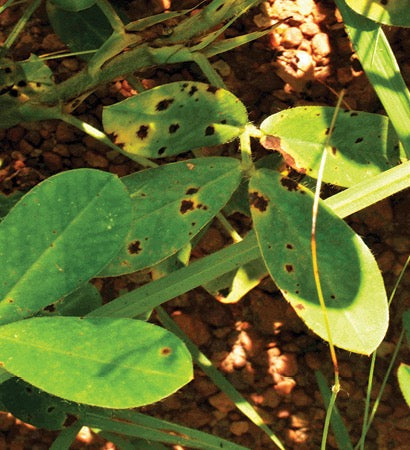
Photo at the top: Early leaf spot on groundnut in the field: brown spots, some with a yellow ring, Photo: Meswaet Y, Mangelsdorff R, Yorou NS, Piepenbring M (MycoKeys, 2021), cropped, CC BY 4.0
Quick answer
Tikka disease of groundnut is a fungal leaf spot disease. It comes in two forms, early leaf spot and late leaf spot. Brown or black round spots appear on the leaves, the spots join, and the leaves fall early, so pods stay small and fodder is lost. Rotate crops, remove volunteer groundnut plants, and spray a fungicide labelled for groundnut when the first spots appear.
Symptoms of tikka disease of groundnut
Tikka is called tikka rog in Hindi and aaku macha tegulu (leaf spot disease) in Telugu. Two different fungi cause it, and each one makes its own kind of spot. Both often appear in the same field, one after the other. Look first at the older leaves near the ground, as the disease starts there.
Early leaf spot
- When: it starts about a month after sowing, as TNAU (Tamil Nadu Agricultural University) notes.
- Spot: starts as a small pale spot and grows into a round or slightly uneven brown spot.
- Halo: a bright yellow ring (halo) around each spot. This is the easiest sign of early leaf spot.
- Two sides of the leaf: the spot is dark brown on the upper side and light brown on the lower side.
- Other parts: spots can also form on the leaf stalks (petioles), stems and the small leaf-like parts at the base of the stalk (stipules).
Late leaf spot
- When: it starts later. TNAU gives about 55 to 57 days after sowing in kharif and 42 to 46 days in rabi.
- Spot: smaller, darker and rounder spots, dark brown to black.
- Lower side: the black spots show most clearly on the lower side of the leaf. They look rough, because the fungus makes its spores there.
- Halo: no clear yellow ring, or only a faint one.
- Spread: several spots on each leaflet join into large black patches. The leaflets age early and drop. Spots can also form on the leaf stalks and the stem.

Tikka disease of groundnut: causal organism
Early leaf spot is caused by the fungus Cercospora arachidicola. Late leaf spot is caused by Phaeoisariopsis personata, also called Cercospora personata or Cercosporidium personatum in older books. The ICAR-NCIPM groundnut IPM package lists both under "leaf spot" as major diseases of national importance.
Early and late leaf spot: how they differ
| Sign | Early leaf spot | Late leaf spot |
|---|---|---|
| Starts | About 30 days after sowing | Later: about 55–57 days in kharif, 42–46 days in rabi |
| Spot colour | Brown, lighter brown below | Dark brown to black, darkest below |
| Yellow ring | Clear and bright | Absent or faint |
| Spot size | Larger, sometimes uneven | Smaller and rounder |
Look-alikes and how to tell them apart
- Rust: small, raised, reddish-brown or orange pustules (blisters) on the lower side of the leaf. They burst and release a powder that rubs off on your finger. Tikka spots are flat and do not leave powder. Both diseases often come together. See our guide to rust in groundnut, wheat and other crops.
- Alternaria leaf spot: another fungal disease of groundnut. The ICAR-NCIPM package notes it mainly in the rabi-summer crop. If the spots do not match the tikka signs above, show a leaf to your KVK before you spray.
- Magnesium deficiency: the older leaves turn yellow between the veins, with no clear round spots. Read magnesium deficiency symptoms in groundnut, cotton and tomato. Low magnesium also makes tikka worse, as the next section explains.
Life cycle and when it attacks
The fungus lives on in old groundnut leaves and plant waste left in the soil, and can also come with infected seed. Early in the season, its spores land on the oldest leaves near the ground. The spots on these leaves make new spores. Wind and rain splash carry them to other leaves and other plants. So the disease moves up the plant and across the field, crop stage by crop stage.
TNAU lists the weather and field conditions that favour both leaf spots:
- High humidity that lasts for about 3 days in a row.
- Low temperature, around 20°C, with dew on the leaves.
- Heavy doses of nitrogen and phosphorus fertiliser.
- Magnesium deficiency in the soil.
In Telangana and Andhra Pradesh, groundnut is grown in both kharif and rabi, and tikka can appear in both seasons. Long cloudy, humid spells and heavy dew are the danger signs.
Crops it attacks
Groundnut: tikka is a disease of groundnut. It attacks the crop from about a month after sowing until harvest, and the damage is worst at pod formation and pod filling. When many leaves fall early, the plant cannot fill its pods, so pods stay small and yield drops. The fallen leaves also mean less and poorer fodder (haulm) for cattle. Check every groundnut field regularly, whatever the variety.
When to spray
We could not find a fixed economic threshold (a count of spots at which spraying starts to pay) for tikka in the ICAR-NCIPM groundnut IPM package. That package lists thresholds for groundnut insects, but not for leaf spot. Instead, it advises spraying after the disease appears and repeating after 15 days. TNAU also advises a second spray after 15 days if needed.
So start checking the lower leaves about 30 days after sowing, when TNAU says early leaf spot begins. The ICAR-NCIPM package advises field scouting every 3 to 5 days. Check plants across the field, not just at the edge. Spray as soon as the first spots appear, rather than waiting for leaves to drop. Check more often in humid, dewy weather.
Control without chemicals
- Crop rotation: do not grow groundnut after groundnut. The ICAR-NCIPM package says rotating with sorghum, pearl millet (bajra), rice or maize after the kharif crop can reduce early leaf spot, late leaf spot and rust.
- Intercropping: TNAU advises growing pearl millet or sorghum with groundnut, in a 1 : 3 row ratio.
- Remove volunteer plants: pull out groundnut plants that come up on their own from last season's pods. They carry the fungus to the new crop.
- Clean up crop waste: destroy the diseased leaves and plant waste after harvest, so the fungus has less to survive on.
- Healthy seed: sow seed from a healthy crop, since the disease can come with infected seed.
- Balanced fertiliser: do not overdo nitrogen and phosphorus. Correct magnesium deficiency, based on a soil test.
- Tolerant varieties: the ICAR-NCIPM package lists several groundnut varieties that tolerate leaf spot. Ask your KVK or Professor Jayashankar Telangana State Agricultural University (PJTSAU) which tolerant variety suits your area and season.
- Bio-agents: Kerala Agricultural University lists a preventive spray of Pseudomonas fluorescens, a helpful bacterium, against early leaf spot. Ask your local agriculture officer or KVK about a product and the rate for your field.
Fungicides for tikka disease of groundnut
Only the products below have groundnut and tikka or leaf spot on their official label. Doses are per acre, converted from the label's per-hectare dose. Where the label gives only a strength in water, we say "dose as per label" and quote that strength. Use one product at a time. Do not mix products in one tank. Cover both sides of the leaves, starting with the lower leaves.
Groundnut: foliar spray
| Product | Contains | Label dose per acre | Water per acre | Wait before harvest |
|---|---|---|---|---|
| Score Fungicide | Difenoconazole 25% EC | Dose as per label: 0.1%, or 100 ml per 100 L of water | Not fixed on the label | 34 days |
| Polyram Fungicide | Metiram 70% WG | 809 g | 200–300 L | 16 days |
| Indofil M45 Fungicide | Mancozeb 75% WP | 0.6–0.8 kg | 300 L | 20 days |
| Companion Fungicide | Carbendazim 12% + Mancozeb 63% WP | 202 g | 200 L | 72 days |
| Saaf Fungicide | Carbendazim 12% + Mancozeb 63% WP | 202 g | 200 L | 72 days |
| Saafilizer Systemic and Contact Fungicide | Carbendazim 12% + Mancozeb 63% WP | 202 g | 200 L | 72 days |
Notes from the labels:
- Score: spray when the disease appears. The label lists "leaf spot" on groundnut. 100 ml per 100 L is the same as 1 ml per litre of water.
- Polyram: the label lists "Tikka (Cercospora spp.)" on groundnut.
- Indofil M45: foliar spray. The label lists "Tikka, Leaf spot" on groundnut.
- Saaf and Saafilizer: spray as soon as the first symptoms appear.
- Companion, Saaf and Saafilizer have the same two active ingredients in one pack. They are ready-mixed products approved on the label, not tank mixes. Treat them as one choice, not three.
- Companion, Saaf and Saafilizer need 72 days between the last spray and harvest. Count back 72 days from your expected harvest date before you use them.
Groundnut: seed treatment
The Indofil M45 label also lists seed treatment of groundnut against leaf spot and collar rot: 25–30 g per 10 kg of seed, made into a slurry with 10 ml of water per kg of seed. Dry the treated seed in the shade, then sow.
Rotate to avoid resistance
If you spray the same type of fungicide again and again, the fungus can stop responding to it. Fungicides are grouped by how they work, using the FRAC code (FRAC is the international Fungicide Resistance Action Committee). Change the group from one spray to the next.
| FRAC group | Active ingredient | Products in this article |
|---|---|---|
| 3 (triazoles) | Difenoconazole | Score |
| M03 (multi-site contact) | Mancozeb, metiram | Indofil M45; Polyram; one part of Companion, Saaf and Saafilizer |
| 1 | Carbendazim | One part of Companion, Saaf and Saafilizer |
A simple plan for two sprays 15 days apart: Score first, then Polyram or Indofil M45 for the second spray. Multi-site contact fungicides (group M03) carry a low risk of resistance. Groups 3 and 1 carry a higher risk, so do not use the same one for two sprays in a row. Keep to the number of sprays each label allows.
Safety and waiting period
- The waiting period before harvest (PHI, pre-harvest interval) for each product is in the table above. Count the days from the last spray.
- Wear gloves, a mask, full-sleeve clothes and boots while mixing and spraying. Do not eat, drink or smoke while you work. Wash well afterwards.
- Spray in the morning or evening, in calm weather.
- Keep sprays and washings away from ponds, canals and wells. The Saaf leaflet warns that it is toxic to fish.
- Read the label and leaflet before use.
Frequently asked questions
Tikka disease of groundnut is caused by which fungus?
By two fungi. Cercospora arachidicola causes early leaf spot, and Phaeoisariopsis personata (also called Cercospora personata) causes late leaf spot. Together they are called tikka.
What are the first symptoms of tikka in groundnut?
Small pale spots on the older, lower leaves about a month after sowing. They turn brown, often with a bright yellow ring. Later, smaller black spots appear, mostly on the lower side of the leaf, and leaves start to fall.
How can I tell early leaf spot from late leaf spot?
Early leaf spot comes first, has larger brown spots and a clear yellow ring. Late leaf spot comes later, has smaller, rounder, dark brown to black spots, darkest on the lower side, and little or no yellow ring.
Does tikka spread through seed?
It can. TNAU notes that the first infection comes from infected plant waste or infected seed. Sow healthy seed, remove old crop waste, and treat seed as the label allows.
How many sprays are needed for tikka?
The ICAR-NCIPM package and TNAU both advise a first spray when the disease appears and a second one about 15 days later if needed. Change the fungicide group between sprays and follow each label.
Related reading
- Rust in groundnut, wheat and other crops: symptoms and control
- Magnesium deficiency in groundnut, cotton and tomato
- Calcium deficiency and empty pods in groundnut
- Spodoptera (tobacco caterpillar) in groundnut and cotton
- All fungicides
Sources
- Tamil Nadu Agricultural University, TNAU Agritech Portal: Groundnut, early leaf spot
- Tamil Nadu Agricultural University, TNAU Agritech Portal: Groundnut, late leaf spot
- Tamil Nadu Agricultural University, TNAU Agritech Portal: Groundnut, rust
- Tamil Nadu Agricultural University, TNAU Agritech Portal: Groundnut diseases, organic farming practices
- ICAR-National Centre for Integrated Pest Management and Directorate of Plant Protection, Quarantine and Storage: Integrated Pest Management Package for Groundnut
- Kerala Agricultural University: Groundnut, tikka early leaf spot
- Fungicide Resistance Action Committee: FRAC code list
- Official product labels and leaflets of the fungicides named above
Products that control it, by crop
Groundnut
- Score FungicideSpray 1 ml per litre of water (0.1%) when the disease first appears.
- Polyram - Fungicide809 g per acre
- Indofil M45 Fungicide0.6–0.8 kg per acreFoliar spray.
- Indofil M45 FungicideSeed treatment: mix 25-30 g per 10 kg seed with 10 ml water per kg seed. Dry in shade, then sow.
- Companion Fungicide202 g per acre
- Saaf Fungicide202 g per acreSpray as soon as disease symptoms appear.
- Saafilizer Systemic and Contact Fungicide202 g per acreSpray at the first sign of disease.
Do not spray the same product again and again. Change to a product with a different mode of action (the group number on the label) so the pest or disease does not build resistance.
As printed on the brand's official label. Read the label before use.


Like these farming tips? Add AgriVruddhi as a preferred source on Google
Back to Crop Health Guide