
Calcium deficiency in plants: symptoms, blossom end rot and how to correct it
· By AgriVruddhi
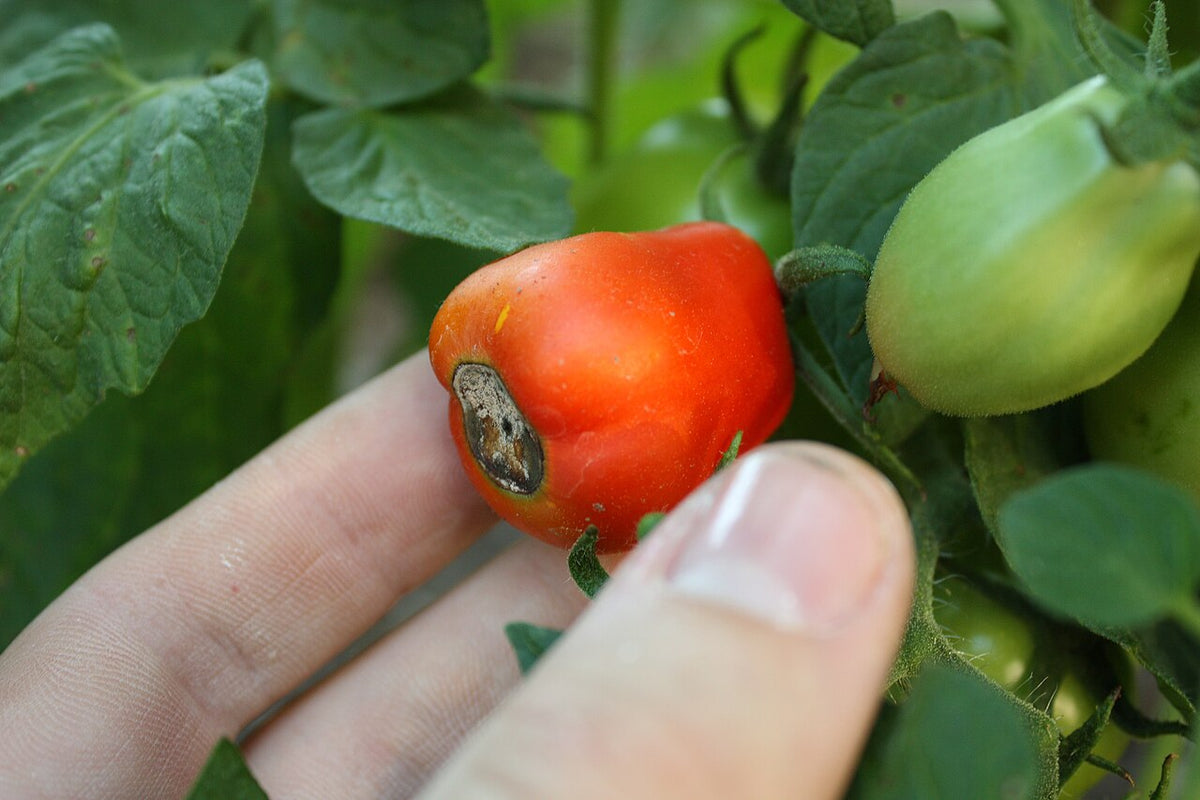
Photo at the top: Blossom end rot on a tomato fruit: a sunken, dark, leathery patch at the bottom, Photo: A13ean, CC BY-SA 3.0
Quick answer
Calcium deficiency in plants means the growing parts of the crop do not get enough calcium. Young leaves curl and their edges burn, the growing tip can die, and fruits rot at the bottom. In tomato and chilli this is called blossom end rot. Keep soil moisture steady, test your soil, and correct calcium only as the test shows.
In groundnut the plant can look healthy while the pods stay empty. The cause is often not a lack of calcium in the soil, but water stress that stops calcium from reaching the fruit.
Calcium deficiency in plants symptoms
Calcium is a building block of cell walls. Every new cell needs it. Calcium moves up the plant with water, from the roots to the leaves. It does not move back out of old leaves to feed new growth. So the signs show on the youngest parts: the growing tip, new leaves, flowers and young fruits. Old leaves usually look normal.
In Hindi it is called calcium ki kami (कैल्शियम की कमी), and in Telugu calcium lopam (కాల్షియం లోపం).
Signs by leaf and plant part:
- Youngest leaves: small, pale or dark, and twisted. The tips hook or cup inward and downward. The edges turn yellow, then brown and dry.
- Growing tip: dead spots form on the upper stem, and the tip can die back. Side shoots may then take over.
- Older leaves: usually normal. If old leaves are yellow between the veins, look at magnesium or another nutrient instead.
- Fruits: a water-soaked patch at the far end of the fruit (the end away from the stalk). It grows, sinks and turns dark brown or black.
- Roots: short and weak, with dead tips. You only see this if you dig a plant out.
Blossom end rot in tomato
Blossom end rot in tomato is the most common sign of calcium shortage in a vegetable field. It starts on young green fruits, often the first fruits of the season.
- A small, pale, water-soaked spot appears at the bottom of the fruit, where the flower was.
- The spot grows, sinks and turns dark brown to black. It becomes leathery and dry, not soft and wet.
- Inside, the tissue under the spot is brown. Some fruits show brown flesh inside with no spot outside.
- Moulds can grow on the dead patch later. That mould is a result, not the cause.
- Affected fruits cannot be sold.

On the plant, Tamil Nadu Agricultural University (TNAU) also describes limp plants, dead spots on the upper stem, a dying growing tip, and upper leaves that first look dark green, then turn yellow at the edges and curl inward and downward.
Calcium deficiency in chilli and capsicum
- Blossom end rot shows at the tip of the fruit. It starts as a pale or water-soaked patch, then dries into a sunken, papery, tan or brown area.
- Moulds often grow on the dead patch and turn it black.
- Young leaves can be small and twisted, with brown edges, in bad cases.
Calcium deficiency in groundnut
Groundnut is special. Its pods form under the soil, and each pod takes calcium straight from the soil around it. Calcium that the roots take up mostly goes to the leaves, not to the pods. So the soil in the pod zone (the top few centimetres) must hold enough calcium.
- Leaf signs are rare. TNAU notes small, twisted leaves near the branch tips and dark terminal buds that stop growing.
- The main sign is in the pods: many empty pods ("pops"), or pods with one shrivelled seed.
- If a kernel forms, the small shoot inside it (the plumule) can be dark. Such seed germinates poorly.
- Large-seeded varieties need more calcium in the pod zone than small-seeded ones.
Look-alikes and how to tell them apart
- Boron shortage: also hurts young tissue and the growing tip. But fruits crack or show corky patches, and in groundnut the kernel turns hollow and brown inside. See boron deficiency symptoms and correction.
- Magnesium shortage: shows on the older, lower leaves first, as yellowing between green veins. Calcium shortage shows on the new leaves. Read magnesium deficiency signs in crops.
- Anthracnose of chilli: sunken spots can form anywhere on the fruit, often with rings of tiny black dots. Blossom end rot is always at the tip, and the patch is dry and leathery. See anthracnose symptoms and control in chilli.
- Late blight on tomato fruit: greasy, brown, firm patches, usually on the upper side or shoulder of the fruit, with leaf spots on the same plant. See late blight of tomato.
- Sun scald: a pale, papery patch on the side of the fruit that faces the sun, not at the tip.
- Thrips and leaf curl virus: also twist young leaves. Check the leaf underside with a hand lens for insects, and look for yellow mottling. See how to identify and control thrips.
Why calcium deficiency happens
Many Indian soils hold enough calcium. Yet blossom end rot still shows up. The reason is that calcium moves only with water. When the water supply to the plant swings, the fast-growing fruit misses out first. The leaves pull most of the water, and the calcium goes with it.
Common causes:
- Uneven watering: a dry spell after wet days, or long gaps between irrigations, especially when the first fruits are growing fast.
- Acid soils: many red and lateritic soils are acidic and low in calcium, more so after years of heavy rain.
- Light, sandy soils: calcium washes down below the roots after heavy rain or heavy irrigation.
- Too much nitrogen: heavy urea or ammonium fertiliser gives fast, soft leaf growth. Ammonium and too much potassium also compete with calcium at the root.
- Salty or sodic soils: sodium in the soil and water cuts calcium uptake.
- Damaged roots: root damage from deep hoeing, waterlogging, or pests such as nematodes lowers uptake.
- Hot, dry wind: leaves lose water fast and take the calcium with them, leaving less for the fruit.
- Groundnut on dry topsoil: if the pod zone is dry at pegging and pod filling, pods cannot take calcium even when the soil has it.
When it shows up
In tomato and chilli, watch the first flush of fruits, and any hot, dry spell during fruit growth. In Telangana and Andhra Pradesh, rabi and summer tomato under hot sun and uneven irrigation is at risk. So are fields where water was given in large, rare doses. In groundnut, the critical time is from pegging (when the flower stalks bend down into the soil) to pod filling. Light red soils and dry spells at this stage carry the most risk.
Confirm with a soil test
Do not guess. Ask your soil testing lab or KVK for a full test that includes pH, calcium and, if your water or soil is salty, sodium. Your Soil Health Card shows your soil type and pH.
- If the pH is low (acid soil) and calcium is low, the soil itself is short. It needs calcium and, often, lime.
- If the soil has enough calcium, the problem is usually watering, heat or too much nitrogen. Adding more calcium to the soil will not fix it.
- A leaf or fruit test from a lab can confirm low calcium in the plant when the soil test looks normal.
Prevent it: water and soil care
- Steady moisture: water little and often. Do not let the root zone dry out between irrigations, and do not flood it either. Drip irrigation helps keep moisture even.
- Mulch: straw, crop waste or plastic mulch keeps the topsoil moist and cool.
- Organic matter: add well-rotted farmyard manure or compost every season. It holds water and nutrients in the root zone.
- Balanced nitrogen: split nitrogen into several small doses as per your soil test. Avoid heavy ammonium doses when fruits are setting.
- Protect the roots: avoid deep hoeing near plants once fruits form. Keep the field well drained.
- Remove affected fruits: fruits with blossom end rot will not recover. Pick them off so the plant puts its effort into new, healthy fruits.
- Variety: some tomato varieties are less prone to blossom end rot. Ask your seed dealer or KVK.
Organic and natural sources of calcium
- Agricultural lime: raises pH in acid soils and adds calcium. Use it only as per your soil test, and well before sowing.
- Gypsum: adds calcium without raising pH. It is the usual calcium source for groundnut and also helps sodic soils.
- Farmyard manure and compost: add some calcium and hold soil moisture, which helps calcium move into the plant.
Correcting calcium deficiency: soil or spray?
Soil application fixes the cause when the soil test shows a real shortage. In groundnut, gypsum goes on the soil around the plants at the start of pegging, so the calcium sits in the pod zone. Spread it near the plant rows, mix it lightly into the topsoil, and then earth up. For groundnut, the TNAU Agritech Portal gives gypsum at 200 kg per hectare (about 80 kg per acre). Recommended rates differ between states and soils, so confirm the rate for your field with your agriculture officer or KVK.
Foliar spray helps leaves and fruits that are forming at the time of the spray. Calcium does not move far inside the plant, so the spray must reach the young fruits and new leaves. For tomato, TNAU gives a foliar spray of calcium chloride at 0.5% (5 g per litre of water), three times, two weeks apart. Spray in the cool morning or evening, and test it on a few plants first, because a strong mix can burn leaves.
A spray cannot save fruits that already have blossom end rot. It protects the fruits that come next. If watering is the cause, fix the watering first, or the problem will come back.
We have no product in our store at present whose official label lists calcium deficiency. Ask your local agriculture officer or KVK for a calcium product suited to your crop and soil.
Safety
- Weigh fertilisers and soil amendments. Do not measure by hand or by eye.
- Do not lime or add gypsum without a soil test. Too much lime can lock up other nutrients such as zinc, iron and boron.
- Wear gloves and a mask when handling lime, gypsum and fertiliser powders. Wash your hands afterwards.
- Store fertilisers away from food, feed and children.
- Read the label and leaflet before use.
Frequently asked questions
What causes blossom end rot in tomato?
Low calcium in the growing fruit. Most often the soil has enough calcium, but uneven watering, heat or too much nitrogen stops it from reaching the fruit. Acid, sandy soils that are truly low in calcium can also cause it.
Can a tomato with blossom end rot be saved?
No. The damaged fruit will not heal. Remove it, fix the watering, and correct calcium if your soil test shows a shortage. The next fruits can then grow normally.
What are the symptoms of calcium deficiency in plants?
Young leaves are small, twisted and burnt at the edges, and the growing tip may die. Fruits get a dark, sunken patch at the bottom. In groundnut, many pods are empty. Old leaves usually stay normal.
Why does groundnut need gypsum?
Groundnut pods take calcium straight from the soil around them, not from the leaves. Gypsum puts calcium in the pod zone at pegging, which helps pods fill. Without enough, you get many empty pods.
Will more calcium fertiliser stop blossom end rot?
Only if your soil is truly short of calcium. If the soil has enough, steady watering, mulch and balanced nitrogen do more good. Test the soil before you add anything.
Related reading
- Boron deficiency in plants: symptoms and correction
- Magnesium deficiency: yellow older leaves
- Anthracnose of chilli, mango and grapes
- Late blight of potato and tomato
- Products for tomato, products for chilli and all fertilizers
Sources
- TNAU Agritech Portal, Tamil Nadu Agricultural University: calcium deficiency in tomato
- TNAU Agritech Portal: calcium deficiency in groundnut
- Royal Horticultural Society: blossom end rot
Like these farming tips? Add AgriVruddhi as a preferred source on Google
Back to Crop Health Guide