
Alternaria leaf spot and blight: symptoms and control in cotton, chilli, mustard, cumin and apple
· By AgriVruddhi
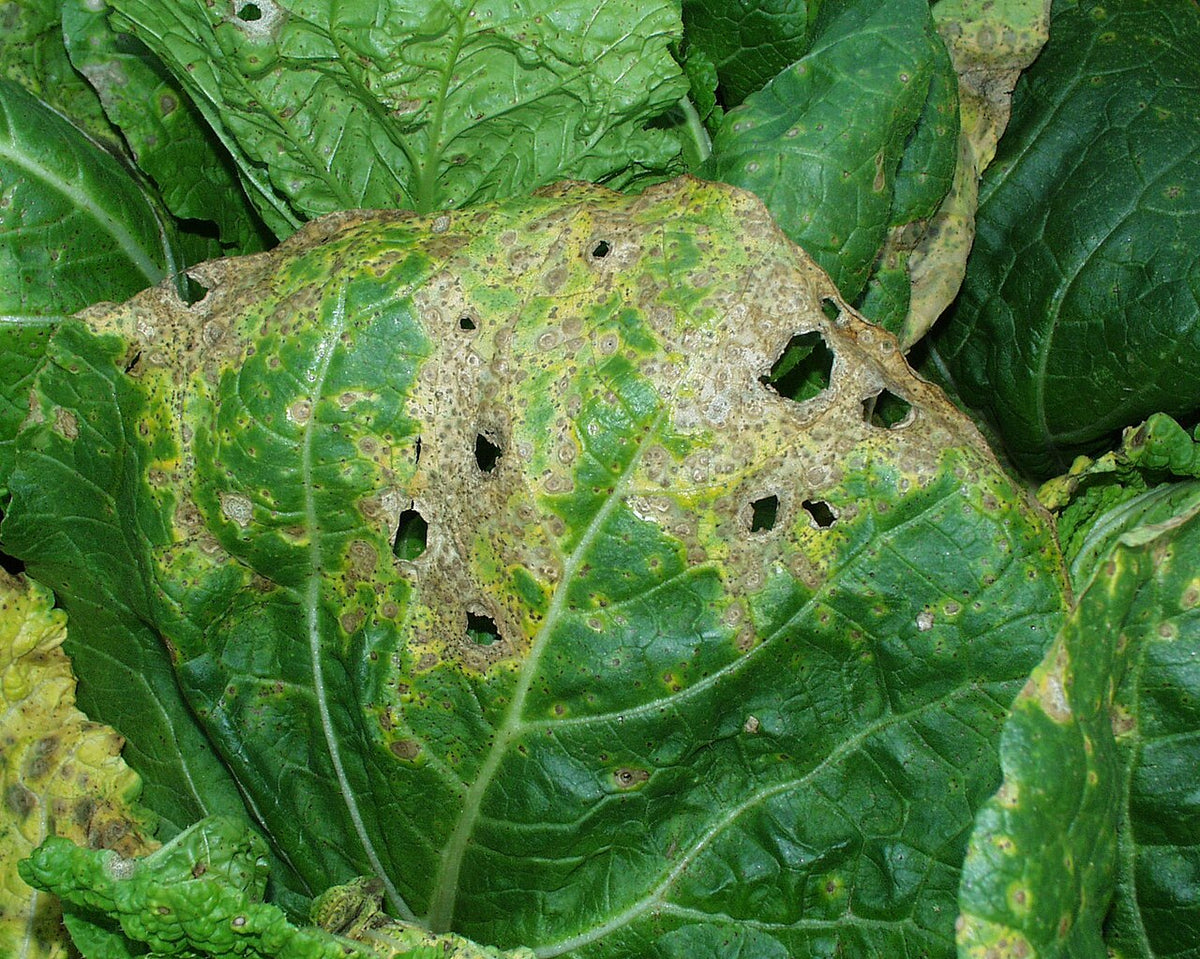
Photo at the top: Alternaria on a leaf of Chinese cabbage, a relative of mustard: round brown spots with rings, yellow edges and joined dead patches, Photo: Jochen Kreiselmaier, DLR Rheinpfalz, CC BY-SA 4.0
Quick answer
Alternaria leaf spot is a fungal disease that makes brown spots with rings, like a target, on the leaves of cotton, mustard, chilli, cumin and apple. Spots join, leaves dry and fall early, and pods, bolls or seeds suffer too. Use clean seed, destroy crop waste and spray a fungicide labelled for your crop when the first spots appear.
How to identify Alternaria leaf spot and blight
In Hindi it is called alternaria patti dhabba (अल्टरनेरिया पत्ती धब्बा). In Telugu it is alternaria aakumacha tegulu (ఆల్టర్నేరియా ఆకుమచ్చ తెగులు). Many books also call it Alternaria blight, because badly hit leaves look burnt. Different Alternaria fungi attack different crops, but the signs are much alike. Check the older, lower leaves first.
- Young spot: a small brown or purple-brown dot on the leaf.
- Grown spot: round or irregular, brown to dark brown, often with rings inside it like a target. Many spots have a yellow ring around the edge.
- Spots join: many spots run together into large dead patches. The leaf turns yellow, dries and falls.
- Other parts: dark spots can also form on stems, cotton bracts and bolls, mustard pods and cumin stems.
- Black growth: in humid weather, old spots get a dark, sooty layer. These are the spores (the seeds of the fungus) that spread the disease.
Look-alikes and how to tell them apart
- Cercospora leaf spot: the spot has a grey or white centre and a dark edge, like a frog's eye, and usually no rings. See our guide to Cercospora leaf spot of chilli and its frog-eye spots.
- Bacterial blight of cotton: the spots start dark green and water-soaked, and they are angular because the leaf veins stop them. Alternaria spots are round or irregular and dry, with rings. See angular leaf spot and bacterial blight of cotton.
- Anthracnose in chilli: mainly sunken spots on the fruit with rings of tiny black dots, and twigs that dry from the tip. See anthracnose and fruit rot of chilli.
- Early blight of tomato and potato and purple blotch of onion are also caused by Alternaria fungi. They have their own guides: early blight of tomato and potato and purple blotch of onion.
Life cycle and when it attacks
The fungus lives through the off-season in old crop waste in the soil. In many crops it also comes with the seed, on or inside it. TNAU (Tamil Nadu Agricultural University) notes this for cotton, and ICAR (Indian Council of Agricultural Research) scientists note it for mustard and cumin. From these first spots, spores are carried by wind and rain splash to new leaves and new fields.
The spores need wet leaves to infect. Dew, drizzle, cloudy days and high humidity help the disease spread fast. TNAU gives high humidity, on-and-off rain and a moderate temperature of 25 to 28 °C as the favourable weather for Alternaria blight of cotton. Crowded crops stay wet longer, so they suffer more. Old leaves and stressed, poorly fed plants get the disease first.
In Telangana and Andhra Pradesh, cotton and chilli are most at risk during humid, rainy spells of kharif, mainly from flowering to boll or fruit stage. Mustard and cumin are rabi crops in north and west India. They get it in cool, cloudy, dewy weather from flowering onwards. In apple orchards of the hills, it comes with the warm, wet weather of the rainy season.
Crops it attacks
Alternaria leaf spot of cotton
Caused by Alternaria macrospora. TNAU describes small pale to brown spots on the leaves, each with rings around the centre. The spots join, and the leaves turn brittle and fall. Spots also form on bracts and bolls. Bolls get small, sunken, reddish brown spots, and the lint can be stained yellow or brown. Seedlings can get reddish spots on the first leaves and may die if the stem is ringed at the base. Long spells of rain at boll formation and close planting make it worse, as TNAU notes.
Alternaria blight of mustard
Caused mainly by Alternaria brassicae. Small brown spots with rings form on the lower leaves first, then on the upper leaves. Dark spots also form on stems and pods. Infected pods give small, shrivelled seeds, so both yield and oil quality drop. ICAR scientists describe it as one of the main diseases of rapeseed and mustard, worst in wet seasons and high-rainfall areas.
Alternaria leaf spot in chilli
Brown spots with rings, often with a yellow edge, appear on older leaves. Badly spotted leaves fall early, so plants carry fewer and smaller fruits. Dark sunken spots can also form on the fruit.
Cumin blight
Caused by Alternaria burnsii. It is one of the most damaging diseases of cumin (jeera). It usually starts around flowering. Small whitish or purplish spots on the leaves and stems turn dark brown to black. The tips of the plants droop, and the field can look burnt within days of cloudy, humid weather. Diseased plants set little seed, and the seed is small and shrivelled.
Alternaria leaf blotch of apple
Caused by Alternaria mali. Small round brown spots with a purple border appear on the leaves in early summer. They grow larger and may join into irregular blotches. Badly spotted leaves turn yellow and fall early, which weakens the tree and the fruit.

When to spray (economic threshold)
The economic threshold is the disease level at which spraying starts to pay for itself. We could not confirm a threshold for Alternaria blight from a recognised public source, so we do not give one here. This disease spreads fast in humid weather, so spraying usually starts as soon as the first spots appear, or before them in apple. Each product label below says when to spray.
Walk the field once or twice a week from flowering, and more often after cloudy or rainy days. Turn over the lower leaves of a few plants in several parts of the field. For cotton, TNAU's crop protection guide times sprays at 60, 90 and 120 days after sowing.
Control without chemicals
- Clean seed: TNAU advises against using seed from an infected crop. Buy certified seed, or keep seed only from a healthy field.
- Destroy crop waste: TNAU advises removing and destroying infected plant waste and fallen bolls after harvest, and deep ploughing in summer to bury the rest. In apple orchards, rake up and destroy fallen leaves.
- Remove weed hosts: TNAU names weed hosts as a source of the fungus in cotton. Keep fields and bunds clean.
- Rotate crops: do not grow the same crop, or a close relative, in the same field year after year.
- Sowing time and spacing: in an ICAR study on mustard, crops sown on 10 October had less blight on leaves and pods than later sowings. Rows 45 cm apart had less disease than broadcast sowing. Ask your KVK for the right sowing window in your area.
- Weeding and feeding: the same study found less disease in weeded plots, and when potassium was given along with the recommended nitrogen, or sulphur along with the recommended NPK. Use a soil test, and avoid too much urea.
- Water with care: do not over-irrigate, mainly in cumin. Wet soil and a wet crop canopy help the fungus.
- Biological control: for cotton, TNAU lists the friendly bacterium Bacillus subtilis, applied at 60, 90 and 120 days after sowing. Ask your KVK for a registered product and its dose.
Chemical control: fungicide for Alternaria blight by crop
Only the products below have that crop and this disease on their official label. Doses are per acre, as printed on the label or worked out from the label's per-hectare dose. Use one product at a time. Do not mix products in one tank. Cover both sides of the leaves well.
Chilli
| Product | Contains | Label dose per acre | Water per acre | Wait before harvest |
|---|---|---|---|---|
| Merger Fungicide | Tricyclazole 18% + Mancozeb 62% WP | 506 g | 200 L | 7 days |
Merger has two active ingredients in one pack. It is a ready-mixed product approved on the label. Its label lists this disease on chilli. Spray when the first spots appear, in the morning or evening, with a high-volume knapsack sprayer. One to three sprays, depending on how bad the disease is.
Cumin
| Product | Contains | Label dose per acre | Water per acre | Wait before harvest |
|---|---|---|---|---|
| Score Fungicide | Difenoconazole 25% EC | Dose as per label: 0.05%, or 50 ml per 100 L of water | 200 L | 15 days |
| Indofil Z78 Fungicide | Zineb 75% WP | 0.6–0.8 kg | 300–400 L | Not given on the label |
Score: its label lists "Blight (Alternaria burnsii)" on cumin. Spray when the disease appears. Indofil Z78: its label lists this use on cumin as "Early Blight", which on cumin is the same Alternaria blight. To prepare it, make a thick paste with a little water, let it soak for 5 to 10 minutes, then add the rest of the water while stirring.
Apple
| Product | Contains | Label dose | Water | Wait before harvest |
|---|---|---|---|---|
| Merivon Fungicide | Fluxapyroxad 250 g/L + Pyraclostrobin 250 g/L SC | 152 ml per acre (15 ml per 100 L of water) | 1,010 L per acre | 29 days |
| Avtar Fungicide | Hexaconazole 4% + Zineb 68% WP | Dose as per label: 0.25%, or 25 g per 10 L of water | 10 L per tree | 30 days |
Merivon and Avtar each have two active ingredients in one pack. Both are ready-mixed products approved on the label. Merivon: spray before the first spots appear, at the vegetative and fruiting stage, in the morning or evening, with a hollow cone nozzle. Three to four sprays, depending on disease pressure. Avtar: its label lists Alternaria blight on apple.
Cotton and mustard
None of the products in our store has this disease on cotton or mustard on its label, so we do not suggest one here. Use the non-chemical steps above, and ask your local agriculture officer or Krishi Vigyan Kendra (KVK) for a product labelled for your crop.
Rotate to avoid resistance
If you spray the same type of fungicide again and again, the fungus can stop responding to it. Fungicides are grouped by how they work, using the FRAC code (FRAC is the international Fungicide Resistance Action Committee). Change the group from one spray to the next.
| FRAC group | Active ingredient | Products in this article |
|---|---|---|
| 3 (DMI, triazoles) | Difenoconazole, hexaconazole | Score; one part of Avtar |
| M03 (multi-site contact) | Zineb, mancozeb | Indofil Z78; one part of Avtar and Merger |
| 7 (SDHI) | Fluxapyroxad | One part of Merivon |
| 11 (strobilurins) | Pyraclostrobin | One part of Merivon |
| 16.1 | Tricyclazole | One part of Merger |
In cumin, change between Score (group 3) and Indofil Z78 (group M03). In apple, change between Merivon (groups 7 and 11) and Avtar (groups 3 and M03). Group M03 fungicides act on many points inside the fungus, so the risk of resistance to them is low, but they work only where they land. Keep to the number of sprays each label allows.
Safety and waiting period
- The waiting period before harvest (PHI, pre-harvest interval) for each product and crop is in the tables above. Count the days from the last spray. The Indofil Z78 label does not give a waiting period for cumin, so ask your agriculture officer before spraying close to harvest.
- After a Merger spray, keep people out of the field for 48 hours. After Merivon, wait until the spray has dried.
- Wear gloves, a mask, full-sleeve clothes and boots while mixing and spraying. Do not eat, drink or smoke while you work. Wash well afterwards.
- Spray in the morning or evening, not in strong wind or hot afternoon sun.
- Fish: Merger and Merivon are toxic to fish and other water life. Keep sprays and washings away from ponds, canals and wells.
- Read the label and leaflet before use.
Frequently asked questions
What causes Alternaria leaf spot?
Fungi of the genus Alternaria. Each crop has its own main species: A. macrospora in cotton, A. brassicae in mustard, A. burnsii in cumin and A. mali in apple. They survive in crop waste and seed, and spread by wind and rain splash in humid weather.
Is Alternaria blight the same as early blight?
Both are caused by Alternaria fungi and look alike. "Early blight" usually means the disease on tomato and potato, caused by Alternaria solani. Some labels also use the name for cumin blight.
How do I control cumin blight?
Sow clean seed, avoid over-irrigation and keep a close watch from flowering, mainly after cloudy days. When the first spots appear, spray a fungicide labelled for cumin, such as Score or Indofil Z78 at the doses above, and change between them.
Which fungicide is labelled for Alternaria leaf spot in chilli?
In our store, Merger Fungicide lists this disease on chilli on its label. The label dose is 506 g per acre in 200 L of water, with a 7-day waiting period before picking.
Does Alternaria blight spread through seed?
Yes. In cotton, mustard and cumin the fungus can come with the seed. Use certified seed or seed from a healthy crop, and treat seed as your KVK advises.
Related reading
- Early blight of tomato and potato: symptoms and control
- Purple blotch of onion: an Alternaria disease
- Cercospora leaf spot of chilli, cotton and pulses
- Bacterial blight of cotton
- Anthracnose and fruit rot of chilli
- Products for chilli
- Products for cotton
- All fungicides
Sources
- Tamil Nadu Agricultural University, TNAU Agritech Portal: Alternaria leaf blight of cotton and Alternaria boll and seedling infection of cotton
- Meena P.D. and others, ICAR-Directorate of Rapeseed-Mustard Research, Journal of Oilseed Brassica: Alternaria blight: a chronic disease in rapeseed-mustard
- Kumar N. and Kumar A., The Indian Journal of Agricultural Sciences (ICAR): Effect of cultural practices on Alternaria blight in Brassica juncea and B. napus
- Meena R.D. and others, ICAR-National Research Centre on Seed Spices, International Journal of Seed Spices: Aerial diseases and their management in Cuminum cyminum: a review
- Fungicide Resistance Action Committee (FRAC): Fungicides by FRAC mode of action group
- Product labels and leaflets of the fungicides listed above.
Products that control it, by crop
Chilli
- Merger Fungicide506 g per acreSpray when disease signs first appear, in the morning or evening. 1 to 3 sprays, based on how bad the disease is.
Cumin
- Score FungicideSpray 0.5 ml per litre of water (0.05%) when the disease first appears.
- Indofil Z78 Fungicide0.6–0.8 kg per acreSpray on leaves. Make a paste with a little water, soak 5-10 minutes, then add the rest of the water while stirring.
Apple
- Avtar FungicideMix 25 g in 10 litres of water (0.25%). Use 10 litres per tree.
Do not spray the same product again and again. Change to a product with a different mode of action (the group number on the label) so the pest or disease does not build resistance.
As printed on the brand's official label. Read the label before use.


Like these farming tips? Add AgriVruddhi as a preferred source on Google
Back to Crop Health Guide