
Purple blotch of onion: symptoms, treatment and when to spray
· By AgriVruddhi
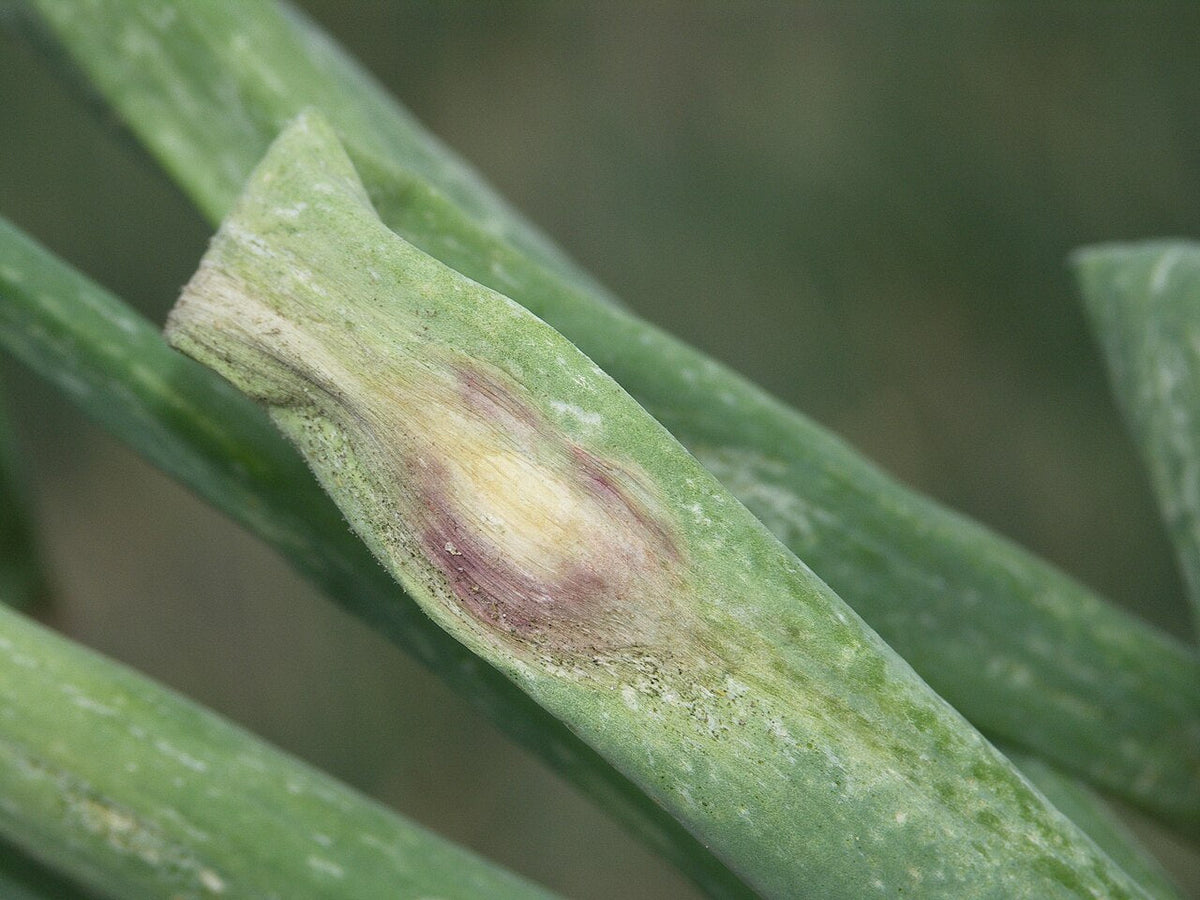
Photo at the top: An oval patch on an onion leaf with a pale centre and a purple border, Photo: Jochen Kreiselmaier, DLR Rheinpfalz, CC BY-SA 4.0
Quick answer
Purple blotch of onion is a leaf disease caused by the fungus Alternaria porri. It starts as small whitish spots that turn into purple patches with rings, and the leaves dry from the tip down, so bulbs stay small. Warm, humid weather spreads it. Rotate crops, drain the field, control thrips, and spray a labelled fungicide when spots first appear.
How to identify purple blotch of onion
In Hindi the disease is called baingani dhabba (बैंगनी धब्बा), and in Telugu ooda macha tegulu (ఊదా మచ్చ తెగులు). It attacks the leaves and the flower stalks of onion and garlic. Older leaves get it first. Walk through the field and look closely at the outer leaves, mainly on cloudy, damp days.
Purple blotch of onion symptoms, stage by stage
- Early stage: very small, sunken, whitish spots on the leaf. TNAU (Tamil Nadu Agricultural University) notes that they often start near the top of the leaf, with a pale yellow area around them.
- Middle stage: the spot grows into an oval patch. The centre turns purple, and the edge is often purple or reddish with a yellow halo.
- Late stage: dark brown to black rings form inside the patch, like the rings of a target. These rings are the fungus making new spores (its "seeds"), and they can look velvety.
- Advanced damage: patches join together and wrap right around the leaf or flower stalk. The leaf bends at the patch, and everything above it dries. The leaves die from the tip downwards.

Look-alikes and how to tell them apart
- Stemphylium blight: a close cousin. The National Horticulture Board (NHB) describes it as small yellow to orange spots or streaks in the middle of the leaf, which grow into long, spindle-shaped spots with a pinkish edge. It is a bigger problem in the seed crop and in North India. The two diseases often occur together, and the field steps are the same.
- Downy mildew: pale, oval patches with a violet-grey fuzzy growth on them in humid mornings. There are no target-like rings. Purple blotch often grows inside old downy mildew patches, so you may see both. See our guide to downy mildew in onion, grapes and maize.
- Thrips damage: silvery white streaks and patches, with no purple colour and no rings. Look for tiny, thin insects inside the leaf folds. See our thrips control guide for onion, chilli and cotton.
- Natural drying: near harvest, the leaves of a healthy crop turn yellow and fall over on their own. That drying is even across the field and has no spots.
Life cycle and when it attacks
The fungus lives on in old onion leaves, crop waste and infected bulbs left in or near the field. NIPHM (the National Institute of Plant Health Management) adds that it can survive in the soil. Wind and rain splash carry the spores to new plants. Once one spot forms, it makes new spores all through the season, and these spread to the leaves and plants nearby.
Spores need a wet leaf to infect. Utah State University Extension notes that the fungus enters mostly through wounds, such as the scratches thrips make when they feed, hail damage or patches of other diseases. This is why a field with heavy thrips often gets more purple blotch. Older leaves are more easily infected than young ones.
The NHB and NIPHM name hot, humid weather as the main trigger: a temperature of 21–30 °C and relative humidity (the amount of moisture in the air) of 80–90%. Long nights with dew, cloudy days and drizzle all help it. The NHB notes the disease is more common in the kharif (rainy season) crop. In Telangana and Andhra Pradesh, keep the closest watch on kharif onion, and on rabi onion after unseasonal rain or a spell of heavy dew.
Crops it attacks
Onion: the main host. The crop can be hit from a month after transplanting up to bulb filling. When many leaves die early, the plant cannot feed the bulb, so bulbs stay small. NIPHM notes that badly infected plants may fail to form bulbs at all. In a seed crop, patches on the flower stalk make it bend and break, so seed yield drops.
Garlic: the same fungus attacks garlic leaves with the same purple, ringed patches. The field steps in this guide apply to garlic too.
When to spray
We could not find an economic threshold (the disease level at which spraying starts to pay for itself) for purple blotch from a recognised public source, so we do not give one here. The product labels below say to spray when the disease appears. So check the older leaves once or twice a week from about a month after transplanting, and start at the first spots, mainly when the weather is humid or rainy.
Control without chemicals
- Healthy planting material: use clean seed and healthy, disease-free bulbs or garlic cloves. NIPHM advises soaking onion seed in hot water at 50 °C for 20 minutes before sowing.
- Crop rotation: NHB and NIPHM advise a gap of 2–3 years before onion or garlic come back to the same field. Grow a crop from another family, such as a cereal, in between.
- Clean up crop waste: remove and destroy old leaves, rejected bulbs and crop waste after harvest. They carry the fungus to the next crop.
- Drainage: TNAU and NIPHM advise a well-drained field. Do not let water stand in the beds.
- Water with care: avoid watering late in the day, so leaves do not stay wet all night.
- Balanced fertiliser: NIPHM advises the recommended doses of nitrogen and phosphorus. Too much urea gives soft leaves that get the disease more easily.
- Control thrips and downy mildew: both open the door for purple blotch. Keeping them in check lowers the risk.
- Tolerant varieties: NIPHM lists the TNAU hybrid CO 2 as tolerant of purple blotch. Ask your local Krishi Vigyan Kendra (KVK) which varieties do well against it in your area.
Purple blotch of onion treatment: fungicides by crop
Only the products below have onion and purple blotch on their official label or company leaflet. Use one product at a time. Do not mix products in one tank. Onion leaves are smooth and waxy, so spray until the leaves are evenly covered.
Onion
| Product | Contains | Dose | Water per acre | Wait before harvest |
|---|---|---|---|---|
| Amistar Top Fungicide | Azoxystrobin 18.2% + difenoconazole 11.4% SC | Dose as per label: "0.1% or 1 ml per litre water" | 200 L | 7 days |
| Score Fungicide | Difenoconazole 25% EC | Dose as per label: "0.1% or 100 ml per 100 L water" | 200 L | 20 days |
| Custodia Fungicide | Azoxystrobin 11% + tebuconazole 18.3% SC | Leaflet dose 300 ml per acre | Not given on the leaflet | Not given on the leaflet |
Notes from the labels:
- Amistar Top: one or two sprays when the disease appears. Its label lists onion for purple blotch, Stemphylium blight and downy mildew, so one spray also covers the two diseases that often come with purple blotch.
- Score: spray when the disease appears. The label gives no crop stage.
- Custodia: the dose comes from the company leaflet, not the official label. The leaflet does not give the water volume, spray timing or waiting period, so ask the store before use.
- Amistar Top and Custodia each hold two active ingredients in one pack. These are ready-mixed products approved on the label. They are not tank mixes.
Garlic
None of the products in our store has purple blotch on garlic on its label, so we do not suggest one here. Use the field steps above, and ask your local agriculture officer or KVK for a product labelled for garlic.
Rotate to avoid resistance
If you spray the same type of fungicide again and again, the fungus can stop responding to it. Fungicides are grouped by how they work, using the FRAC group number (FRAC is the international Fungicide Resistance Action Committee). Change the group from one spray to the next.
| FRAC group | Active ingredient | Products in this article |
|---|---|---|
| 3 (triazoles) | Difenoconazole, tebuconazole | Score; one part of Amistar Top and Custodia |
| 11 (strobilurins) | Azoxystrobin | One part of Amistar Top and Custodia |
All three products carry group 3, and two of them also carry group 11. Both groups carry a real risk of resistance. So switching between these three alone is not a true rotation. Do not use them for spray after spray. Keep to the number of sprays each label allows, and in between use a fungicide from a different group whose label lists onion. Public guides from the NHB and TNAU name contact fungicides such as mancozeb and chlorothalonil for purple blotch. Ask your KVK or agriculture officer for one approved for onion in your state.
Safety and waiting period
- The waiting period before harvest (PHI, pre-harvest interval) is in the table above: 7 days for Amistar Top and 20 days for Score. Count the days from the last spray. For Custodia the leaflet gives no waiting period, so check the pack before use.
- Wear gloves, a mask, full-sleeve clothes and boots while mixing and spraying. Do not eat, drink or smoke while you work. Wash well afterwards.
- Spray in the morning or evening, not in strong wind or hot afternoon sun.
- Fish: keep sprays and sprayer washings away from ponds, canals and wells.
- Read the label and leaflet before use.
Frequently asked questions
What are the first signs of purple blotch on onion leaves?
Small, sunken, whitish spots on the older leaves, often near the tip. Within days they grow into oval patches with a purple centre. Later, dark rings form inside the patch, and the leaf dries from the tip down.
Which fungicide is used for purple blotch of onion treatment?
On our store, Amistar Top and Score list onion purple blotch on their official labels, and Custodia lists it on its company leaflet. The doses are in the onion table above. Start at the first spots and change the FRAC group between sprays.
Why does purple blotch spread so fast in the rainy season?
The fungus needs wet leaves and warm, humid air to infect. In the rainy season the leaves stay wet for many hours, and rain splash carries spores from plant to plant. Each patch keeps making new spores, so the disease can cover a field in a short time.
Do thrips make purple blotch worse?
Yes. Thrips scrape the leaf surface when they feed, and the fungus enters through these wounds. Fields with heavy thrips often get more purple blotch, so control thrips too.
Can I still harvest the bulbs from an infected field?
Yes, but bulbs from a badly infected crop stay small, because the dead leaves could not feed them. Count the waiting period from your last spray before you harvest.
Related reading
- Thrips insecticide guide: control thrips in chilli, cotton and onion
- Downy mildew of grapes, maize, onion and cucurbits: identify and control
- Early blight of tomato and potato, another Alternaria disease
- Alternaria leaf spot and blight in cotton, mustard, chilli and cumin
- All fungicides
Sources
- Tamil Nadu Agricultural University, TNAU Agritech Portal: Purple blotch of onion
- National Horticulture Board (NHB), Government of India: Onion diseases and their control
- National Institute of Plant Health Management (NIPHM) and DPPQS, Government of India: AESA based IPM package for onion
- University of California Statewide IPM Program: Purple blotch and Stemphylium leaf blight
- Utah State University Extension: Purple blotch and Stemphylium leaf blight of onion
- Fungicide Resistance Action Committee (FRAC): FRAC code list
- Product labels and leaflets of the fungicides listed above.
Products that control it, by crop
Onion
- Amistar Top FungicideSpray 1 ml per litre of water (0.1%) when the disease appears; 1-2 sprays
- Score FungicideSpray 1 ml per litre of water (0.1%) when the disease first appears.
- Custodia Fungicide300 ml per acreSpray on the leaves.
Do not spray the same product again and again. Change to a product with a different mode of action (the group number on the label) so the pest or disease does not build resistance.
As printed on the brand's official label. Read the label before use.


Like these farming tips? Add AgriVruddhi as a preferred source on Google
Back to Crop Health Guide