
Northern corn leaf blight (turcicum leaf blight) of maize: symptoms and control
· By AgriVruddhi
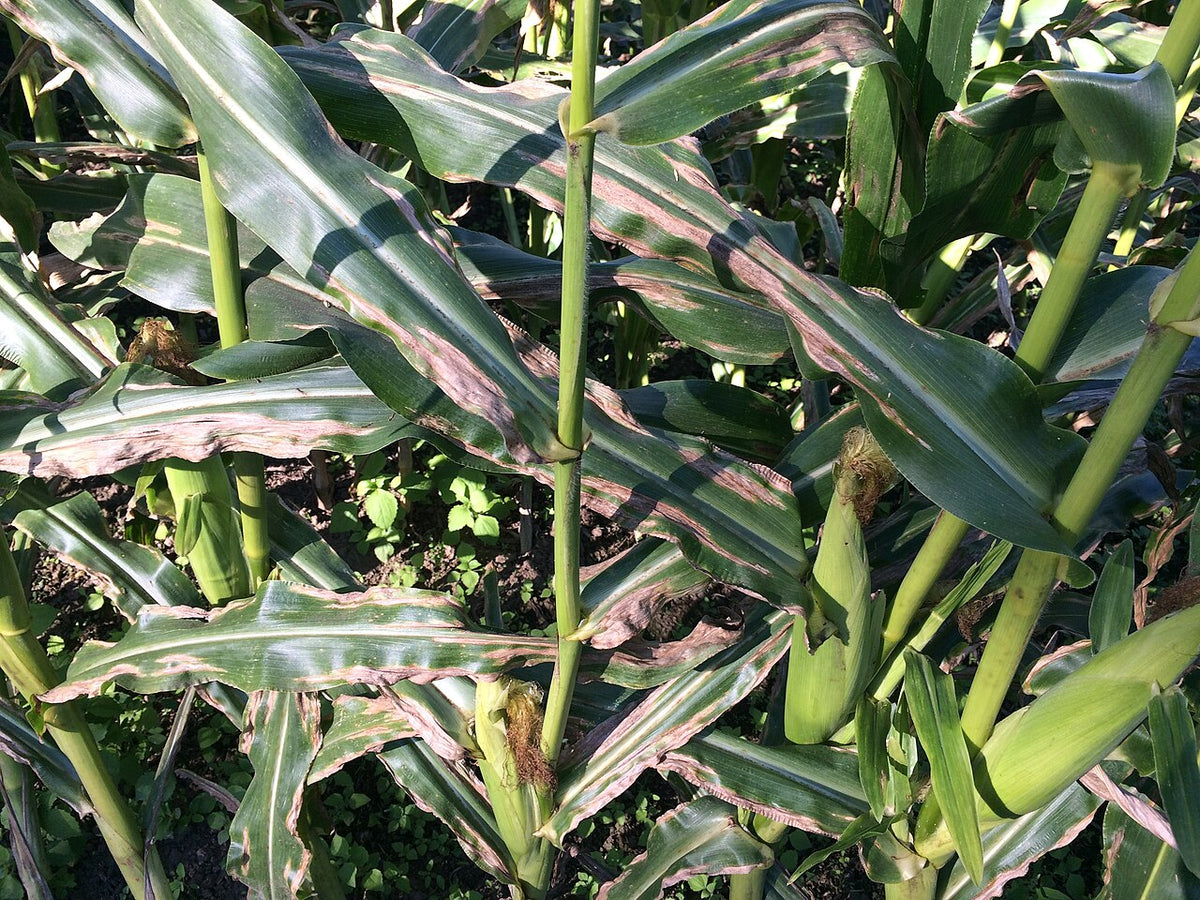
Photo at the top: A maize field with long tan spots running along the leaves, a typical field view of the disease. Photo: Chroanch, CC BY-SA 4.0
Quick answer
Northern corn leaf blight, also called turcicum leaf blight, is a fungal disease of maize caused by Exserohilum turcicum. It makes long, cigar-shaped grey to tan spots on the leaves, starting with the lower leaves. Badly hit leaves dry up early and cobs fill poorly. Grow resistant hybrids, bury old stubble and spray a labelled fungicide at the first spots.
How to identify northern corn leaf blight
In Hindi the disease is called makka ka uttari patti jhulsa (मक्का का उत्तरी पत्ती झुलसा), and in Telugu mokkajonna aaku maadu tegulu (మొక్కజొన్న ఆకు మాడు తెగులు). Many books and seed packets call it turcicum leaf blight, or TLB for short. Walk into the field and look at the lower leaves first. That is where the spots start. From there the disease moves up the plant.
- Early spots: small, oval, grey-green, water-soaked looking spots on the lower leaves.
- Full-size spots: long, narrow and pointed at both ends, like a cigar or a boat. TNAU (Tamil Nadu Agricultural University) gives their length as 1 to 6 inches (about 2.5 to 15 cm). They run along the length of the leaf, parallel to the leaf edge.
- Colour: grey-green at first, then pale grey or tan (light brown).
- Dark fuzz: in moist weather the fungus makes spores on the spots, mostly on the underside of the leaf. This gives the spot a dusty, dirty grey or black look.
- Severe stage: spots join together and cover the whole leaf. The leaf turns greyish, dry and brittle, as if burnt by frost. Whole leaves die, and you can no longer see single spots.

Some resistant hybrids still get the disease, but the spots stay small and yellowish and may look like thin streaks. These spots make few spores, so the disease spreads slowly on such hybrids.
Look-alikes: southern corn leaf blight and other problems
- Southern corn leaf blight (maydis leaf blight): caused by a different fungus, Bipolaris maydis. Its spots are much smaller and shorter, tan, with straight sides held between the leaf veins. Northern corn leaf blight spots are long, wide in the middle and pointed at both ends. Ask your agriculture officer to confirm if you are not sure, because the control advice and labels differ.
- Common rust: small, raised, powdery pustules (tiny bumps) that are reddish brown. When you rub them, a rust-coloured powder comes off on your finger. Blight spots are flat and do not leave powder like this.
- Downy mildew: pale yellow or white stripes along the leaf with white downy growth in the early morning, often on young plants. See our guide on downy mildew in maize, grapes and cucurbits.
- Nitrogen shortage: the older lower leaves turn yellow in a V shape from the tip along the midrib. There are no separate cigar-shaped spots. Read how to spot nitrogen deficiency in plants.
- Potassium shortage: the edges of older leaves turn yellow, then brown and dry, starting from the tip. The middle of the leaf stays green. See potassium deficiency signs and correction.
- Insect feeding: holes, ragged leaves and sawdust-like waste in the whorl point to caterpillars, not a fungus. See fall armyworm in maize: how to identify and control it.
Life cycle and when it attacks
The fungus lives through the gap between crops on infected maize leaves and stalks left in the field. TNAU notes that it can also form thick-walled resting spores, which help it survive. When the new crop grows and the weather turns moist, spores form on the old stubble. Wind and splashing rain carry them onto the lower leaves of the young crop.
A spore needs a wet leaf to infect. The Crop Protection Network, a group of university extension experts, says the disease is favoured when leaves stay wet for more than 6 hours from rain or dew, and the temperature is moderate, about 18 to 27°C (64 to 81°F). New spots then make fresh spores, and wind carries these up the plant and to other fields. Over a few weeks of wet weather, the disease can climb from the lower leaves to the leaves above the cob.
So the riskiest weather is cool nights, heavy dew, cloudy days and long wet spells. TNAU describes it as wet, humid, cool weather, often later in the growing season. In Telangana and Andhra Pradesh, watch rabi maize closely in the cooler months when dew is heavy, and kharif maize during long cloudy, rainy spells. A field sown in the same place as last year's infected maize, with old stubble left on top, is at the highest risk.
Crops it attacks
Maize: the main crop at risk, grown for grain or fodder. Spots can show up on young plants, but the real damage comes when the disease reaches the upper leaves around tasselling and silking (when the cob silk comes out). The leaves above and just below the cob feed the grain. If these leaves dry up before the grain is filled, cobs stay light, grains are small and stalks get weak. Spots can also form on the outer husk of the cob, but the Crop Protection Network notes that the grains are not infected.
Sorghum and related grasses: the same fungus also causes a leaf blight in sorghum (jowar) and in some fodder grasses. A sorghum crop or fodder field next to maize can carry the disease from one to the other.
When to spray (economic threshold)
The economic threshold is the level of attack at which spraying starts to pay for itself. We could not find a number-based threshold for this disease from a recognised Indian public source, so we do not give one here.
What you can do is check the field every week from about knee height. Look at the lower and middle leaves on plants across the field. If the first cigar-shaped spots appear and the weather is wet, cloudy or dewy, that is the time to act. TNAU's spray schedule for maize leaf blight places the sprays at about 35 and 50 days after sowing. Spraying late, once the upper leaves are already dry, saves little.
Turcicum leaf blight control without chemicals
- Grow resistant or tolerant hybrids: this is the most useful step where the disease comes back every year. Ask your KVK (Krishi Vigyan Kendra), the state agricultural university or ICAR-IIMR (Indian Institute of Maize Research) which hybrids tolerate turcicum leaf blight in your area.
- Deal with old stubble: TNAU advises destroying infected maize stubble. Bury it by ploughing after harvest so it rots, rather than burning it. Do not leave infected leaves and stalks lying on top of the soil.
- Rotate crops: do not grow maize after maize in the same field if the last crop had blight. Grow a crop from another family, such as a pulse, groundnut or cotton, for a season. Avoid sorghum as the rotation crop, because the same fungus attacks it.
- Spacing: sow at the recommended spacing. A crowded crop stays wet longer after rain and dew, which helps the fungus.
- Water: avoid watering late in the evening, so leaves do not stay wet all night.
- Balanced feeding: give fertiliser as per a soil test. A crop short of nutrients is weaker and its lower leaves die early.
- Remove sources nearby: keep an eye on sorghum and fodder grass beside the maize field. If they show the same long spots, tell your neighbour and check your maize more often.
Chemical control: fungicide for leaf blight of maize
Of the products on our store, only the one below lists turcicum blight on maize on its official label. The dose is per acre, converted from the label's per-hectare dose. Use one product at a time. Do not mix products in one tank. Spray so the leaves are well covered, including the lower and middle leaves where the disease starts.
Maize
| Product | Contains | Label dose per acre | Water per acre | Wait before harvest |
|---|---|---|---|---|
| Avtar Fungicide | Hexaconazole 4% + Zineb 68% WP | 506 g | 200 L | 43 days |
The label gives the dose as 1250 g per hectare in 500 L water. Avtar is a ready-mixed product with two active ingredients in one pack, and this mix is approved on the label for maize.
For more products for this crop and others, see all fungicides.
Rotate to avoid resistance
If you spray the same type of fungicide again and again, the fungus can stop responding to it. Fungicides are grouped by how they work, using the FRAC code (FRAC is the international Fungicide Resistance Action Committee).
| FRAC group | Active ingredient | Products in this article |
|---|---|---|
| 3 (triazoles) | Hexaconazole | One part of Avtar |
| M03 (multi-site contact) | Zineb | One part of Avtar |
Avtar already joins two groups. Zineb acts at many points in the fungus (multi-site), so the risk of resistance to it is low. Hexaconazole acts at one point, so its risk is higher. Keep to the number of sprays the label allows. If your crop needs more sprays than that, ask your agriculture officer for a fungicide labelled for maize leaf blight from a different FRAC group, and alternate the two.
Safety and waiting period
- The waiting period before harvest (PHI, pre-harvest interval) for Avtar on maize is 43 days. Count the days from the last spray.
- Wear gloves, a mask, full-sleeve clothes and boots while mixing and spraying. Do not eat, drink or smoke while you work. Wash well afterwards.
- Spray in the morning or evening, in calm weather. Tall maize is hard to cover, so walk between the rows with care and do not spray against the wind.
- Keep sprays and washings away from ponds, canals and wells.
- Read the label and leaflet before use.
Frequently asked questions
What causes northern corn leaf blight?
A fungus called Exserohilum turcicum (older books call it Helminthosporium turcicum). It lives on old maize stubble and spreads by wind-blown spores in cool, wet, dewy weather.
Is turcicum leaf blight of maize the same as northern corn leaf blight?
Yes. They are two names for the same disease. In India it is more often called turcicum leaf blight, or TLB.
How can I tell northern from southern corn leaf blight?
Look at the shape and size of the spots. Northern blight spots are long, wide in the middle and pointed at both ends, often several centimetres long. Southern blight spots are small, short and have straight sides between the leaf veins. If you are not sure, show a leaf to your KVK.
Which fungicide is used for leaf blight in maize?
On our store, Avtar Fungicide lists turcicum blight on maize on its label, at 506 g per acre in 200 L water. Start at the first spots in wet weather, and keep to the label's number of sprays.
Can a blighted maize leaf turn green again?
No. The dead part of the leaf does not recover. A spray protects the healthy leaves and slows the spread to the upper leaves, which matter most for filling the cob.
Related reading
- Fall armyworm in maize: how to identify and control it
- Downy mildew of grapes, maize and cucurbits: identify and control
- Shoot fly in sorghum and maize: dead heart signs and control
- Nitrogen deficiency in plants: symptoms, causes and how to correct it
- All fungicides
Sources
- Tamil Nadu Agricultural University, TNAU Agritech Portal: Leaf blight of maize
- Crop Protection Network: Northern corn leaf blight of corn
- Fungicide Resistance Action Committee (FRAC): FRAC Code List (fungicide groups)
- Product label and leaflet of Avtar Fungicide.
Products that control it, by crop
Maize
- Avtar Fungicide506 g per acre
Do not spray the same product again and again. Change to a product with a different mode of action (the group number on the label) so the pest or disease does not build resistance.
As printed on the brand's official label. Read the label before use.

Like these farming tips? Add AgriVruddhi as a preferred source on Google
Back to Crop Health Guide