
White backed plant hopper (WBPH) in paddy: symptoms, ETL and control
· By AgriVruddhi
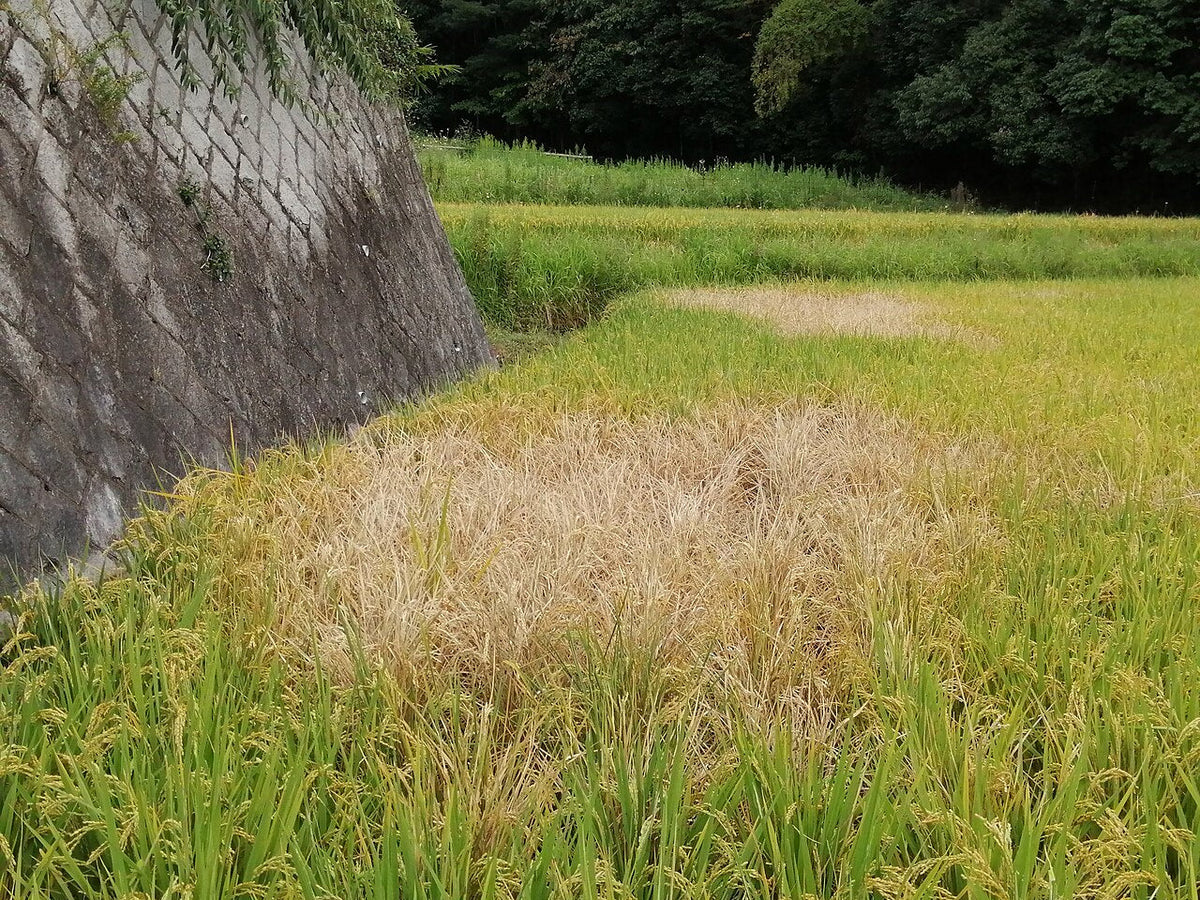
Photo at the top: Hopper burn in a paddy field after a planthopper attack. Damage in round patches like this is more typical of BPH. WBPH damage often spreads more evenly, so always check the insect at the base of the plants, Photo: つくる暮らし, CC BY 2.0
Quick answer
White backed plant hopper (WBPH, Sogatella furcifera) is a small paddy hopper with a white band on its back. It sucks sap at the base of the tillers, so plants stay stunted and leaves dry from the tip. Space plants well, avoid extra urea, drain the field at times, and spray a labelled insecticide only above the threshold.
How to identify white backed plant hopper
In Telugu this pest is called tella veepu sudi doma (తెల్ల వీపు సుడిదోమ). In Hindi it is safed peeth wala phudka (सफेद पीठ वाला फुदका). Like the brown plant hopper, it lives at the base of the plant, not on the top leaves. Part a few hills and look at the lower stems. The adults are very active and jump away the moment you touch the plant.
Tamil Nadu Agricultural University (TNAU) describes the stages like this:
- Eggs: long and narrow, laid in groups inside the plant tissue. On young plants they are lower down. On older plants they are in the upper part, often along the midrib of the leaf. You will rarely see them.
- Nymphs (young hoppers): very small when they hatch. They are white, or mottled grey or black and white. Older nymphs have a narrow head and a white or cream body with grey and white marks on the back. They have no wings.
- Adults: 3.5 to 4 mm long. The front wings are clear with dark veins. The key sign is a clear white band on the back, where the wings meet. Some adults have long wings and fly to new fields. Some females have short wings and stay to breed.
Damage signs in the field
- Plants are stunted and do not grow well, because the hoppers suck sap from the base of the tillers.
- Leaves dry from the tip downwards. In a heavy attack this becomes "hopper burn", where plants turn yellow, then brown and dry.
- TNAU notes that WBPH hopper burn tends to spread evenly over a large part of the field. Brown plant hopper (BPH) more often causes hopper burn in separate round patches.
- Sticky honeydew (a sugary liquid the hoppers pass out) on the lower stems, sometimes with black sooty mould on it.
WBPH or BPH? Look-alikes and how to tell them apart
- Brown plant hopper: sits in the same place and is often found on the same hills. BPH adults are brown all over and do not have the white band on the back. The threshold below is counted for both hoppers together. See our guide on brown plant hopper in paddy and hopper burn.
- Green leafhopper: bright green and wedge-shaped. It feeds higher up, on the leaves, and not at the base. See green leafhopper in paddy: identification and control.
- Sheath blight: oval grey-green spots with a brown edge on the leaf sheath near the water line, and no hoppers. See sheath blight of rice: symptoms and control.
- Nitrogen shortage or water stress: plants turn pale or yellow in a pattern that follows the field, but you find no hoppers and no honeydew at the base.
Life cycle and when it attacks
The female lays eggs inside the stems or along the leaf midribs. According to the Insecticide Resistance Action Committee (IRAC), one female can lay 100 to 350 eggs, and there can be up to five generations in one crop season. So a small number of hoppers early in the season can become a large number a few weeks later.
WBPH is a migratory insect. Long-winged adults fly in from other fields and settle on the crop. IRAC notes that it prefers young plants, although it can attack the crop at any stage. That is why you should start checking the base of the hills from the early tillering stage, and not wait for the crop to reach flowering.
Close planting, heavy nitrogen and fields kept under standing water all the time make the base of the crop warm, humid and shaded. This suits planthoppers. Sprays of the wrong insecticides can also kill spiders and other natural enemies, and the hoppers then come back in larger numbers. This is called resurgence.
The national rice IPM package from NCIPM (ICAR), DPPQS and NIPHM lists the brown and white backed plant hoppers among the major insect pests of rice in India. In Telangana and Andhra Pradesh, keep watch in both kharif and rabi paddy.
Crops it attacks
Paddy: WBPH is a pest of rice. Nymphs and adults suck sap from the base of the tillers, which causes stunting and drying of the leaves. A heavy attack ends in hopper burn and poor grain filling. IRAC also notes that WBPH can spread a virus disease of rice called southern rice black-streaked dwarf.
When to spray: WBPH economic threshold
The economic threshold (ETL) is the pest count at which spraying starts to pay for itself. Below it, spiders and other natural enemies, and good field care, usually keep the hoppers in check.
- The Integrated Pest Management Package for Rice (NCIPM, DPPQS and NIPHM) gives 10 to 15 hoppers per hill from early to late tillering, and 15 to 20 hoppers per hill from panicle initiation to booting. These counts are for brown and white backed plant hoppers together.
- TNAU gives 2 hoppers per tiller when there is at least 1 spider per hill. When there are no spiders, TNAU gives a lower count, so act sooner.
Check the field once a week from tillering onwards. Walk across the field, not only along the bund. Tilt a few hills in different places, tap them, and count the hoppers at the base. Count the spiders too, because they eat many hoppers.
WBPH control without chemicals
- Spacing: do not plant too close. TNAU advises leaving a 30 cm walking gap (alley) after every 2.5 to 3 m of crop. Light and air then reach the base of the plants, and spraying is easier.
- Nitrogen: do not use more urea than recommended. Too much nitrogen makes the plants soft and lush, which hoppers prefer. Give nitrogen in split doses.
- Water: TNAU advises controlling irrigation by draining the field from time to time, instead of keeping water standing all season.
- Light traps: set up a light trap to see when winged adults arrive in your area. TNAU lists light traps both to watch the pest and to help control it.
- Tolerant varieties: the rice IPM package lists varieties with resistance to WBPH, such as Suraksha (released in Andhra Pradesh) and Shaktiman, and some north Indian varieties. Ask your nearest Krishi Vigyan Kendra (KVK) which variety suits your area and season.
- Clean bunds: remove grassy weeds from bunds and channels, where hoppers can shelter.
- Natural enemies: spiders, mirid bugs that eat hopper eggs, and ladybird beetles all feed on planthoppers. Do not spray early when the count is below the threshold, so these friends survive.
- Avoid sprays that cause resurgence: TNAU warns against synthetic pyrethroids and quinalphos for this pest, because the hoppers can come back stronger after them.
White backed plant hopper insecticide: chemical control in paddy
Only the products below have paddy and white backed plant hopper on their official label or leaflet. Doses are per acre, as printed on the label or worked out from the label's per-hectare dose. Spray one product at a time. Do not mix products in one tank.
Paddy
| Product | Contains | Label dose per acre | Water per acre | Wait before harvest |
|---|---|---|---|---|
| Skystar Insecticide | Dinotefuran 15% + Pymetrozine 45% WG | 135 g | 200 L | 24 days |
| Pexalon Insecticide | Triflumezopyrim 10% SC | 94 ml | 150–200 L | Not printed on the brand leaflet; check the pack label |
| Ulala Insecticide | Flonicamid 50% WG | 61 g | 200 L | 36 days |
| Hogger Insecticide | Dinotefuran 70% WG | 36 g | 200 L | 32 days (check the pack) |
| Imidagold Plus | Imidacloprid 30.5% SC | 24–30 ml | 200–300 L | 37 days |
| Jhumru Insecticide | Fipronil 4% + Thiamethoxam 4% SC | 445 g (the label gives the dose in grams) | 200 L | 45 days |
| Hokori Insecticide | Dinotefuran 5% + Ethion 50% EC | 405 ml | 200 L | 33 days |
| Sapper Insecticide | Dinotefuran 4% + Acephate 50% SG | 356 g | 200 L | 21 days |
| Mahaveer Insecticide | Fipronil 5% SC | 405–607 ml | 200 L | 32 days |
Notes from the labels:
- Skystar, Jhumru, Hokori and Sapper each hold two active ingredients in one pack. These are ready-mixed products approved on the label. They are not tank mixes.
- Skystar and Hokori: spray when the pest reaches the ETL.
- Pexalon: apply when you see 5–10 hoppers per hill, from active tillering to panicle initiation. Use it only once per crop season. If another spray is needed 21–25 days later, use a product from a different group.
- Ulala: spray after the pest appears, from the vegetative to the reproductive stage, 2–3 sprays depending on pest numbers.
- Hogger and Sapper: spray as soon as the pest reaches the ETL, in the morning or evening. No more than two sprays.
- Imidagold Plus: spray when the pest attacks. The label gives no crop stage.
- Jhumru: spray at the vegetative growth stage, 2–3 sprays, in the morning or evening. Avoid the afternoon, and spray when the wind is steady and the temperature is below 30 °C. The label advises a knapsack sprayer with a hollow cone nozzle.
- Mahaveer: first spray 25–30 days after transplanting.
How to spray for WBPH
Drain the standing water before you spray, as TNAU advises. Point the nozzle at the base of the hills, where the hoppers live. A spray that only wets the top leaves will miss most of them.
Rotate to avoid resistance
IRAC reports that WBPH has become resistant to several insecticide groups in South-East Asia, including neonicotinoids, organophosphates, fipronil and pymetrozine. If you use the same group again and again, it stops working. Insecticides are grouped by how they work, using the IRAC group number. Change the group from one spray to the next.
| IRAC group | Active ingredient | Products in this article |
|---|---|---|
| 4A (neonicotinoids) | Dinotefuran, imidacloprid, thiamethoxam | Hogger, Imidagold Plus, and one part of Skystar, Jhumru, Hokori and Sapper |
| 9B | Pymetrozine | One part of Skystar |
| 4E | Triflumezopyrim | Pexalon |
| 29 | Flonicamid | Ulala |
| 2B | Fipronil | Mahaveer, and one part of Jhumru |
| 1B (organophosphates) | Ethion, acephate | One part of Hokori and Sapper |
Group 4A is in six of the nine products. So after Hogger, Imidagold Plus, Skystar, Jhumru, Hokori or Sapper, choose the next spray from a product without group 4A, such as Ulala (29) or Mahaveer (2B). Pexalon (4E) works on the same nerve target as group 4A, but through a different chemistry. IRAC advises moving between sub-groups like 4A and 4E only when no other group is available. Keep to the number of sprays each label allows.
Safety and waiting period
- The waiting period before harvest (PHI, pre-harvest interval) for each product is in the table above. Count the days from the last spray. For Pexalon our label record does not give a waiting period, so check the pack label before use.
- Wear gloves, a mask, full-sleeve clothes and boots while mixing and spraying. Do not eat, drink or smoke while you work. Wash well afterwards.
- Bees: the Hogger, Sapper, Imidagold Plus and Jhumru labels warn about harm to honey bees. Do not spray when bees are active nearby.
- Fish: Jhumru's label says it is very toxic to fish. Do not use it in or near fish ponds, or in paddy fields where fish are raised. Keep all sprays and washings away from ponds, canals and wells.
- Sapper contains acephate. Some states have placed limits on acephate in basmati paddy. If you grow basmati or rice for export, check your state's current rules and the buyer's residue limits before you spray.
- Read the label and leaflet before use.
Frequently asked questions
How do I know if it is white backed plant hopper or brown plant hopper?
Look at the adults at the base of the plant. WBPH has a clear white band on its back where the wings meet. BPH is brown all over. Both can be on the same hill, and the threshold counts them together.
Which insecticide controls WBPH in paddy?
Use one whose label lists paddy and WBPH. In our store these are Skystar, Pexalon, Ulala, Hogger, Imidagold Plus, Jhumru, Hokori, Sapper and Mahaveer. The doses are in the table above. Change the IRAC group between sprays.
At what stage does WBPH attack paddy?
It can attack at any stage, but it prefers young plants. Start checking the base of the hills every week from early tillering.
Why do hoppers come back after I spray?
Common reasons are spraying the top leaves instead of the plant base, using the same insecticide group again and again, and sprays that kill spiders and other natural enemies. Heavy nitrogen and close planting also help the hoppers build up again.
Should I drain the field before spraying?
Yes. TNAU advises draining the water first and aiming the spray at the base of the plants, where the hoppers sit.
Related reading
- Brown plant hopper in paddy: symptoms, treatment and control
- Green leafhopper in paddy: how to identify and control it
- Stem borer in paddy: dead heart, white ear and control
- Sheath blight of rice: symptoms and control
- Paddy crop protection products
- All insecticides
Sources
- Tamil Nadu Agricultural University, TNAU Agritech Portal: White backed plant hopper of rice
- NCIPM (ICAR), DPPQS and NIPHM: Integrated Pest Management Package for Rice
- Insecticide Resistance Action Committee (IRAC): White-backed planthopper
- Insecticide Resistance Action Committee (IRAC): Mode of action classification
- Product labels and leaflets of the insecticides listed above.
Products that control it, by crop
Paddy (rice)
- Pexalon Insecticide94 ml per acreSpray at 5-10 hoppers per hill, active tillering to panicle initiation. Once per season; then rotate to another insecticide group.
- Ulala Insecticide61 g per acreFoliar spray from the growing stage to the flowering stage, once the pest appears. Give 2-3 sprays as needed.
- Hogger Insecticide36 g per acreFoliar spray when the pest reaches the action level (ETL). Spray in the morning or evening. Maximum 2 sprays.
- Jhumru Insecticide445 g per acreFoliar spray at the growing stage, 2-3 sprays. Spray morning or evening with a hollow cone nozzle. Stay out until the spray dries (24 hours).
- Hokori Insecticide405 ml per acreSpray when the pest reaches the action level (ETL).
Do not spray the same product again and again. Change to a product with a different mode of action (the group number on the label) so the pest or disease does not build resistance.
As printed on the brand's official label. Read the label before use.


Like these farming tips? Add AgriVruddhi as a preferred source on Google
Back to Crop Health Guide