
Spotted pod borer (Maruca) in red gram, black gram and green gram: identify and control
· By AgriVruddhi
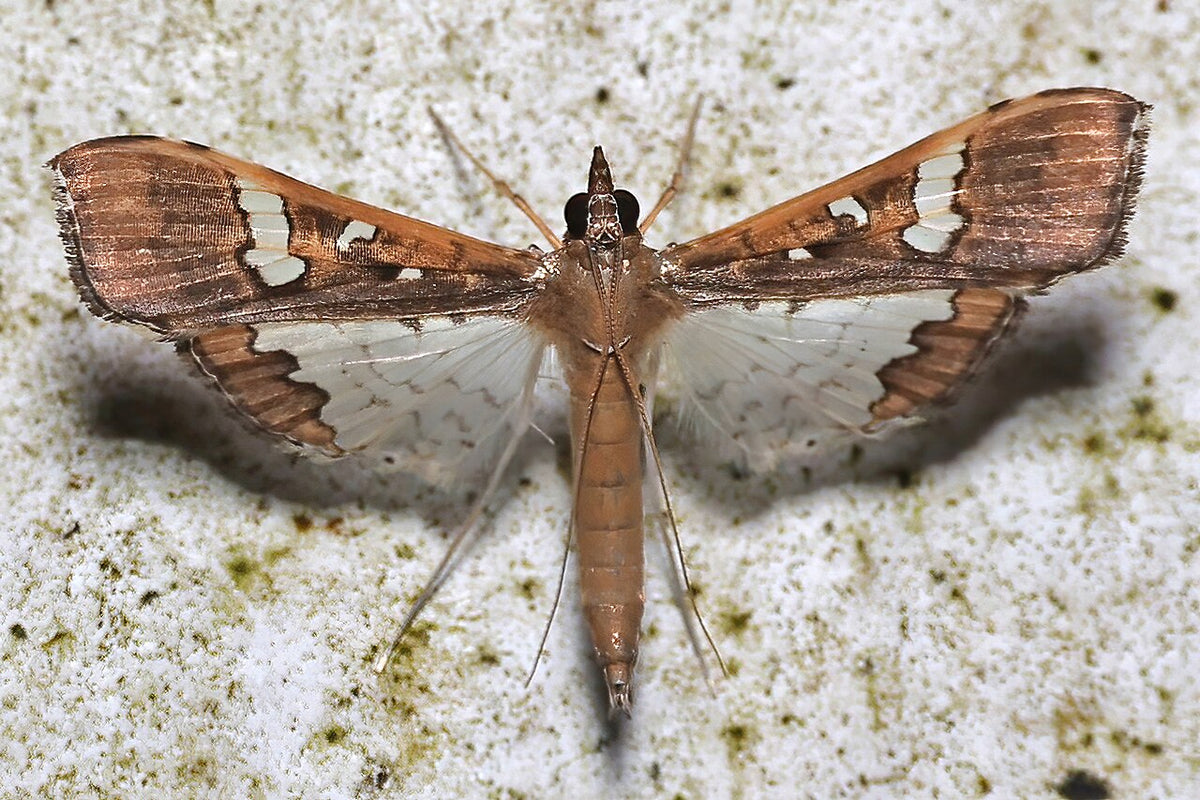
Photo at the top: The adult moth of the spotted pod borer, wings spread flat. Photo: Charles J. Sharp, CC BY-SA 4.0
Quick answer
The spotted pod borer (Maruca) is a moth caterpillar that ties flowers, pods and leaves together with silk webs and bores into the pods of red gram, black gram and green gram. Check webbed flowers from the start of flowering. At the threshold, spray an insecticide whose label lists Maruca for your crop, and rotate groups.
How to identify spotted pod borer (Maruca)
Its scientific name is Maruca vitrata. Older books and some labels call it Maruca testulalis. In English it is also called the legume pod borer or bean pod borer. In Hindi it is chitteedar phali chhedak (चित्तीदार फली छेदक), and in Telugu maruka kaya toliche purugu (మారుకా కాయ తొలిచే పురుగు).
The easiest sign is the web. Walk into the field when the crop starts to flower and look at the tips of the branches. A clump of flowers, young pods and leaves stuck together with silk threads, with brown droppings inside, means Maruca is there. Open the web and you will usually find the caterpillar.
- Egg: very small and flat. Laid one by one or in small groups on the flower buds, petals and pods.
- Caterpillar (larva): young ones are dull white. Grown ones are greenish white with a dark brown or black head and pairs of dark spots on the back of each body segment. These spots give the pest its name.
- Pupa (resting stage): inside a silk cell in fallen leaves or in the soil, so you rarely see it on the plant.
- Moth: front wings light brown with clear white patches. Hind wings white and almost see-through, with a brown edge. It sits with its wings spread out flat, and it comes to lights at night.
Damage signs
- Flowers, buds, pods and leaves webbed together into a clump, with droppings inside.
- Flowers and buds eaten and dropping early. Young caterpillars feed mostly on flowers.
- Round, dark entry holes on the pods. Older caterpillars bore into the pods and eat the seeds.
- Rotten, brown seeds inside holed pods. TNAU (Tamil Nadu Agricultural University) notes that water gets in through the holes and the seeds rot.
Look-alikes and how to tell them apart
- Gram pod borer (Helicoverpa armigera): a bigger, green to brown caterpillar with stripes along its sides. It does not make thick webs. It often feeds with its head inside the pod and the back half of its body outside. See our Helicoverpa pod borer guide for red gram, Bengal gram and cotton. Many labels cover both pests on red gram.
- Tobacco caterpillar (Spodoptera litura): young ones feed in groups and scrape the leaves. Older ones eat whole leaves and pods at night. Read how to identify and control Spodoptera caterpillars.
- Pod fly in red gram: the pod looks fine from outside until a small exit hole appears. Inside you find a small white maggot (no legs) in a damaged seed, and no web.
Maruca life cycle and when it attacks
TNAU gives these stage lengths. A female moth can lay up to about 400 eggs on flowers, buds and pods. The eggs hatch in 2 to 3 days. The caterpillar feeds for 8 to 14 days, first inside flowers and later inside pods. It then drops down and turns into a pupa in fallen leaves or soil for 5 to 15 days. The moth lives for 7 to 10 days. From egg to moth, one generation takes roughly 15 to 32 days, so numbers can build up fast during a long flowering period.

The pest needs flowers and pods. So the attack starts at flower bud stage and goes on while the crop keeps flowering and forming pods. Red gram flowers for many weeks, which gives Maruca a long time to breed. In Telangana and Andhra Pradesh, kharif red gram is at risk from the start of flowering until the pods fill. Black gram and green gram are at risk at flowering and pod stage in every season they are grown.
Crops it attacks
Red gram (pigeon pea, tur, kandi): the main host. Webs form on the clustered flowers and pods at the branch tips. Flower drop and holed pods both cut the harvest.
Black gram (urad, minumulu): attacked from flowering. Young caterpillars web and eat the flowers, older ones bore the pods.
Green gram (moong, pesalu): same pattern as black gram. Webbed flower clusters and holed pods appear from the flowering stage.
When to spray: economic threshold
The economic threshold level (ETL) is the pest level at which spraying starts to pay for itself. Below it, natural enemies and the steps in the next section are usually enough.
- Red gram: TNAU lists the ETL for spotted pod borer as 5 per plant.
- Black gram and green gram: TNAU lists the ETL as 3 larvae (caterpillars) per plant.
To check, pick a few plants at random across the field, open the webs and count the caterpillars. Do this once or twice a week from the start of flowering. Spray when the average reaches the ETL, and aim to hit young caterpillars before they get deep into the pods.
Control without chemicals
- Remove weed hosts: TNAU advises removing Sesbania weeds from and around the field, because the pest also breeds on them.
- Trap crop: TNAU suggests growing sunnhemp as a trap crop with black gram and green gram. The moths like to lay eggs on it, but the caterpillars do not grow well there.
- Bird perches: put up T-shaped sticks for birds to sit on. TNAU gives 50 per hectare for red gram, which is about 20 per acre. Birds pick the caterpillars from the plants.
- Hand collection: in a small field, open the webs and pick out the grown caterpillars. Crush them or drop them into soapy water.
- Neem: TNAU lists neem seed kernel extract (NSKE) at 5%, sprayed twice, and neem oil at 2% for red gram. Spray them while the caterpillars are still young.
- Save natural enemies: TNAU advises against broad-spectrum insecticides (ones that kill many kinds of insects) before flowering. This keeps the natural enemies of the pest alive in the field.
- Clean up after harvest: the pest rests in fallen leaves and soil. Remove crop waste and plough the field after harvest.
Chemical control of spotted pod borer, crop by crop
Only the products below have that crop and Maruca (spotted pod borer) on their official label. Doses are per acre, converted from the label's per-hectare dose. Use one product at a time. Do not mix products in one tank. Spray well into the flower clusters, because the caterpillar hides inside the webs.
Maruca in red gram
| Product | Contains | Label dose per acre | Water per acre | Wait before harvest |
|---|---|---|---|---|
| Exponus Insecticide | Broflanilide 300 g/L SC | 17–25 ml | 200 L | 25 days |
| Gracia Insecticide | Fluxametamide 10% EC | 162 ml | 200 L | 28 days |
| Simodis Insecticide | Isocycloseram 9.2% w/w DC | 202–243 ml | 200 L | 58 days |
| Pirate Insecticide | Chlorfenapyr 240 g/L SC | 324–405 ml | 200 L | 41 days |
Notes from the labels:
- Exponus: spray when the pest appears, in the morning or evening. Do not spray within 2 hours of rain or when bees are working. No more than two sprays.
- Gracia: spray when the pest reaches ETL. Two or three sprays, 7 to 14 days apart, depending on the attack.
- Simodis: first spray at ETL. One more spray 10 to 15 days later if needed. No more than two sprays in a season.
- Pirate: spray as soon as the pest reaches ETL. Up to two sprays.
- All four labels also list the gram pod borer (Helicoverpa) on red gram, so one spray covers both pests when they come together.
Spotted pod borer in black gram
| Product | Contains | Label dose per acre | Water per acre | Wait before harvest |
|---|---|---|---|---|
| Coragen Insecticide | Chlorantraniliprole 18.5% SC | 40 ml | 200 L | 20 days |
| Aston Insecticide | Chlorantraniliprole 18.5% SC | 40 ml | 200 L | 20 days |
| OMG Insecticide | Chlorantraniliprole 18.5% SC | 40 ml | 200 L | 20 days |
| Mokin Insecticide | Chlorantraniliprole 18.5% SC | 40 ml | 200 L | 20 days |
| Shenzi SC Insecticide | Chlorantraniliprole 18.5% SC | 40–51 ml | 200 L | 20 days |
All five contain the same active ingredient at the same strength. They are different brands, so pick one. Spray at ETL. The Coragen and OMG labels say preferably during the vegetative stage or at the start of flowering, and Coragen allows no more than two sprays. These labels list Maruca together with Spodoptera litura on black gram.
Spotted pod borer in green gram
| Product | Contains | Label dose per acre | Water per acre | Wait before harvest |
|---|---|---|---|---|
| Coragen Insecticide | Chlorantraniliprole 18.5% SC | 51 ml | 160–240 L | 14 days |
Coragen: spray at ETL, preferably during the vegetative stage or at the start of flowering. No more than two sprays. On green gram its label lists Maruca, Helicoverpa armigera and Spodoptera litura together as pod borers.
Rotate to avoid resistance
Insecticides are grouped by how they kill the insect. This is called the mode of action. IRAC, the international Insecticide Resistance Action Committee, gives each group a number. If you spray the same group again and again, the caterpillars that survive breed, and the next generation is harder to kill. So change the group for the next spray.
| IRAC group | Active ingredient | Products in this article |
|---|---|---|
| 30 | Broflanilide, fluxametamide, isocycloseram | Exponus, Gracia, Simodis |
| 13 | Chlorfenapyr | Pirate |
| 28 | Chlorantraniliprole | Coragen, Aston, OMG, Mokin, Shenzi |
- Red gram: Exponus, Gracia and Simodis are all group 30, so never use one right after another. If your first spray was one of them, use Pirate (group 13) for the next spray, or the other way round.
- Black gram and green gram: all the products listed here are group 28. Changing the brand does not change the group. If you need a spray from a different group, ask your local agriculture officer or Krishi Vigyan Kendra (KVK) for one labelled for your crop. Also count any group 28 spray you gave earlier in the season against Helicoverpa or Spodoptera.
Safety and waiting period
- The waiting period before harvest (PHI, pre-harvest interval) for each product and crop is in the tables above. Count the days from the last spray. If you pick green pods of red gram for the kitchen or the market, this rule applies to them too. Simodis needs 58 days and Pirate 41 days on red gram, so plan the last spray early.
- Wait before going back into the sprayed field: 24 hours for Coragen, Mokin, Exponus and Gracia, and 48 hours for Pirate, as their leaflets say. For the other products, follow the time on their leaflet.
- Wear gloves, a mask, full-sleeve clothes and boots while mixing and spraying. Do not eat, drink or smoke while you work. Wash well afterwards.
- Bees: you will be spraying a flowering crop. Spray in the evening, when bees are not working, and tell beekeepers nearby before you spray.
- Silkworms: the Coragen label warns that chlorantraniliprole is toxic to silkworms. With any chlorantraniliprole product, keep spray drift away from mulberry and silkworm rearing areas.
- Keep sprays and washings away from ponds, canals and wells.
- Read the label and leaflet before use.
Frequently asked questions
Which insecticide controls Maruca pod borer in red gram?
On our store, Exponus, Gracia, Simodis and Pirate have red gram and Maruca on their labels. The doses are in the red gram table above. Start with one of the group 30 products or Pirate, and change the group for the next spray.
How do I know if it is Maruca or Helicoverpa in my red gram?
Look for webs. The spotted pod borer (Maruca) ties flowers and pods together with silk and has rows of dark spots on its body. Helicoverpa makes no thick web, is larger and striped, and often sits with half its body outside the pod. Both can be in the field at the same time.
When should I spray for pod borer in black gram and green gram?
From the start of flowering, check the webs once or twice a week. Spray when you find 3 caterpillars per plant on average, the threshold TNAU gives. Early sprays on young caterpillars work better than late ones.
Why does the spray not kill the caterpillars inside the webs?
The web and the pod wall shield the caterpillar. Spray when the caterpillars are still young and feeding in the flowers. Use enough water to wet the flower clusters well, and do not wait until most of them are inside the pods.
Can I spray the same product twice?
Keep to the number of sprays on the label, and change the IRAC group between sprays where you can. Using one group again and again lets the pest build resistance.
Related reading
- Helicoverpa armigera: pod borer, fruit borer and bollworm control
- Spodoptera litura (tobacco caterpillar): identification and control
- Stem fly in soybean and moong (green gram): identification and control
- All insecticides
Sources
- Tamil Nadu Agricultural University, TNAU Agritech Portal: Spotted pod borer of red gram
- Tamil Nadu Agricultural University, TNAU Agritech Portal: Spotted pod borer of black gram and green gram
- Insecticide Resistance Action Committee (IRAC): Mode of action classification
- Product labels and leaflets of the insecticides listed above.
Products that control it, by crop
Red gram (tur)
- Exponus Insecticide17–25 ml per acreSpray when the pest appears, in the morning or evening. Not within 2 hours of rain or when bees are active. Max 2 sprays.
- Gracia Insecticide162 ml per acreFoliar spray at the action level (ETL). 2-3 sprays, 7-14 days apart, based on pest attack.
- Simodis Insecticide202–243 ml per acreFirst spray when the pest reaches the action level (ETL). One more spray 10-15 days later if needed. Max 2 sprays per season.
Black gram (urad)
- Coragen Insecticide40 ml per acreSpray on the leaves at the action level (ETL), ideally in the growing stage or when flowering starts.
- Aston Insecticide40 ml per acreSpray on the leaves with a knapsack sprayer when the pest reaches the action level (ETL).
- OMG Insecticide40 ml per acreFoliar spray when the pest reaches the action level (ETL), ideally at early growth or when flowering starts.
- Mokin Insecticide40 ml per acreSpray on the leaves with a knapsack sprayer when the pest reaches the action level (ETL).
- Shenzi SC Insecticide40–51 ml per acreSpray on the leaves at the action level (ETL), with a knapsack or foot sprayer.
Green gram (moong)
- Coragen Insecticide51 ml per acreSpray on the leaves at the action level (ETL), ideally in the growing stage or when flowering starts.
Do not spray the same product again and again. Change to a product with a different mode of action (the group number on the label) so the pest or disease does not build resistance.
As printed on the brand's official label. Read the label before use.


Like these farming tips? Add AgriVruddhi as a preferred source on Google
Back to Crop Health Guide