
Stem fly in soybean and moong: identification and control
· By AgriVruddhi
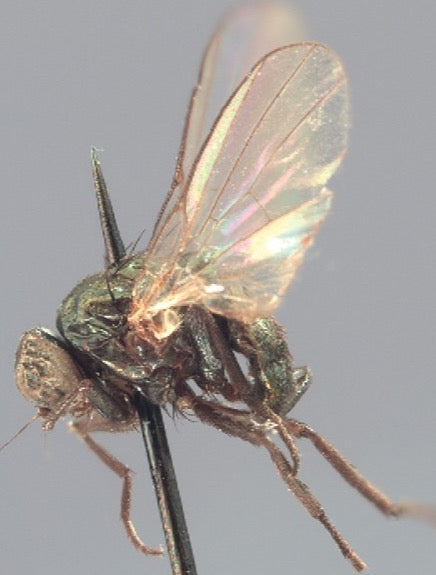
Photo at the top: Adult soybean stem fly (Melanagromyza sojae), a museum specimen seen up close. In the field it is only about 2 mm long, Photo: Lonsdale O, Murphy ST, Scheffer SJ, CC BY 4.0 (cropped)
Quick answer
Stem fly (Melanagromyza sojae) is a tiny shiny black fly. Its white maggot tunnels inside the stem of young soybean plants, so they wilt, dry and may die. On mung bean a close relative, the bean fly, does similar harm. Sow on time, remove damaged plants, and spray a label-approved insecticide at the threshold.
How to identify stem fly in soybean
It is called tana makkhi in Hindi and kandam eega in Telugu. You will rarely notice the adult fly. You notice the damage, and you confirm it by cutting the stem open.
- Adult: a shining black fly, about 2 mm long, smaller than a house fly. It rests on leaves and flies off quickly.
- Egg: laid on the leaf. It is too small to see in the field.
- Maggot (young stage): white to pale yellow, with no legs. After hatching it bores into the nearest leaf vein, moves down the leaf stalk into the main stem, and feeds there.
- Pupa (resting stage): brown and small, inside the tunnel in the stem. The new fly comes out through a small hole in the stem.
Damage signs
- Young leaves droop and turn yellow. Seedlings wilt and dry.
- Small holes on the stem where flies have come out.
- Split the stem lengthwise with a blade. You will see a zig-zag, reddish-brown tunnel, often with a maggot or pupa inside. This is the surest sign.
- The tunnel can run down to the tap root. Then the whole plant dies, and you see gaps in the row.
- Older plants that survive stay short and weak, and set fewer pods.
Look-alikes and how to tell them apart
- Girdle beetle: the female cuts two rings around the stem, leaf stalk or branch, and the part above the rings dries. Look for the two ring cuts on the outside. This fly leaves no rings, only a tunnel inside. See our girdle beetle guide for soybean.
- Charcoal rot and other root rots: the plant wilts too, but the inside of the stem and root turns grey or black from the fungus, and you find no maggot or tunnel.
- Serpentine leaf miner: also the maggot of a small fly, but it stays in the leaf and makes winding white lines there. It does not go into the stem. See how to identify leaf miner.
- Shoot fly: a different fly, mainly of sorghum and maize. It kills the central shoot and causes "dead heart". See our shoot fly guide for sorghum and maize.
Life cycle and when it attacks
The female fly lays her eggs on the leaves. The maggot mines the leaf vein, then the leaf stalk, and then the stem. It finishes growing and turns into a pupa inside the stem. The new adult comes out through a hole it leaves in the stem wall. In warm weather this takes only a few weeks, so there are many generations in one season.
The worst damage is in the first few weeks after the seed comes up, when the stem is thin and one tunnel can kill the plant. A crop sown before the monsoon is exposed early. TNAU (Tamil Nadu Agricultural University) advises against pre-monsoon sowing for this reason.
In Telangana, soybean is a kharif crop, grown mostly in the northern districts. Watch for the pest from germination through the first month, and keep checking until flowering.
Crops it attacks
Soybean: the main host of Melanagromyza sojae. Seedlings can die. Older plants carry tunnels in the main stem, grow weak and give fewer pods. It is one of the main pests of soybean in India and other parts of Asia.
Mung bean (moong, green gram): here the usual culprit is the bean fly, Ophiomyia phaseoli, also called the stem fly. It is a close relative with a similar life. TNAU's page on this fly (written for red gram, another pulse) notes that tender leaves droop and yellow, and the stem swells where the maggot and pupa sit. Young plants suffer most. Older plants become stunted but are not usually killed.

When to spray (economic threshold)
The economic threshold is the pest level at which spraying starts to pay for itself. The insecticide labels in this guide say to spray "at ETL" (economic threshold level). We could not confirm a threshold for this pest from a recognised public source such as ICAR or a state agricultural university, so we do not give a number here. Ask your local agriculture officer or Krishi Vigyan Kendra (KVK) for the threshold used in your district.
To check your field, walk across it once a week from germination. Pull a few wilting plants at random from different spots and split the stems. If many stems have tunnels with live maggots, the attack is building, and that is the time to act.
Stem fly control without chemicals
These steps come from TNAU's advice for this pest on soybean and pulses.
- Deep summer ploughing: plough deep in summer to break up old crop stubble and stems left in the field.
- Sow on time: avoid pre-monsoon sowing. Timely sowing reduces the attack in pulses too.
- Seed rate and spacing: use the recommended seed rate and plant spacing, so the crop is neither crowded nor patchy.
- Crop rotation: follow soybean or mung bean with a crop from a different family, such as a cereal. Do not grow soybean after soybean in the same field.
- Remove damaged plants: pull out and destroy wilted plants and damaged parts, with the maggots and pupae still inside. Do not leave them on the bund.
- Protect natural enemies: small parasitic wasps attack the maggots. Avoid sprays that are not needed, so these friends survive.
- Neem: for pulses, TNAU lists neem seed kernel extract (NSKE) as a spray option against this fly.
Chemical control, crop by crop
The products below, from our store, have soybean and stem fly on their official label. Doses are per acre, converted from the label's per-hectare dose. Use one product at a time. Do not mix products in one tank. Cover the whole plant, stems included.
Soybean
| Product | Contains | Label dose per acre | Water per acre | Wait before harvest |
|---|---|---|---|---|
| Coragen Insecticide | Chlorantraniliprole 18.5% SC | 61 ml | 200–300 L | 29 days |
| Aston Insecticide | Chlorantraniliprole 18.5% SC | 61 ml | 200–300 L | 22 days |
| Mokin Insecticide | Chlorantraniliprole 18.5% SC | 61 ml | 200–300 L | 22 days |
| OMG Insecticide | Chlorantraniliprole 18.5% SC | 61 ml | 200–300 L | 22 days |
| Shenzi SC Insecticide | Chlorantraniliprole 18.5% SC | 61 ml | 200–300 L | 29 days |
| Simodis Insecticide | Isocycloseram 9.2% DC | 243 ml | 200 L | 35 days |
| Ampligo Insecticide | Lambda-cyhalothrin 4.6% + Chlorantraniliprole 9.3% ZC | 81 ml | 200 L | 41 days |
| Alika Insecticide | Thiamethoxam 12.6% + Lambda-cyhalothrin 9.5% ZC | 51 ml | 200 L | 48 days |
- Coragen, Aston, Mokin, OMG and Shenzi: one foliar spray at ETL. The Coragen and OMG labels add "preferably during the vegetative stage or at the onset of flowering". The Coragen label allows no more than two sprays.
- Simodis: first spray when the pest reaches ETL, one more after 10–15 days if needed, and no more than two sprays in a season.
- Ampligo: first spray at the start of the attack (ETL), one more after 10–15 days if the attack is severe.
- Alika: first spray at ETL, then one or two more depending on how bad the attack is.
- Ampligo and Alika each hold two active ingredients. They are ready-mixed products approved on the label, not tank mixes.
- The same labels also list other soybean pests, such as girdle beetle and green semilooper, at the same dose. Some also list the tobacco caterpillar. See our semilooper guide and tobacco caterpillar (Spodoptera litura) guide.
Mung bean (moong)
None of the products in our store has stem fly or bean fly on mung bean on its label, so we do not suggest one here. Use the non-chemical steps above, and ask your local agriculture officer or KVK for a product labelled for your crop.
Rotate to avoid resistance
If you use the same insecticide group again and again, the pest can stop responding to it. Insecticides are grouped by how they work, using the IRAC group number (IRAC is the international Insecticide Resistance Action Committee). Change the group from one spray to the next.
| IRAC group | Active ingredient | Products in this guide |
|---|---|---|
| 28 (diamides) | Chlorantraniliprole | Coragen, Aston, Mokin, OMG, Shenzi; one part of Ampligo |
| 30 | Isocycloseram | Simodis |
| 3A (pyrethroids) | Lambda-cyhalothrin | One part of Ampligo and Alika |
| 4A (neonicotinoids) | Thiamethoxam | One part of Alika |
Coragen, Aston, Mokin, OMG and Shenzi all hold the same active ingredient, so they are one group, not five choices. Ampligo also holds it. So after one of these, do not follow with another of them or with Ampligo. Choose Simodis (group 30) or Alika (groups 4A and 3A) for the next spray. Keep to the number of sprays each label allows.
Safety and waiting period
- The waiting period before harvest (PHI, pre-harvest interval) for each product is in the table above. Count the days from the last spray. Note that the same active ingredient can carry a different waiting period on different brands, so follow your own pack.
- Wear gloves, a mask, full-sleeve clothes and boots while mixing and spraying. Do not eat, drink or smoke while you work. Wash well afterwards.
- Spray in the morning or evening, not in strong wind or hot afternoon sun.
- Bees: lambda-cyhalothrin and thiamethoxam are toxic to bees. The Alika leaflet says not to spray it on flowering crops from 5 days before flowering and through flowering, or when bees are active. Tell beekeepers nearby before you spray.
- Silkworms: chlorantraniliprole is toxic to silkworms. Keep spray drift away from mulberry.
- Fish: keep sprays and washings away from ponds, canals and wells.
- Read the label and leaflet before use.
Frequently asked questions
How do I know if my soybean has stem fly?
Pull a wilting seedling and split the stem lengthwise. A zig-zag reddish tunnel with a small white maggot or a brown pupa inside confirms the attack. Small exit holes on the stem are another sign.
Which insecticide controls stem fly in soybean?
Use one whose label lists soybean and stem fly. On our store these are Coragen, Aston, Mokin, OMG, Shenzi, Simodis, Ampligo and Alika. The doses are in the soybean table above. Change the IRAC group from one spray to the next.
When should I spray for stem fly?
Early. The pest does most harm in the first weeks after germination. Check stems from the time the crop comes up, and spray at the threshold your KVK gives, as the labels say.
Is stem fly the same as shoot fly?
No. Both are small flies whose maggots feed inside the plant, but shoot fly is a pest of sorghum and maize and kills the central shoot. Stem fly tunnels the stem of soybean and pulses.
Can a spray save plants that have already wilted?
No. A plant whose stem is tunnelled down to the root will not recover. Pull it out and destroy it. A spray protects the plants that are still healthy.
Related reading
- Girdle beetle in soybean: identification and control
- Green semilooper in soybean: identification and control
- Spodoptera litura (tobacco caterpillar): identification and control
- Leaf miner: identification and control
- Shoot fly in sorghum and maize
- All insecticides
Sources
- Tamil Nadu Agricultural University, TNAU Agritech Portal: Soybean stem fly, Melanagromyza sojae
- Tamil Nadu Agricultural University, TNAU Agritech Portal: Stem fly, Ophiomyia phaseoli
- Lonsdale O, Murphy ST, Scheffer SJ (2023): Agromyzidae (Diptera) Plant Pests (photos)
- Insecticide Resistance Action Committee (IRAC): Mode of action classification
- Product labels and leaflets of the insecticides listed above.
Products that control it, by crop
Soybean
- Coragen Insecticide61 ml per acreSpray on the leaves at the action level (ETL), ideally in the growing stage or when flowering starts.
- Aston Insecticide61 ml per acreSpray on the leaves with a knapsack sprayer when the pest reaches the action level (ETL).
- Mokin Insecticide61 ml per acreSpray on the leaves with a knapsack sprayer when the pest reaches the action level (ETL).
- OMG Insecticide61 ml per acreFoliar spray when the pest reaches the action level (ETL), ideally at early growth or when flowering starts.
- Shenzi SC Insecticide61 ml per acreSpray on the leaves at the action level (ETL), with a knapsack or foot sprayer.
- Simodis Insecticide243 ml per acreFirst spray when the pest reaches the action level (ETL). One more spray 10-15 days later if needed. Max 2 sprays per season.
- Ampligo Insecticide81 ml per acreFirst spray when the pest reaches the action level (ETL). Repeat once after 10-15 days if the attack is still high.
- Alika Insecticide51 ml per acreStart spraying when the pest reaches the action level (ETL). Repeat 1-2 times based on pest pressure.
Do not spray the same product again and again. Change to a product with a different mode of action (the group number on the label) so the pest or disease does not build resistance.
As printed on the brand's official label. Read the label before use.


Like these farming tips? Add AgriVruddhi as a preferred source on Google
Back to Crop Health Guide